by
Universities are increasingly searching for career services software to improve student employability, engagement, and graduate outcomes.
But with the rise of AI-powered career guidance platforms, choosing the right solution has become more complex than ever.
👉 Before exploring solutions, it’s important to understand
why traditional career services models are no longer effective
What Is Career Services Software for Universities?
Definition and Purpose
Career services software is a digital platform designed to help universities:
- support student career development
- improve employability outcomes
- manage career center activities
Key Categories of Career Services Platforms
Traditional Career Center Management Systems
- appointment scheduling
- job boards
- event management
👉 Limitation: administrative focus, not employability impact
Student Employability Platforms
- skill development tools
- career readiness tracking
- personalized guidance
👉 More aligned with modern needs
AI Career Guidance Platforms
- CV feedback automation
- personalized recommendations
- scalable support
👉 This is where the market is evolving
👉 Request a demo and see how AIRA improves student employability
Why Universities Are Investing in Career Services Platforms
Pressure to Improve Graduate Employability
Universities are increasingly evaluated on:
- employment rates
- student outcomes
- rankings
According to the
👉 World Economic Forum
skills are becoming more important than degrees.
🔗 The Future of Jobs Report 2023 | World Economic Forum
The Need to Scale Career Support
Career centers cannot support thousands of students individually.
👉 This is the core limitation explored here:
➡️ Why Students Don’t Use Career Services — And How AI Is Transforming Universities
Increasing Student Expectations
Students expect:
- instant feedback
- digital access
- personalized experiences
👉 Traditional systems fail to deliver this.
Key Features to Look for in Career Services Software
1. AI Resume Feedback and CV Optimization
Students should receive:
- instant analysis
- actionable recommendations
2. Career Readiness Tracking
Platforms should align with frameworks like
👉 NACE Career Readiness Competencies
3. Student Engagement Tools
Look for:
- interactive interfaces
- continuous engagement features
4. Data and Analytics for Universities
Institutions need:
- dashboards
- insights
- measurable outcomes
According to
👉 McKinsey & Company
data-driven strategies improve performance.
🔗 Global management consulting | McKinsey & Company
👉 Request a demo and see how AIRA improves student employability
Traditional vs AI Career Services Platforms
Traditional Career Services Software
- manual processes
- limited scalability
- low engagement
AI-Powered Career Services Platforms
- automated guidance
- scalable support
- personalized experiences
👉 This shift is redefining employability strategies.
How to Choose the Best Career Services Software for Your University
Step 1: Define Your Objectives
- improve employability
- increase engagement
- support all students
Step 2: Evaluate Scalability
Can the platform support:
Step 3: Assess AI Capabilities
Does it provide:
- real personalization?
- actionable insights?
Step 4: Measure Impact
Can you track:
- student progress?
- employability outcomes?
👉 Request a demo and see how AIRA improves student employability
AIRA: AI Career Services Platform for Universities
A New Approach to Career Services
AIRA is designed to:
- scale career guidance
- improve engagement
- enhance employability
Why AIRA Stands Out
- AI-powered CV feedback
- continuous student engagement
- alignment with
👉 NACE Career Readiness Competencies
Conclusion: Choosing the Right Career Services Platform
The question is no longer:
👉 “Do we need career services software?”
But:
👉 “How do we deliver employability at scale?”
AI-powered platforms are becoming the standard.
👉 Explore AIRA for Universities
👉 Request a demo and see how AIRA improves student employability
Universities are increasingly turning to career services software to scale their impact.
👉 Explore how to choose the right platform
➡️ Read: Why Students Don’t Use Career Services — And How AI Is Changing It
by
Why Career Service Management Is at an Inflection Point
University career centers are better funded than ever. According to NACE’s 2024–25 Career Services Benchmarks Report, the median overall career center budget has reached approximately $504,000 — a 21% increase over two years. Staffing levels are growing. Technology adoption is accelerating: 59.3% of career center staff now use AI as an assistive tool.
And yet, the fundamental problem has not moved: most students still graduate without meaningful career preparation support.
This article is for Directors of Career Services, Vice Presidents of Student Affairs, and Employability Deans who are actively evaluating career services platforms — including alternatives to Handshake and legacy career service management tools — and who want to understand what a genuinely modern, AI-powered approach looks like in 2026.
What Does NACE Mean — and Why It Should Drive Every Career Services Platform Decision You Make
Before evaluating any career services platform or career path tool, every career professional needs a clear answer to one foundational question: what does NACE mean, and why does it matter for platform selection?
NACE stands for the National Association of Colleges and Employers — established in 1956, it is the leading source of information on the employment of the college educated, with a mission to empower the community of talent acquisition and higher education professionals focused on the development and employment of college-educated talent by advancing equitable, evidence-based practices. UAEU
NACE is not simply a professional association. It is the primary standards body for career readiness in higher education globally. Its research, benchmarks, and competency frameworks are what institutional rankings, accreditation bodies, and employers use to measure the quality of your graduates — which means they should drive every career services platform evaluation you conduct.
The 8 NACE Competencies — and the Uncomfortable Gap Your Career Services Platform Must Close
What Are the NACE Competencies?
Career Readiness is the attainment and demonstration of requisite competencies that broadly prepare college graduates for a successful transition into the workplace. Employers have identified the following eight competencies as necessary skills for any new college graduate. HigherEdJobs
The 8 NACE competencies are: Career & Self-Development, Communication, Critical Thinking, Equity & Inclusion, Leadership, Professionalism, Teamwork, and Technology. Uaeu
NACE launched its Career Readiness Initiative in 2015 to give students, career centers, and employers a shared vocabulary, and the competencies have been updated through 2024, reflecting what today’s hiring managers actually screen for. UAEU
What Are the NACE Professional Competencies Telling Us About the State of Graduate Readiness?
The answer is sobering. Data from NACE’s 2024 Student Survey and Job Outlook 2025 survey reveal that although both groups are in alignment when it comes to the high importance of communication, critical thinking, teamwork, and professionalism, for other competencies — most notably leadership and career and self-development — there is a sizable gap in the perception of importance between new graduates and employers. LinkedIn
The biggest perception gap is in Leadership: students overestimate their leadership proficiency by approximately 30 percentage points compared to how employers rate them. That is the largest single gap in NACE’s 2024 data. Uaeu For Professionalism and Communication, the gap approaches or exceeds 25–30%.
NACE Materials and What They Mean for Your Career Services Platform
The NACE Career Readiness Competency framework and its assessment tools were developed to help students, higher education professionals, and employers assess and ensure readiness for the workforce. The main goals are twofold: to help students identify skills essential for career success, and to support educators and employers in guiding skill development. Kaust
More than 83% of career service professionals and recruiting organizations are now implementing NACE’s career readiness competencies as part of their programs. Russell Group Yet slightly less than one-quarter of schools (24.4%) have developed an assessment plan for their competency integration. Russell Group
This is the core structural failure: institutions are adopting the NACE career competencies as a framework, but they lack the technology to operationalize and measure them at scale — across every student, every semester, every cohort.
The Career Services Platform Landscape in 2026 — Websites Like Handshake and Their Limitations
Websites Like Handshake — What They Do Well, and Where They Stop
When career professionals search for websites like Handshake or Handshake AI alternatives, they are typically evaluating platforms designed to connect students with employer job postings. Handshake has built a network of over 14 million college students and recent graduates from 1,400 campuses, and helps young talent find everything from paid internships to full-time jobs. RocketReach
Handshake and platforms like it — including Symplicity, RippleMatch, and Highered — perform a specific and valuable function: employer-side recruitment infrastructure. They help employers post jobs, and they help students find postings. Symplicity focuses on student engagement and career outcomes in the higher education sector, offering software solutions that help universities provide services for students. KFUPM
But here is the fundamental limitation of every platform in the websites like Handshake category: they assume the student is already prepared. They are job boards with matching logic. They do not close the NACE competencies gap. They do not tell a student why 75% of their CVs are filtered by ATS screening before a human ever reads them (Harvard Business Review, 2019). They do not provide personalized, role-specific feedback at 2 a.m. before a student submits an application.
The Career Services Platform Gap That AI Now Fills
The limitations of traditional career services platforms are well documented by NACE itself. The 2024-25 Career Services Benchmarks data show that the median career center has a total office FTE of just 7.0. Wikipedia Seven full-time staff members supporting thousands of students. That is not a staffing problem. That is a structural impossibility.
Career path tools that rely on human delivery — workshops, 1:1 coaching, drop-in appointments — hit a ceiling that no additional budget can raise. The problem is not resources. The problem is architecture.
Career Service Management in the Age of AI — A New Standard for Career Services Platforms
What Modern Career Service Management Actually Requires
Effective career service management in 2026 must deliver five outcomes simultaneously:
- Universal reach — not the 31% of students who actively walk through the door, but every enrolled student across every cohort
- Personalisation at scale — feedback that is specific to each student’s CV, target role, and individual skills gaps
- NACE competency alignment — tools that map directly to the 8 NACE career competencies and generate measurable data
- Institutional visibility — real-time dashboards that show engagement, application quality trends, and placement outcomes
- Zero IT dependency — deployment that does not require months of integration with existing LMS or ERP infrastructure
No traditional career services platform delivers all five. That is the gap that AI-powered platforms now exist to fill.
AI Career Path Tools — What Genuine AI Looks Like in Career Services
The term “AI” is used loosely across the career services platform market. Most platforms that describe themselves as websites like Handshake AI or AI-enhanced job boards are applying basic recommendation algorithms to job matching — the same logic Netflix uses to suggest a film.
Genuine AI career path tools operate differently. They:
- Analyse a student’s specific CV against the requirements of a specific job description, identifying precise competency gaps
- Generate role-tailored interview preparation questions based on the employer’s actual screening criteria
- Produce structured, actionable CV improvement recommendations — not generic tips, but specific edits
- Do all of this in seconds, available 24/7, with no human bottleneck
This is the architecture of AIRA, EDLIGO’s AI-powered career readiness platform built specifically for university career centers.
AIRA — The AI Career Services Platform Designed Around NACE Professional Competencies
How AIRA Maps to the 8 NACE Competencies
Unlike employer-facing platforms, AIRA is designed from the ground up around the 8 NACE competencies that employers actually use to evaluate graduates. Here is how each competency maps to AIRA’s capabilities:
Career & Self-Development → AIRA provides each student with a clear, data-driven picture of where they stand relative to their target role, what skills they are missing, and precisely how to close those gaps before application.
Communication → AIRA’s CV analysis identifies structural and linguistic weaknesses in how students present their experience — not as generic feedback, but as specific, evidence-based recommendations aligned with recruiter expectations.
Critical Thinking → The platform trains students to read job descriptions analytically, identify the competencies employers are actually screening for, and strategically align their application language accordingly.
Technology → Technology appears as specific tools with specific outcomes in employer expectations, not just “proficient in Microsoft Office.” Uaeu AIRA familiarises students with the ATS-driven hiring logic that governs 75% of initial CV screening decisions.
Professionalism & Leadership → For leadership and professionalism, the gap between student self-rating and employer rating exceeds 30% — the largest single gaps in NACE’s 2024 data. Uaeu AIRA’s interview preparation module directly addresses this by exposing students to the behavioural and leadership questions employers actually ask.
Teamwork, Equity & Inclusion → AIRA’s job matching logic surfaces roles aligned with students’ demonstrated collaborative and cross-cultural experience, helping them position these competencies effectively.
What AIRA Delivers to Career Service Management Teams
For career service management professionals, AIRA functions as an institutional intelligence layer — not just a student-facing tool:
- Real-time engagement dashboards showing platform usage, CV improvement rates, and application activity across the entire student population
- Cohort-level competency gap analysis identifying which NACE career competencies are most underdeveloped across specific programmes or year groups
- Placement outcome tracking that generates the data needed for accreditation reporting, board presentations, and ministerial employability returns
- Automated reporting exports formatted for institutional benchmarking against NACE material standards
Deployment — No IT Project, No Integration, No Delay
One of the most consistent barriers to adopting new career services platforms is IT complexity. AIRA eliminates this entirely. The platform is:
- Fully standalone SaaS — no integration with Workday, Banner, or any LMS required
- Accessible on mobile and web — meeting students where they actually are
- Live within days of agreement — not months
- Self-service for students, with minimal onboarding required from career center staff
The Evidence Case for AI-Powered Career Services Platforms
The NACE Data Your Board Needs to See
Career center budgets for the 2024-25 academic year have increased across the board since 2022-23. At approximately $504,000, the median overall budget has increased by 21% in the last two years. SI-UK
Budgets are growing. But engagement is not keeping pace. NACE’s own research consistently shows that fewer than a third of students actively use career services. The institutions that will win the next decade of graduate employability competition are not those that spend more on the same model — they are those that deploy career path tools that operate independently of human availability and institutional capacity.
More than 83% of career service professionals and recruiting organisations are now implementing NACE’s career readiness competencies as part of their programs. Russell Group But implementation without measurement is aspiration, not strategy. Slightly less than one-quarter of schools have developed an assessment plan for their competency integration. Russell Group AIRA closes this gap — turning NACE competency frameworks from poster content into operational data.
Skills-Based Hiring Is Accelerating — and Your Graduates Must Be Ready
In 2019, about 73% of employers screened candidates by GPA. By 2026, that figure has dropped to roughly 42%. What replaced it? Demonstrated skills. Seventy percent of employers participating in NACE’s Job Outlook 2026 survey report using skills-based hiring for entry-level hires, up from 65% the year before. Uaeu
Your graduates are competing in a market where their CV is screened by an algorithm before a human ever reads it — and where the criteria are competency-based, not credential-based. Traditional career services platforms were not designed for this world. AIRA was built for it.
Who Should Evaluate AIRA
AIRA is designed for key stakeholders involved in shaping, managing, and improving student employability outcomes within higher education institutions.
These stakeholders typically include, but are not limited to:
Career Services and Employability Leaders responsible for designing and delivering career support strategies, expanding student engagement, and demonstrating measurable ROI on employability initiatives.
Student Affairs and Academic Leadership (including Deans, Vice Presidents, and institutional leaders) who are accountable for graduate outcomes, student success metrics, and the scalability of career support services across the full student population.
Employability, Quality Assurance, and Accreditation Leads who oversee graduate outcomes reporting, competency frameworks (such as NACE or equivalent), institutional rankings, and compliance with external evaluation bodies.
University Digital Transformation and IT Leadership (CIO / Digital Officers) who evaluate and approve platforms that integrate into existing student systems, ensure scalability, and align with institutional digital strategies.
Institutional Research and Analytics Teams who require reliable data on student engagement, employability outcomes, and program effectiveness to support strategic decision-making.
The Pilot Offer — 90 Days, Up to 200 Students
AIRA offers a structured 90-day pilot program designed for a select cohort of universities across key regions — including the UAE and Saudi Arabia, the United Kingdom, Germany, France, the United States, and North Africa.
This pilot is delivered as a paid engagement at preferential rates, allowing institutions to:
- Validate impact on student employability outcomes
- Assess platform adoption and usage patterns
- Generate initial performance insights for internal stakeholders
The pilot is structured to ensure commitment, measurable results, and a clear path to scale, rather than a free trial with limited engagement.
Conclusion: The Future of Career Services Platforms Is Not a Better Job Board
The search for websites like Handshake reflects a real and legitimate need — but it is the wrong frame for the challenge that career center leaders actually face in 2026.
Handshake and platforms like it solve a recruitment pipeline problem. They connect employers to students. That is valuable. But they do not close the NACE competency gaps that determine whether your graduates succeed once they reach that pipeline. They do not reach the 69% of students who never engage with career services. They do not generate the institutional data that makes the case for career center investment at board level.
There is a clear and persistent disconnect between how students and employers perceive students’ development of the competencies they need to be career ready as they enter the workforce. Uaeu That disconnect will not be closed by a better job board. It will be closed by an AI platform that makes personalised, competency-aligned career preparation available to every student, at any time, at institutional scale.
That is AIRA.
→ Request a University Pilot | edligo.net/aira-for-universities
For partnerships and institutional enquiries: visit edligo.net
Read More:
AllBlogsPage – EDLIGO
Sources cited in this article:
- National Association of Colleges and Employers (NACE): naceweb.org/career-readiness/competencies
- NACE 2024 Career Readiness Competencies Framework (revised April 2024): naceweb.org
- NACE 2024–25 Career Services Benchmarks Report: naceweb.org
- NACE Quick Poll — Career Readiness Competencies Implementation: naceweb.org
- NACE Gap in Perceptions of New Grads’ Competency Proficiency (January 2025): naceweb.org
- Extern — Career Readiness NACE’s 8 Competencies Explained (2026): extern.com
- Harvard Business Review — ATS Filtering (2019)
- Handshake Platform Overview: joinhandshake.com
by
Universities are under increasing pressure to prove that education leads to outcomes, not only credentials. ACE frames learner success as a coordinated institutional strategy that connects career readiness, curriculum, faculty and staff support, partnerships, and data‑informed decision‑making.
At the same time, AI is becoming part of the student experience and the workplace. EDUCAUSE states that students, faculty, and staff need to understand AI fundamentals to use tools effectively and evaluate outputs responsibly, and it recommends integrating AI literacy into curricula and responsible‑use policies.
For career services leaders, the job is no longer just to advise students one by one. The challenge is to deliver career support that is personalized, measurable, and scalable enough to reach the whole student body.
What Does NACE Mean? Understanding NACE Career Competencies for Universities
NACE stands for the National Association of Colleges and Employers. In higher education, NACE matters because it gives universities a shared language for career readiness, employer expectations, and student development.
NACE defines career readiness as a foundation from which students demonstrate core competencies that prepare them for success in the workplace and lifelong career management. That definition shifts the conversation away from vague “job prep” and toward observable skills that universities can build across the student journey.
This is where modern career services platform thinking becomes important. Universities need a system that helps students develop those competencies continuously, not only during a final‑year workshop.
What Are the NACE Competencies? The 8 NACE Career Competencies Explained
NACE currently lists eight career readiness competencies: Career and Self‑Development, Communication, Critical Thinking, Equity + Inclusion, Leadership, Professionalism, Teamwork, and Technology. The competencies are intentionally flexible and can be used in any combination (NACE notes that Equity + Inclusion is currently under review).
The 8 NACE Competencies Every Student Needs
A practical way to think about the NACE professional competencies is this:
- Career and Self‑Development – helping students reflect, set goals, and build habits of continuous growth.
- Communication – helping them express ideas clearly in writing, speaking, and digital settings.
- Critical Thinking – helping them analyze problems and make sound decisions.
- Equity + Inclusion – helping them work across difference and challenge inequity.
- Leadership – helping them mobilize strengths and influence outcomes.
- Professionalism – helping them operate effectively in work environments.
- Teamwork – helping them collaborate toward shared goals.
- Technology – helping them use digital tools effectively and ethically.
Career Service Management: Why Universities Need a Career Services Platform, Not More Admin
Many universities still manage career service management through a patchwork of emails, spreadsheets, forms, and disconnected tools. That model may work for a small office, but it does not scale when the goal is to support every student across multiple programs with consistent quality.
A modern career services platform should do four things well: organize student support, centralize employer engagement, track participation, and show impact. Handshake presents itself as a career services platform that helps institutions do exactly that, with curated jobs, events, employer connections, and reporting tools for student engagement and outcomes.
What Handshake and Similar Platforms Bring to Career Service Management
Handshake is a partner to over 1,500 educational institutions and emphasizes access to employers, student engagement, and outcome reporting for career centers. That is a strong signal about what the market now expects from university career platforms: not just listings, but infrastructure.
The key lesson for universities is not to copy any one vendor. It is to recognize that career services now sits inside a larger institutional system, where scale, visibility, and consistency matter as much as one‑to‑one advising.
Career Path Tools That Help Students Decide, Not Just Search
Students do not only need access to opportunities. They need help understanding where they fit, what they are missing, and what to do next. ACE’s model describes “life design” as a career‑services approach that gives learners agency over their education, career path, and purpose, while helping them design the next step.
That is the real job of career path tools. They should help students move from uncertainty to action, not just from one job board to another.
Career Path Tools vs. Job Boards – What’s the Difference?
Good career path tools do at least three things:
- Translate ambition into a concrete plan.
- Show students what their profile communicates to employers.
- Make improvement immediate and understandable.
This is where AI becomes especially relevant. If a platform can review a CV, suggest gaps, recommend roles, and prepare interview practice in real time, it does more than automate a task. It creates a decision‑support layer for students who may never book a one‑to‑one appointment.
Why Universities Choose AI Career Services Platforms Like Handshake and Beyond
The old model of career support assumed students would proactively come to the center, book an appointment, and ask for help at the right moment. The new model assumes that support should be available earlier, more often, and in more formats.
A strong AI career services platform now needs to serve students where they already are, while giving staff enough visibility to guide strategy. That means helping students access feedback on CVs, job matches, and interview readiness without waiting for limited office hours.
It also means supporting institutional leadership. Universities increasingly need evidence of student participation, service usage, and readiness outcomes. Handshake’s career‑center messaging highlights student engagement and post‑grad outcomes as part of the platform value proposition.
Websites Like Handshake: What to Look for in a Career Platform
When evaluating websites like Handshake, universities should look for:
- AI‑powered personalization (CV analysis, job matching, interview prep)
- Scalability to reach all students, not just those who visit the career center
- Integration with existing student success systems
- Analytics that measure competency development and outcomes
The broader institutional direction is clear. ACE says institutions should align policies, practices, and resources around learner success, while building partnerships and using data to improve outcomes. Career services is now part of that operating model.
How to Use NACE Materials to Build a Career-Ready Campus
One of the most practical things universities can do is use NACE materials to create a shared language across career services, faculty, and student success teams. NACE provides definitions, supporting materials, and an assessment tool that helps institutions move from theory to practice.
Using NACE Materials for Assessment and Feedback
NACE states that its competency assessment tool can measure proficiency among students, interns, and new hires, while providing actionable feedback and personalized development plans. That matters because universities do not just need to tell students what employers want. They need to help students see where they are today and what to improve next.
What the AI Career Services Platform AIRA Changes for Universities
AIRA gives students direct access to AI‑powered CV optimization, job matching, and interview preparation – without needing to expand the career‑services team or rely on heavy IT integration.
That makes AIRA different from static content libraries or generic advice portals. Students get structured feedback, immediate action steps, and continuous support. Career services leaders get a way to extend support beyond the students who already walk through the door.
In practical terms, AIRA helps universities:
- Scale personalized support across the student population
- Improve CV quality and job readiness
- Support interview preparation with guided practice
- Give students clearer direction on roles and fit
- Increase visibility into engagement and outcomes
That combination connects student experience to institutional strategy. If career services can prove it is improving readiness at scale, it becomes easier to justify investment, governance, and long‑term adoption.
Why AI Career Services Matter for NACE Professional Competencies & Skills‑Based Hiring
Students are graduating into a market where digital screening, skills‑based evaluation, and AI‑enabled hiring workflows are becoming more common. That makes it even more important that universities support students with tools that teach them how to present themselves well, not just how to apply.
EDUCAUSE argues that higher education must prepare students to engage effectively and ethically with AI in academic and professional contexts. In career services, that means helping students understand how to use AI responsibly in job search, preparation, and self‑presentation.
AI Career Services for CV Optimization, Interview Prep, and Job Matching
A good AI career services platform does not replace human guidance. It extends it. It turns the career center into a scalable support system that can reinforce the same messages across hundreds or thousands of students.
That is especially valuable for universities that want a consistent experience across different departments, campuses, or student populations. A well‑designed platform helps standardize support while still allowing for personalization.
Scaling Career Support: The Institutional Advantage of AI Career Services Platforms
The biggest mistake universities make is treating career services as a transactional support function. In reality, it affects reputation, recruitment, retention, student satisfaction, and employer relationships.
When universities make employability visible and actionable, they improve the student experience and strengthen their position in a competitive market. ACE’s model explicitly connects learner success with partnerships, curriculum, and data‑informed decision‑making – exactly the mindset required here.
That is why an AI career services platform is not just a software decision. It is a student‑success decision.
For university leaders, the strategic question is simple: do we want career support to depend on student initiative and staff bandwidth, or do we want it to be available by design?
Final Takeaway: AI Career Services Platforms Are No Longer Optional
The future of university career services is not one more workshop, one more PDF, or one more disconnected portal. It is a system that helps students build the NACE career competencies, act on them, and present them clearly to employers.
That is the opportunity AIRA is designed to capture. By giving students AI‑powered support for CVs, job matching, and interviews, AIRA helps universities make career readiness scalable, measurable, and accessible to every student.
And in a higher education market where employability is part of institutional value, that is no longer optional.
Universities are increasingly turning to career services software to scale their impact.
👉 Explore AIRA For Universities and transform your career services
References
Model-for-Comprehesive-Learner-Success.pdf
AI Literacy in Teaching and Learning: Executive Summary | EDUCAUSE
What is Career Readiness?
Career centers | Handshake
by
Executive Summary
The global recruitment landscape is broken. 88% of employers admit their ATS systems reject qualified candidates they desperately want to hire, while 66% of job seekers refuse to apply for positions screened by AI. This trust gap—amplified by opaque algorithms and discriminatory outcomes—is costing organizations billions in lost productivity and talent.
Enter AIRA (AI-powered Recruitment Assistant) by Edligo: a revolutionary artificial intelligence sourcing platform that transforms recruitment from a black-box nightmare into a transparent, equitable, and efficient process—for both recruiters and job seekers.
Unlike generic AI tools that perpetuate bias and confusion, AIRA introduces explainable AI-Reasoning that shows exactly why candidates match (or don’t match) roles. Built on 11 years of proprietary talent intelligence research and recognized with the prestigious Brandon Hall Group Gold Award for Excellence in Technology, AIRA represents a paradigm shift in AI in recruiting—delivering measurable ROI from day one while keeping humans firmly in control of final decisions.
The Recruitment Crisis: A Market Drowning in Dysfunction
The Talent Acquisition Nightmare
According to LinkedIn’s 2025 Future of Recruiting Report, 73% of recruitment professionals agree that AI will fundamentally change how organizations recruit. Yet the reality is far from optimistic:
- 89% of TA professionals believe measuring quality of hire will become increasingly important, but only 25% are confident in their ability to do so effectively
- 70% of HR directors in France report being overwhelmed by workload (RH Matin, 2025)
- 47% cite lack of qualified candidates as their primary challenge
- 85% face greater pressure to meet recruitment targets
The root cause? Most AI in recruiting tools are glorified keyword matchers wrapped in marketing hype. They promise efficiency but deliver:
The Job Seeker Perspective: Applying Into a Void
For candidates, the experience is equally broken:
- 39% of job seekers use AI to craft applications, creating an arms race of AI-polished resumes vs. AI screening (Gartner 2025)
- Only 26% trust AI to evaluate them fairly
- Applications disappear into black boxes with zero feedback
- Candidates have no visibility into why they’re rejected
- The result: frustration, disengagement, and damaged employer brands
The AIRA Solution: Intelligent AI That Keeps Humans in Control
What Makes AIRA Different?
AIRA is not another AI tool for recruitment. It’s a complete paradigm shift built on five core principles validated by Gartner’s 2024-2025 AI research:
-
Intelligent Automation with Human Decision-Making
AIRA accelerates repetitive tasks (CV screening, job matching, interview preparation) while always keeping humans in the decision loop. The AI analyzes and recommends; recruiters make final hiring decisions based on transparent insights.
Impact: Reduces time-to-hire by up to 95% while freeing recruiters to focus on relationship-building—a skill 54x more in-demand in 2025 than in prior years.
-
Explainable, Not Black Box
AI-Reasoning shows exactly WHY each candidate scored high or low—with specific, auditable criteria. No mystery algorithms. No hidden biases. Just clear explanations anyone can understand and defend.
Impact: EU AI Act compliance-ready with full audit trails for every decision.
-
Domain-Specific, Not Generic
5 specialized agents trained exclusively on recruitment workflows using Edligo’s 11 years of proprietary skills intelligence data—not generic internet chatbots.
Impact: Accuracy and relevance generic AI cannot match.
-
Plug-and-Play, Not Complex
No lengthy data preparation. Modular agents work standalone or integrate with existing ATS. Start analyzing CVs in minutes, not months.
Impact: Measurable ROI in 90 days vs. 12-18 months for generic AI projects.
-
Dual-Sided Transparency
AIRA serves both recruiters AND job seekers, making evaluation logic visible to all parties. Candidates see how their profiles match roles BEFORE applying.
Impact: Reduced wasted effort, improved candidate experience, stronger employer brand.
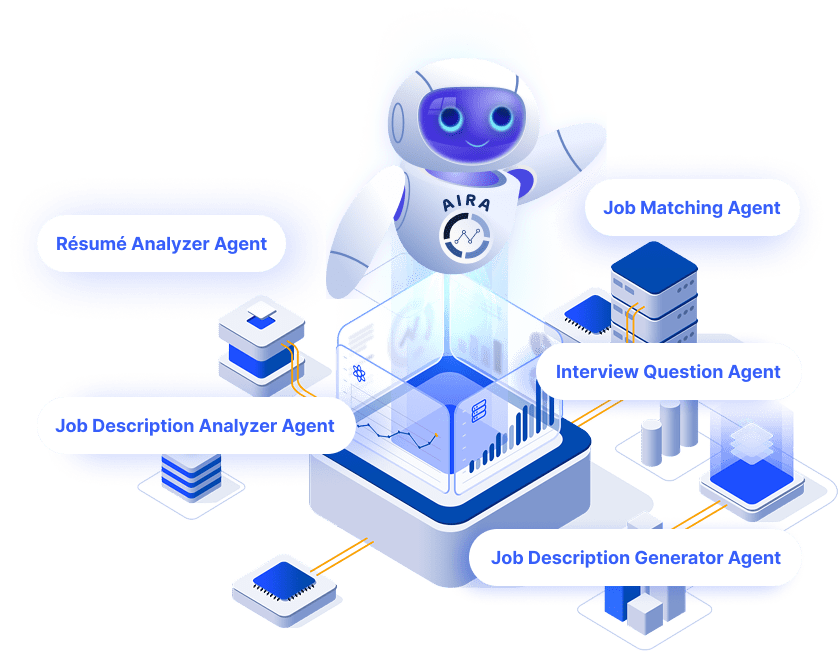
AIRA’s 5 AI Agents: The Complete Talent Acquisition Suite
-
🤖 AI-Resume Analyzer Agent
For Recruiters:
- Automatically extracts skills, certifications, languages from CVs
- Analyzes hundreds of resumes in minutes vs. days of manual work
- Shows clear, structured candidate profiles
For Job Seekers:
- Shows how YOUR CV is evaluated against specific roles
- Highlights strengths and gaps based on actual requirements
- Supports strategic profile optimization before applying
ROI Example: Saves ~€3,333 in recruiter time per 1,000 CVs screened
-
🎯 AI-Job Matching Agent
For Recruiters:
- Scores and ranks candidates with transparent AI-Reasoning
- Shows exactly WHY someone is a 92% match vs. 65% match
- Applies consistent criteria to eliminate unconscious bias
For Job Seekers:
- Calculates structured match scores with clear explanations
- Helps prioritize which roles to pursue vs. avoid
- Reduces application blind spots and rejection anxiety
Key Feature: Every score comes with explainable reasoning—not just a number.
-
📝 AI-Interview Guide Agent
For Recruiters:
- Generates personalized interview questions for each candidate
- Aligns questions with role requirements AND candidate backgrounds
- Standardizes interview quality across hiring managers
For Job Seekers:
- Shows what recruiters are likely to ask based on your profile
- Accelerates interview preparation with role-specific talking points
- Supports stronger interview performance through clarity
Key Feature: Questions tailored to individual candidates, not generic templates.
-
✍️ AI-Job Description Generator
For Recruiters:
- Creates and optimizes JDs aligned with industry benchmarks
- Reduces unclear or inflated role profiles
- Improves quality of applicant pool from day one
For Job Seekers:
- Helps understand how roles are framed from the employer perspective
- Clarifies mandatory vs. secondary criteria
- Supports more strategic application decisions
-
🔍 AI-Job Description Analyzer Agent
For Recruiters:
- Analyzes existing JDs to extract essential requirements
- Identifies inconsistencies or gaps in role definitions
- Supports alignment between hiring managers and recruiters
For Job Seekers:
- Breaks down complex JDs into clear evaluation criteria
- Shows what REALLY matters vs. nice-to-haves
- Reduces confusion about role expectations
The Dual-Sided Value Proposition
For SME Recruiters & HR “Lone Fighters”
AIRA was designed for small teams and solo recruiters who need to hire professionally without large HR departments.
|
Pain Point
|
AIRA Solution
|
Measurable Impact
|
|
Manual CV Screening Overload
|
AI-Resume Analyzer processes hundreds of CVs in minutes
|
Save up to 40% of recruiter time
|
|
Inconsistent Candidate Evaluation
|
AI-Job Matching with explainable scoring
|
43% report higher quality hires
|
|
Generic Interviews
|
AI-Interview Guide with personalized questions
|
Standardize hiring quality
|
|
Compliance & Bias Risks
|
Privacy-by-design, GDPR-compliant, auditable
|
Mitigate discrimination lawsuits
|
|
Poor Candidate Experience
|
Transparent AI-Reasoning + feedback
|
Improve acceptance rates
|
|
No ROI Visibility
|
Built-in analytics + 90-day measurable outcomes
|
30% reduction in cost-per-hire
|
Key Benefits for SMEs:
- ✅ Hire without large HR teams or expensive agencies
- ✅ Reduce dependency on external recruiters
- ✅ Professionalize HR processes affordably
- ✅ Scale hiring as you grow
- ✅ Compete for talent against larger companies
For Job Seekers: From Confusion to Confidence
|
Pain Point
|
AIRA Solution
|
Impact
|
|
No Feedback on Rejections
|
AI-Reasoning shows exactly why profiles don’t match
|
Reduce application anxiety
|
|
Black-Box Algorithms
|
Transparent evaluation criteria visible BEFORE applying
|
Informed decision-making
|
|
Wasted Application Effort
|
Match score analysis helps prioritize realistic opportunities
|
Focus time wisely
|
|
Interview Unpreparedness
|
AI-Interview Guide shows likely questions in advance
|
Stronger interview performance
|
|
Unclear Role Requirements
|
JD Analyzer clarifies must-haves vs. nice-to-haves
|
Avoid misaligned applications
|
Key Benefits for Candidates:
- ✅ See applications through a recruiter’s lens
- ✅ Understand expectations before applying
- ✅ Prepare smarter, not harder
- ✅ Enter interviews better informed
- ✅ Apply with clearer intent and strategy
The Competitive Differentiation: Why AIRA Wins
Traditional AI Tools vs. AIRA
|
Dimension
|
Traditional Competing Tools
|
AIRA – The Strategic Differentiator
|
|
Automation Focus
|
Speed and processing time reduction
|
Intelligent automation + human decision control
|
|
Quality Metrics
|
Limited to time-to-hire, cost-per-hire
|
Makes quality MEASURABLE via skills assessment + fit
|
|
Compliance
|
GDPR as add-on, frequent legal risks
|
Privacy-by-design, native EU AI Act compliance
|
|
Data Utilization
|
Primarily CVs and external applications
|
Cross-references data for skills assessment
|
|
Strategic Vision
|
Focused on immediate hiring needs
|
Beyond recruitment: quality, retention, skills planning
|
|
User Base
|
Recruiters only
|
Dual-sided platform serving recruiters AND job seekers
|
|
Explainability
|
Black-box scoring with no reasoning
|
Full AI-Reasoning transparency for every decision
|
|
Human Control
|
Often replaces human judgment
|
AI recommends, humans decide—always
|
The AIRA Competitive Advantage
- 11 Years of Proprietary Skills Data: Edligo’s talent intelligence foundation powers accuracy generic AI cannot replicate
- Award-Winning Technology: Brandon Hall Group Gold Award validates world-class innovation
- Modular Architecture: Buy only what you need—no forced ATS replacement
- Dual-Sided Network Effects: As more recruiters AND job seekers use AIRA, matching accuracy improves for everyone
- True Transparency: Only platform showing evaluation logic to both sides of the hiring equation
Real-World Impact: ROI for SMEs
For Business Owners & CFOs: The Business Case
According to industry research, AI recruiting solutions reduce cost-per-hire by 30% through:
- Elimination of manual screening labor
- Reduced dependency on external recruitment agencies
- Faster time-to-productivity for new hires
- Lower turnover from better candidate-role fit
AIRA ROI Calculator for SMEs:
|
Metric
|
Without AIRA
|
With AIRA
|
Annual Savings
|
|
Screening 500 CVs/year
|
€1,665 (recruiter time)
|
~€150 (AIRA credits)
|
€1,515
|
|
Average cost per hire (SME)
|
€5,000
|
€3,500 (30% reduction)
|
€1,500 per hire
|
|
External agency fees
|
€10,000/year
|
€2,000 (80% reduction)
|
€8,000
|
|
Time-to-hire
|
35 days
|
18 days (50% reduction)
|
Faster revenue generation
|
For a small business hiring 20 people annually: Potential savings exceed €30,000 in direct costs, plus faster hiring and reduced turnover.
Case Study: German Tech SME Transforms Hiring
The Challenge:
A 50-person software company in Munich struggled with:
- Solo HR manager handling all recruitment
- 200+ applications per role with no time to review properly
- 6-week time-to-hire hurting growth targets
- No budget for expensive ATS or agencies
- Inconsistent interview quality across founders
The AIRA Implementation:
Week 1-2: Deployed AI-Resume Analyzer and AI-Job Matching
- Screened 200 applicants for 3 open roles in 2 hours
- Identified top 15 candidates with clear reasoning
- Reduced shortlisting time from 10 days to 2 hours
Week 3-4: Added AI-Interview Guide
- Generated personalized questions for each shortlisted candidate
- Standardized interview approach across founders
- Improved candidate experience feedback
Results After 3 Months:
|
Metric
|
Before AIRA
|
After AIRA
|
Improvement
|
|
Time-to-hire
|
42 days
|
21 days
|
50% faster
|
|
Cost-per-hire
|
€4,800
|
€3,200
|
33% reduction
|
|
Applications reviewed
|
30%
|
95%
|
3x coverage
|
|
Candidate NPS
|
35
|
68
|
94% increase
|
|
HR manager satisfaction
|
5/10
|
9/10
|
Reduced stress
|
Financial Impact: €24,000 saved in first year from reduced agency fees, faster hiring, and better quality matches.
HR Manager Quote: “AIRA gave me back 15 hours per week. I went from drowning in CVs to actually talking with candidates and building relationships. The AI-Reasoning helps me explain decisions to both candidates and founders—complete game-changer for a one-person HR team.”
Addressing the Trust Gap: Ethical AI in Practice
How AIRA Ensures Fairness
- Transparent Criteria: AI-Reasoning shows exact evaluation logic—no hidden variables
- Bias Audits: Regular testing to identify and mitigate disparate impact
- Human-in-the-Loop: AI analyzes and recommends; humans always make final hiring decisions
- Candidate Visibility: Job seekers see their own evaluation data—full transparency
- Focus on Skills: Evaluates documented skills and experience, not personal characteristics
What AIRA Does NOT Do
- ❌ Does not guarantee interviews or job offers
- ❌ Does not contact recruiters on behalf of job seekers
- ❌ Does not submit applications automatically
- ❌ Does not bypass human judgment in hiring
- ❌ Does not manipulate ATS systems
- ❌ Does not assess age, gender, race, or background
- ❌ Does not replace recruiters—it empowers them
Compliance Framework
- ✅ GDPR Compliant: Privacy-by-design architecture from day one
- ✅ EU AI Act Ready: Documented risk assessment and transparency measures
- ✅ NYC Local Law 144: Bias audit methodology meets regulatory requirements
- ✅ ISO 27001: Information security management certified
- ✅ Explainable AI: Every decision comes with clear reasoning
The Market Opportunity: Why Now?
The AI Recruitment Market Explosion
The Window of Opportunity: According to Gartner’s Hype Cycle, AI agents are at the “Peak of Inflated Expectations” with 2-5 years until mainstream adoption. Organizations that adopt transparent, explainable AI NOW will lead the next decade of talent acquisition.
Strategic Imperatives Driving Adoption
- Labor Shortages: 69% of employers struggle to find qualified candidates
- Cost Pressure: SMEs need efficient hiring without enterprise budgets
- Compliance Risk: EU AI Act enforcement began August 2025—penalties are severe
- Quality Crisis: 89% of TA pros say measuring quality of hire is critical, yet only 25% can do it
- Skills Evolution: 73% of recruiters say AI will change hiring—adaptive tools are essential
The AIRA Promise: Recruitment Transformed
For SME Recruiters & HR Managers
✅ Save 40% of screening time
✅ Achieve 50% faster time-to-hire
✅ Reduce cost-per-hire by 30%
✅ Improve quality of hire with explainable decisions
✅ Zero compliance risk with built-in governance
✅ Defend hiring decisions with transparent reasoning
For Job Seekers
✅ Transparent evaluation before you apply
✅ Understand WHY you match (or don’t match) roles
✅ Interview preparation based on real recruiter logic
✅ Focus effort on realistic opportunities
✅ Faster, clearer feedback on applications
✅ Fair assessment based on skills, not demographics
For Organizations
✅ Measurable ROI in 90 days
✅ Scalable hiring without proportional HR headcount growth
✅ Internal mobility support (with Edligo integration)
✅ Future-proof compliance as regulations evolve
✅ Employer brand protection through superior candidate experience
Getting Started with AIRA
Three Pathways to Adoption
- Try Before You Buy (Job Seekers & Individual Recruiters)
- Create free account at edligo.net/aira
- Upload CV + job description
- Get instant AI-Reasoning match analysis
- No credit card required
- Pilot Program (SMEs & Small HR Teams)
- 30-day pilot with 100 CV analyses included
- Hands-on training with AIRA team
- Custom ROI calculation for your hiring volume
- Schedule pilot consultation
- Enterprise Deployment (Growing Companies & ATS Partners)
- Full platform access with optional API integration
- Dedicated customer success support
- White-label options for ATS partners
- Credit-based pricing—pay only for what you use
- Book enterprise demo
The Future of Work Is Transparent
The question is no longer WHETHER to adopt AI in recruiting—it’s HOW to do it intelligently, ethically, and effectively.
Generic AI has failed. Black-box algorithms that alienate candidates and perpetuate bias are not the answer.
AIRA represents the new standard: transparent, explainable, domain-specific AI tools for recruitment that serve recruiters AND job seekers equally. Built on 11 years of talent intelligence expertise and validated by industry-leading awards, AIRA transforms recruitment from a broken, opaque process into a fair, efficient, and human-centered talent marketplace.
The organizations and individuals who embrace transparent artificial intelligence in recruitment today will define the future of work tomorrow.
Resources & Next Steps
Learn More
Get Started
Stay Connected
About Edligo
Founded in 2012, Edligo is a pioneer in artificial intelligence sourcing and talent intelligence. With 11 years of experience serving organizations globally, Edligo has built comprehensive skills intelligence solutions—now powering AIRA’s transparent approach to recruiting with AI.
Awards & Recognition:
- 🏆 Brandon Hall Group Gold Award for Excellence in Technology (2023)
- 🏆 HR Tech Award for Best Talent Intelligence Solution (2023)
- 🏆 Top 3 Most Innovative SMEs in Germany (2023)
Headquarters: Germany
Technology: Privacy-by-design, GDPR-compliant, EU AI Act ready
© 2026 Edligo GmbH. All rights reserved.
AIRA is a product of EDLIGO.

by
We’d love to hear how your company is leveraging AI recruiting tools — let’s share tips in the comments!
AI in Recruiting: The Uncomfortable Truth About Your “AI-Powered” ATS
Your recruitment software vendor swears their AI in recruiting is revolutionary. They showed you a demo. You saw the dashboard. You signed the contract.
Then reality hit.
Implementation took 6 months instead of 6 weeks. The AI recommendations make zero sense. Candidates complain about the experience. And your recruiters are spending more time fixing the system than actually recruiting with AI.
Welcome to the AI recruitment software scam costing companies billions.
Here’s what nobody tells you: There’s more smoke and mirrors in AI recruiting tools than at a Vegas magic show. And if you don’t know how to separate real AI from glorified keyword matching, you’re burning money and destroying your employer brand.
The $1.13 Billion AI in Hiring Question: Why Is Everyone Buying Tools That Don’t Work?
The AI recruitment market exploded from USD 617.56 million in 2024 to a projected USD 1.125 billion by 2033, a 7.2% CAGR — growth fueled by hype and high expectations. ()
Despite this boom and widespread adoption intentions, many companies remain skeptical about the actual performance of these tools. According to a recent Gartner survey, only 26% of job applicants trust that AI will evaluate them fairly — raising serious questions about reliability and bias in AI-driven hiring. ()
- For Business Owners: Buying “plug-and-play” AI often means prolonged integration, unexpected IT overhead, and tools that still struggle to distinguish qualified candidates from those who keyword-stuffed their resumes.
- For Talent Acquisition Teams: The AI system meant to save time ends up requiring manual oversight — you’re reviewing AI decisions, questioning them, and essentially doing the job of an algorithm babysitter.
- For CFOs: The “predictable ROI” promised by vendors often doesn’t materialize. While some organizations see cost reductions after AI adoption, many others report little to no benefit — or even increased costs. Recent studies show that only a small proportion of companies generate significant value from AI adoption. ()
In short: the hype around AI recruiting has driven massive investment and adoption. But the reality — slow onboarding, opaque decision processes, unclear ROI, and low trust from candidates — means many organizations experience disillusionment. Until AI tools deliver reliably and transparently, hiring with AI remains a gamble rather than a guaranteed upgrade.
This rush toward AI in hiring hides an uncomfortable truth: most artificial intelligence in recruitment tools fail on their core promises.
The Five Lies Recruiting AI Software Vendors Tell (And How to Call Them Out)
Lie #1: “Our AI Eliminates Bias” – The Artificial Intelligence Sourcing Reality Check
Vendors often present their AI recruiting software as a magic bullet against bias. Yet research shows that these tools can amplify existing biases in training data.
The Reality: A 2024 study by the University of Washington found that AI-powered resume-screening tools ranked names associated with White candidates 85% of the time, while female-associated names were selected only 11% of the time — even when resumes were equivalent. ()
Call Them Out: Ask vendors for bias audit reports with demographic breakdowns and methodology. If audits are not provided or reveal bias, consider it a red flag.
Lie #2: “Implementation Is Quick and Easy” – AI Tools for Recruitment Implementation Truths
The Reality: Deploying AI recruiting tools is rarely plug-and-play. It usually requires API integrations, data migration, user training, and workflow redesign — a process that can be lengthy and complex. ()
Call Them Out: Request a detailed implementation plan with milestones and client references. Include contractual penalties for delays or failures in compliance or delivery.
Lie #3: “Candidates Love Our AI Experience” – Recruiting with AI Candidate Trust Gaps
The Reality: There is limited large-scale public data showing that most candidates enjoy applying through AI-powered systems. A global 2025 survey of 48,000 people indicated that only 46% of regular AI users were willing to trust AI systems in professional contexts. ()
The UW study also demonstrates that AI can treat applicants in biased ways, damaging candidate trust. ()
Call Them Out: Test the candidate experience yourself by submitting CVs with diverse profiles. Ask vendors about satisfaction rates, candidate feedback, and whether a sandbox or test environment is available.
Lie #4: “Our AI Makes Better Hiring Decisions Than Humans” – AI in Hiring Decision-Making Myths
Many vendors claim AI produces better, more objective hiring decisions than humans. However:
- AI systems may amplify bias, as shown in the UW study. ()
- Research also shows that humans tend to follow AI recommendations, even if biased, reproducing errors in decision-making. ()
- AI is good at pattern recognition but poor at evaluating potential, motivation, culture fit, soft skills, or cognitive diversity — all critical for successful hiring.
Call Them Out: Ask how the AI evaluates soft skills, unconventional experience, or cultural fit. If it claims to handle everything autonomously, approach with caution.
Lie #5: “We’re Fully Compliant with All Regulations” – Recruiting AI Software Compliance Risks
The Reality: Regulations such as NYC Local Law 144 require independent bias audits and candidate notifications for automated decision-making tools. ()
Research shows that, in practice, many employers fail to publish audits or provide transparency. ()
Call Them Out: Demand documentation — bias audits, methodology, results, mitigation plans, and candidate notifications. Engage your legal team before signing any agreement.
Artificial Intelligence Sourcing and Recruiting AI Software: The Truth Criteria
The Real AI Tools for Recruitment That Actually Work
Not all AI recruiting software is garbage. But the good ones share specific characteristics:
What Actually Matters:
- Explainability (AI-Reasoning) – The system must show WHY it made decisions. Your AI in hiring tool must show its reasoning.
- Modularity – You shouldn’t need to buy an entire ATS to get AI screening.
- Human-in-the-Loop Architecture – AI screens and recommends. Humans decide. Always. Successful recruiting with AI augments, never replaces.
- Transparent Training Data – Know what data trained the model. Audit for bias.
- True Plug-and-Play – If it requires 6 months of IT work, it’s not plug-and-play. Period.
The AIRA Difference: AI That Shows Its Work – Transparent Artificial Intelligence in Recruitment
Unlike most AI tools for recruitment, AIRA approaches artificial intelligence in recruitment as a transparent partner, not a black box. Most AI recruiting tools are black boxes that make decisions nobody can explain or defend. That’s not AI—that’s algorithmic roulette.
AIRA’s 5-Agent Architecture:
- AI-Resume Analyzer – Automatically extracts skills, certifications, languages from CVs.
- AI-Job Matching Agent – Scores candidates with full AI-Reasoning visibility.
- AI-Interview Guide Generator – Creates personalized interview questions.
- AI-Job Description Generator – Optimizes JDs based on industry benchmarks.
- AI-Job Description Analyzer – Breaks down existing JDs to extract key requirements.
The Difference: No setup required. Try or buy. Pay only for what you use. Every decision is explainable.
👉
AI in Recruiting: The Real Return on Investment
To seriously evaluate recruiting AI software, look at these metrics, not vendor slogans
The ROI Reality Check: When AI Actually Pays Off
For CFOs and financial leaders evaluating real data rather than vendor marketing: recruiting tools powered by AI can indeed reduce cost-per-hire and hiring cycle times when implemented thoughtfully and integrated into HR workflows. Across , companies report up to ~30% reduction in cost-per-hire and significant acceleration of hiring processes when AI automates screening, matching, and scheduling tasks. These savings come from lower manual workload, less dependence on external agencies, and faster candidate throughput.
However, here’s what vendors often don’t make clear: these ROI figures assume that:
- The AI being used goes beyond simple keyword matching to deliver real automation and candidate prioritization,
- Humans remain in the decision loop to oversee quality and fairness,
- Candidate experience is sustained or improved rather than degraded,
- The system integrates seamlessly with existing HR tech and workflows — a non-trivial project in many organizations.
suggest that not all implementations deliver their promised return because of poor integration planning, lack of training, or weak candidate experience design. As a result, many organizations see only a fraction of the theoretical ROI unless they carefully manage change, monitor results, and optimize processes post-deployment.
Call Them Out: Ask vendors for actual ROI case studies in organizations with a similar size and hiring profile as yours, including before/after metrics for cost per hire, time to fill, recruiter hours saved, and impacts on quality of hire. Verify whether their data reflects real deployments rather than idealized scenarios, and insist on clear implementation milestones with accountability for delivery.
The AI in Hiring Compliance Minefield: Why Your Vendor Might Get You Sued
Choosing non-compliant AI tools for recruitment exposes your organization to serious legal risk, which can outweigh the operational benefits of automation. AI systems that make hiring decisions must adhere to multiple anti-discrimination, privacy, and transparency laws — and failure to do so can lead to litigation, regulatory investigations, fines, and reputational harm. ()
Legal Risks Include:
• under civil rights frameworks if AI tools systematically disadvantage protected groups (e.g., based on race, age, or disability). Employers can be held legally accountable for the outcomes of their AI systems, even if they did not intend discrimination.
• , such as from equal employment enforcement bodies, when algorithmic decisions cannot be explained or justified.
- if candidate data (especially sensitive or biometric information) is processed without proper legal basis or consent.
• and data protection laws (e.g., GDPR), which can entail fines based on revenue and administrative penalties if systems are used without appropriate risk assessments and documentation. Non-compliance can result in fines of up to millions or a percentage of global revenue for serious breaches.
Compliance Challenges:
A (“black-box” systems) makes it difficult to explain AI decisions — a major vulnerability in legal defense if an applicant challenges a hiring decision. Employers are typically responsible for demonstrating compliance and cannot shift legal risk simply because a third party provided the technology.
Many organizations also struggle with : while fairness and bias audits are widely recommended as best practices, there’s no single accepted standard yet, and failing to conduct thorough audits or maintain records weakens legal defenses.
Questions to Ask Before Buying:
- Who is legally liable if the AI you adopt produces discriminatory outcomes?
- Do you provide bias audit reports and documentation on fairness testing?
- Can I review your training data sources or documentation showing representativeness and risk mitigation?
- How do you handle GDPR, the EU AI Act, and other applicable privacy/AI regulations?
- What is your track record on compliance issues or legal complaints related to recruitment outcomes?
If the vendor dodges or refuses to answer these questions — proceed with caution. Ensuring compliance before deployment is critical in avoiding legal exposure, costly investigations, and costly remediation later.
The AI Recruiting Candidate Experience Crisis Nobody’s Solving
While vendors obsess over efficiency metrics, many organizations are creating candidate experiences so poor that they damage employer brands and reduce offer acceptance. Data from recent surveys shows a growing trust gap between job seekers and AI-augmented recruitment processes.
The Data:
• Only 26% of job candidates trust that AI will fairly evaluate them, according to — even though many know AI is used in screening and evaluation.
• In the same , 39% of candidates reported using AI tools (e.g., for resumes, cover letters, or writing samples) during the application process.
- Other show that candidate frustration with slow responses, poor communication, and lack of transparency is widespread — for example, a candidate experience benchmark found that 83% of job seekers reported at least one major negative experience in the hiring process.
This dynamic has created a sort of arms race: candidates use AI to generate polished materials, and automated systems screen that content with opaque criteria. The result is often a cycle of inauthentic interactions, confusion, and dissatisfaction on both sides.
The Solution: To maintain a positive employer brand, organizations need transparent AI processes with human touchpoints:
- Provide clear communication about how AI is used in hiring.
- Offer feedback to candidates — even those who are rejected — so they feel respected and informed.
- Ensure that human recruiters remain involved at key stages to preserve personal connection and judgment.
Research suggests that better candidate experience practices correlate with stronger outcomes for organizations that implement them. For instance, companies with excellent candidate experience metrics see higher offer acceptance, stronger employer brand perception, and better candidate referrals. While specific figures vary by study, quality data indicates that respectful, transparent processes improve real recruitment outcomes.
Artificial Intelligence Sourcing Smart: Your 2024 Buying Guide
To avoid recruiting with AI pitfalls, follow this role-by-role action plan
The Bottom Line on Recruiting with AI: Buy Smart or Buy Twice
The AI recruiting tools market is exploding. Most vendors are selling overhyped, underperforming software with brutal contracts and hidden costs.
Your Defense Strategy:
- For Talent Acquisition Leads: Demand transparency in AI in recruiting. Get trial periods.
- For CHROs: Require compliance documentation. Get legal review.
- For Business Owners: Insist on true plug-and-play.
- For CFOs: Calculate the total cost of AI tools for recruitment, not just subscriptions.
- For CEOs: Aim for Artificial Intelligence Sourcing that values human judgment.
Stop Buying Broken AI. Start Using Intelligent Tools for Recruitment.
The future of recruiting isn’t about replacing humans with algorithms—it’s about giving humans superpowers through intelligent AI.
AIRA delivers:
- Zero setup time
- Modular agents you actually need
- Transparent AI-Reasoning
- Compliance-ready architecture
- Predictable credit-based pricing
- Pay only for what you use
No vendor BS. No 6-month implementations. No hidden costs. Just intelligent AI that actually works.
Recruiting AI software shouldn’t mean complexity. Discover AIRA—an AI in hiring platform built for transparency and results.
👉
Because in 2026, you don’t need another overhyped ATS promising the moon. You need tools that solve real problems, respect candidate dignity, and deliver measurable results from day one.
- – See AIRA’s 5 AI agents in action (30-minute session)
- – “No setup. Try or buy!” – Analyze your first 100 CVs free
Continue Learning:
Artificial intelligence in recruitment is here to stay. The question isn’t if to adopt AI in recruiting, but how to choose AI tools for recruitment that keep promises and respect candidates.

by
The $2 Million Question: “Can You Explain Why Your AI Rejected My Client?”
In discovery for a major AI discrimination lawsuit, plaintiff targeting an opaque applicant tracking system with AI, attorneys posed a simple yet critical question to the defendant company:
“Please explain why your AI system rejected our client’s application.”
The company’s answer?
“The algorithm determined the candidate was not a good fit. We cannot provide specific reasoning due to the proprietary nature of our AI system.”
The result: the judge considered this lack of transparency evidence of discrimination, and the company ultimately settled for $2.3 million.
This is not an isolated incident. Across America, similar courtroom scenarios are unfolding. As we detailed in Part 1 of this series, companies face up to $50 billion in AI discrimination lawsuit exposure. And as Part 2 highlighted, NYC Local Law 144 and the EU AI Act add the risk of massive regulatory fines for non-compliant AI practices.
But here’s the critical point most companies miss: there is only one proven legal defense against AI discrimination lawsuits. It’s not bias audits, and it’s not compliance paperwork.
It’s explainable AI.
The Core Problem: Black-Box AI Cannot Be Defended in Court
What Judges and Juries Hate:
According to Quinn Emanuel’s analysis of AI bias lawsuits, courts consistently rule against companies that cannot explain their AI’s decisions.
The Pattern:
Plaintiff Attorney: ‘Your AI hiring software rejected my client. Explain why.’
Company (Black-Box AI): “ The automated candidate screening algorithm scored the candidate low. We don’t know the exact factors.”
Court’s Interpretation: “You’re making employment decisions you can’t explain? That’s evidence of discrimination.”
Compare to:
Plaintiff Attorney: “Your AI rejected my client. Explain why.”
Company (Explainable AI): “The candidate scored 68/100 because they were missing 2 of 10 required skills: Python proficiency and Agile certification. Here’s the detailed breakdown, the transparent reasoning, and the recommended training to close the gap.”
Court’s Interpretation: “This is a documented, skills-based decision with no reference to protected characteristics. Motion to dismiss granted.”
The Discovery Nightmare
A University of Washington study tested three AI hiring models using identical applications with only the names changed. Results revealed:
- White-associated names: Preferred 85% of the time
- Black-associated names: Preferred 9% of the time
- Male names: Preferred over female names consistently
When companies using these AI tools are asked in discovery to explain why specific candidates were rejected, they often cannot. That’s when settlements skyrocket.
Real Case Study: How Explainable AI Avoided a $2M Lawsuit
Scenario: A Mid-size tech firm used AIRA’s explainable AI hiring platform during a rehiring phase after layoffs, a critical moment for workforce planning and career transition.
- Company: Mid-size tech firm (2,000 employees)
- Situation: Laid off 300 workers in 2024, began rehiring in 2025
- AI Tool: AIRA (explainable AI platform)
- Applicants: 50 former employees applied, 35 rejected
Discovery Request:
“Explain why your AI rejected our 10 clients when they were all previously successful employees.”
Company’s Response (Using AIRA’s Explainable AI):
Our transparent AI scoring provided a personalized career path analysis for each candidate, showing objective skill-gap analysis rather than demographic factors.
DISCOVERY EXHIBIT A: Individualized Candidate Reports
Candidate 1: John Smith (Age 58, Former Senior Engineer)
- Job Applied: Senior Cloud Architect
- Match Score: 68/100 (Threshold: 70)
- AI REASONING:
- ✅ Matches 7/10 required skills (70%)
- ✅ Has AWS/Azure certifications
- ✅ Meets 15+ years experience requirement
- ❌ Missing: Kubernetes proficiency (skill #3)
- ❌ Missing: Python for cloud automation (skill #8)
- RECOMMENDATION: Complete Kubernetes course (2 weeks) + Python for DevOps training (3 weeks) → Reapply when skills gap closed
- SKILLS BREAKDOWN:
- Cloud Architecture: 95% match ✅
- DevOps Practices: 90% match ✅
- Kubernetes: 40% match ❌
- Infrastructure as Code: 85% match ✅
- Python: 45% match ❌
- [Full 10-skill analysis attached]
- AUDIT TRAIL:
- No demographic data used in scoring
- Algorithm version: AIRA v2.3 (bias-audited May 2025)
- Decision date: March 15, 2025
- Human reviewer: [Name] (QA check passed)
[Repeat for all 35 candidates with individualized reasoning]
SUMMARY ANALYSIS:
- 0 rejections based on age, race, gender, or disability
- 35 rejections based on objective skills mismatch
- Average match score: 61/100 (threshold: 70)
- Average skill gap: 3.2 missing required skills per candidate
- All candidates received personalized improvement recommendations
Outcome:
Plaintiff attorney’s response: “We’re declining to file the lawsuit. Your documented, skills-based decisions are legally defensible.”
- Lawsuit avoided: $2M+ (estimated settlement + legal fees)
- Time saved: 18–24 months of litigation
- Reputation preserved: No public lawsuit, no media coverage
Sources / References:
What Makes AI “Explainable”? (And Why Most AI Isn’t)
Black-Box AI (The Problem):
Most AI hiring tools work like this:
INPUT: Resume → [AI Black Box] → OUTPUT: Score 42/100, REJECTED
- What you get: A number
- What you don’t get: Any explanation of how that number was calculated
- Legal exposure: Infinite. You cannot defend what you cannot explain
Explainable AI (The Solution):
Platforms like AIRA use AI-Reasoning engines that provide transparent scoring, turning a black-box AI recruitment tool into a defensible recruitment tool. This bias-free recruitment process is key for compliance:
INPUT: Resume → [AI Processing with Transparent Logic] → OUTPUT:
Match Score: 68/100
- Required Skills (10 total):
- Python: 40% match ❌ (Candidate has basic, needs advanced)
- AWS: 95% match ✅ (Certified Solutions Architect)
- Kubernetes: 40% match ❌ (No certification, limited experience)
- [7 more skills with detailed breakdowns]
- Experience Analysis:
- Years in role: 12 years ✅ (Requirement: 10+)
- Industry match: 90% ✅ (Same sector)
- Leadership: 85% ✅ (Led 3 teams)
- Certifications:
- AWS Solutions Architect ✅
- Scrum Master ❌ (Required but missing)
- [Full certification analysis]
- RECOMMENDATION:
- Complete: Kubernetes Administrator course (2 weeks)
- Complete: Python for Data Engineers (3 weeks)
- Obtain: Scrum Master certification (1 week)
- → Reapply when gaps closed, projected score: 85/100
What you get: Complete transparency into every factor, every decision, every score
Legal exposure: Minimal. Every decision is documented and defensible
How AIRA’s 5 AI Agents Create Legal Defensibility
Agent 1: AI Resume Analyzer
What It Does:
- Extracts skills, certifications, languages from unstructured CVs
- Creates objective, structured candidate profiles
Legal Value:
✅ Creates ATS-friendly applications from unstructured CVs, ensuring candidates pass initial automated screening.
✅ No human bias in interpretation (eliminates “I liked this candidate’s vibe”)
✅ Consistent extraction across all candidates (standardized evaluation)
✅ Audit trail: Shows exactly what data was extracted and when
Courtroom Defense:
“Our AI analyzed 1,000 resumes using the same extraction logic for every candidate. No demographic data was used. Here’s the extraction log.”
Agent 2: AI Job Matching Engine
What It Does:
- Scores candidate-role fit, providing a personalized career path and actionable hiring insights based on skills.
- Shows which skills match, which are missing, which are transferable
Legal Value:
- ✅ Transparent reasoning for every score (the killer feature)
- ✅ Skills-based decisions (no protected characteristics)
- ✅ Explainable to non-technical judges and juries
Courtroom Defense:
“The candidate scored 68/100 because they were missing 2 critical skills. Here’s the documented reasoning. Zero demographic factors were considered.”
Agent 3: AI Interview Guide Generator
What It Does:
- Creates standardized interview questions for every candidate
- Generates role-specific questions based on job description + candidate CV
Legal Value:
- ✅ Eliminates interviewer bias (everyone gets same core questions)
- ✅ Ensures consistent evaluation criteria
- ✅ Documents that interviews were fair and job-related
Courtroom Defense:
“All candidates were asked the same standardized questions generated by AI. Here are the interview guides. No discriminatory questions were asked.”
Agent 4: AI Job Description Generator
What It Does:
- Creates bias-free, legally compliant job postings
- Removes gendered language, age proxies, and other red flags
Legal Value:
- ✅ Prevents discriminatory language before posting
- ✅ Ensures requirements are job-related and defensible
- ✅ Creates audit trail of requirement justification
Courtroom Defense:
“Our job descriptions are AI-generated to eliminate biased language. Here’s the analysis showing no age/gender/race proxies.”
Agent 5: AI Job Description Analyzer
What It Does:
- Analyzes existing job postings for biased language
- Identifies potentially discriminatory requirements
Legal Value:
- ✅ Proactive risk identification (fix before lawsuit)
- ✅ Documents company’s good-faith efforts to eliminate bias
- ✅ Shows pattern of compliance, not just reactive defense
Courtroom Defense:
“We actively scan our job postings for bias using AI. Here are our quarterly bias analysis reports showing continuous improvement.”
The ROI of Explainable AI: Legal Protection Pays for Itself
Cost Comparison: 5-Year Total Cost of Ownership
|
Scenario
|
Black-Box ATS
|
AIRA Explainable AI
|
|
Platform Cost
|
$50K-100K/year
|
$50K-150K/year
|
|
Bias Audit
|
$20K-30K/year (required)
|
Included (continuous monitoring)
|
|
NYC Law 144 Fines Risk
|
HIGH ($10K/week)
|
LOW (compliant by design)
|
|
Class Action Risk
|
VERY HIGH
|
VERY LOW
|
|
Average Settlement (if sued)
|
$500K-$5M
|
$0 (defensible)
|
|
Legal Defense Costs
|
$200K-500K
|
$0-50K (early dismissal)
|
|
Reputational Damage
|
Severe (public lawsuit)
|
Minimal (proactive compliance)
|
|
TOTAL 5-YEAR COST
|
$1.2M-$6M
|
$250K-750K
|
Net Savings with Explainable AI: $950K-$5.25M over 5 years
Note: Unlike a standard applicant tracking system with AI, AIRA’s explainable AI platform includes compliance features, reducing the need for separate bias audits.
Real-World Results: Companies Using Explainable AI
Case Study 1: Fortune 500 Retailer (15,000 employees)
- Before AIRA: Used another platform, 3 EEOC complaints in 2023, legal costs $400K, 1 settlement $750K
- After AIRA (2024-2025): 0 complaints, 0 lawsuits, transparent HR audits, savings $1.15M/year
Case Study 2: Tech Startup (500 employees, Series B)
- Challenge: Rapid growth, NYC office = Law 144 compliance, VC demanded bias-free hiring
- Solution: Implemented AIRA for resume screening + job matching, quarterly bias audits
- Outcome: Clean audit for 18 months, 0 complaints, Series C valuation +15%
Case Study 3: Outplacement Firm (B2B SaaS)
- Challenge: Clients demanded proof of non-discrimination for their career transition services.
- Solution: White-labeled AIRA’s AI for career transition, providing transparent AI scoring in match reports.
- Outcome: Client retention +40%, revenue +$2.4M/year, churn reduced 40%.
5-Step Implementation Plan (From Lawsuit Risk to Legal Safety)
Step 1: Audit Current AI Tools (Week 1)
- List all AI hiring tools
- Ask vendors: “Can you provide explainable reasoning for rejections?”
- Replace opaque tools
Step 2: Implement Explainable AI (Weeks 2-4)
- Option A: Replace your current AI recruitment tool or ATS with AIRA’s plug-and-play platform.
- Option B: Add an explainability layer to your existing AI-powered applicant tracking system.
Step 3: Train HR Team (Week 4)
- How to read explainable match reports, respond to candidates, discovery best practices, NYC Law 144 compliance
Step 4: Update Candidate Communications (Week 5)
- Transparent, skills-based rejection emails with improvement recommendations
Step 5: Establish Continuous Monitoring (Ongoing)
- Monthly score review, adverse impact check
- Quarterly bias audit, job requirement updates
- Annual public bias audit, legal review, board compliance report
The Future: Explainability Will Be Mandatory
- Federal legislation: AI Accountability Act (proposed) → explainability required nationwide
- EU AI Act: fines up to €35M or 7% global revenue, mandatory explainability for high-risk AI
- Court precedents: Mobley v. Workday sets liability for vendors + employers
- Investor/Board pressure: ESG, D&O insurance, IPO/M&A due diligence
Conclusion: The Choice Is Clear
Option A (High Risk): Continue black-box AI → pay $500K-$5M lawsuits, reputational damage
Option B (Low Risk): Implement AIRA → transparent, auditable, defensible, competitive advantage
Question isn’t: Should we switch to explainable AI?
Question is: Can we afford NOT to?
Take Action: Protect Your Company Today
For HR Leaders & CHROs
For Legal & Compliance Teams
For CFOs
About AIRA: Legal Defensibility by Design
An AI-powered applicant tracking and career transition tool that provides court-ready explanations, bias-free recruitment, and personalized career pathing for both enterprises and job seekers.
- AI-Reasoning Engine, Built-in Bias Monitoring
- NYC Law 144 Compliant, Full Audit Trail, Court-Ready Explanations
- Trusted by Fortune 500, outplacement firms, recruiting agencies, HR tech platforms
- Learn more: edligo.com/aira
Read the Complete Series