
HR Metrics and ISO 30414: Elevating Your HR Insights

HR Metrics and ISO 30414: Elevating Your HR Insights

Most organisations will use HR Metrics. They are things like sickness absence rates, employee turnover (how many people are leaving) and where our job applicants find out about our vacancies.

Fewer people are aware of ISO 30414:2018 – Human resource management – Guidelines for internal and external human capital reporting. This is a lengthy way of saying it’s a standard on HR Metrics and reporting. As an international standard, it brings with it a wealth of benefits, not least of which is an external certification saying you meet the standard.

But why am I interested in this?

Over the course of my career, I have contributed to or written entirely, HR reports that are provided to the Board, senior managers etc. I’ve built dashboards in Excel to make managing the reporting easier and worked with IT Directors to begin to use the business reporting mechanism.

In my experience, HR reports are a couple of lines of text and then some graphs highlighting some metrics. Yet they can be so much more! Metrics within HR interlink with each other but also with other departments and that is where the real power of metrics is, consider this from my experience:

A manager is constantly recruiting staff, using any agency that waves a CV in his email, using a test HR wasn’t allowed to see and planning a restructure (that HR wasn’t involved in). In a senior management meeting, I explained that the recruitment budget is gone. It has been wiped out 2 months into the financial year. The preceding slide to this was employee turnover. This manager had a 70% employee turnover rate in a team of 10. On average a new recruit to this team was about £10,000. The restructure was adding 4 more positions to the team to cover shift work.

There were low employee engagement scores, a low number of near-miss incidents being reported, an increase in accidents and poor reports from the agencies that said people wouldn’t work for the company.

The outcome of this was the Finance Director moved budget from the manager’s budget back to my budget so the rest of the organisation could use agencies that year, the entire recruitment process in the team was reviewed and improved, the team were re-briefed about near miss reporting and the manager was asked to attend some training to deal with how the team was run. It gave me a basis to start working with the other departments on how to better support them – one of those initiatives was to install an IT help desk system into the HR department to see the volume of work coming in and to automate some manual processes making them GDPR compliant in the process.

HR should be, in my opinion, at the heart of the organisation yet it is often seen as a cost centre. The HR team have a wealth of data at their fingertips and by linking with other departments, can really change how they are perceived in an organisation.

There is no reason that the HR team can’t share limited and/or anonymised data with other departments. Think about the following:

  • Forecasting the number of leavers for the following financial year
    • to share with finance to determine the recruitment budget
    • to share with IT to arrange the necessary equipment
    • to share with facilities for a desk to be assigned
    • to share with H&S to arrange the necessary PPE
  • Working with Sales & Marketing to see when promotions are going to happen to assess the workforce requirements
  • Working with all the departments about any planned growth
  • Looking at the skills of existing staff against what is needed to generate development/talent plans

In 2021, I was fortunate to be the first auditor to participate in an audit against the ISO30414 standard. I worked alongside the lead auditor and between us, we determined that the reporting both internally and externally met the standard. But what were we looking for?

We looked to see if the policies in place met with legislation and whether the reporting also covered what was required. This was an interesting part as the organisation operates in three different countries.

We determined whether the organisation should be measured against the SME requirements. This isn’t defined within the standard as it is left to the country to determine. In the UK for instance, I would look to the Companies Act for a definition. We talked about what information should be made public and what shouldn’t. The standard has guidelines for this.

We then looked at the metrics and worked through the documents provided to see what the organisation had already covered in their work and what needed further work.

The audit works on a Red/Amber/Green (RAG) process where red is not present, amber requires more work and green meets the standard.

After the initial audit, there were several places that were red or amber and we provided a list of HR consultants that the organisation could work with to move them on to a second and final certification audit.

The organisation has published part of its final report whilst keeping some sections as only for the organisation. You can see more at https://jetruby.com/iso/. Their HR Manager also wrote a testimonial for me:

“I worked with Emma during our auditing process to certify JetRuby according to ISO 30414 Human Capital Reporting and ISO 10018 People Engagement. Emma was our auditor together with David Simmonds. This was our first ISO audit. And, if I'm not mistaken, it was one of the first ISO 30414 audits in the world, since the standard was issued about a year before. It was a challenge for us. Emma carefully and thoroughly reviewed the pile of documents we provided. She was very helpful and attentive. She took care to answer our questions and to provide detailed feedback. We managed to complete the audit within three months and a lot of credit goes to Emma for that. I highly recommend Emma as a great HR expert and a dedicated professional.”

As part of my focus on #peopleanalytics, I partnered with Edligo having had a chat with them and seeing the software that they offer.

It is a fabulous #Talentanalytics platform offering competency, learning & development, performance management and workforce planning to larger organisations.

These four areas are going to be key over the coming years as the world of work continues to change as a result of economics, people entering and leaving the workforce, people taking charge of their own development rather than relying on the organisation to provide opportunities and of course, the shift from office to hybrid or fully remote working.

About The Author:

Emma Smith and The Horsey HR Lady

Emma Smith, founder, and Managing Director of The Horsey HR Lady, provides outsourced HR services to other businesses across the UK. The services include working with internal HR Teams to make HR Reporting more meaningful, Consultancy support with gaining the external audit certification for #ISO30414, auditor for the #ISO30414 standard, conducting workshops on People Analytics to raise the awareness of what people analytics can do.

Emma Smith on LinkedIn: https://www.linkedin.com/in/horseyhrlady/

The Horsey HR Lady: https://thehorseyhrlady.co.uk/

More Information about #ISO30414 https://bit.ly/30414metrics 


HR Expert Emma Smith, The Horsey HR Lady
The Horsey HR Lady collaborates with EDLIGO Talent Analytics

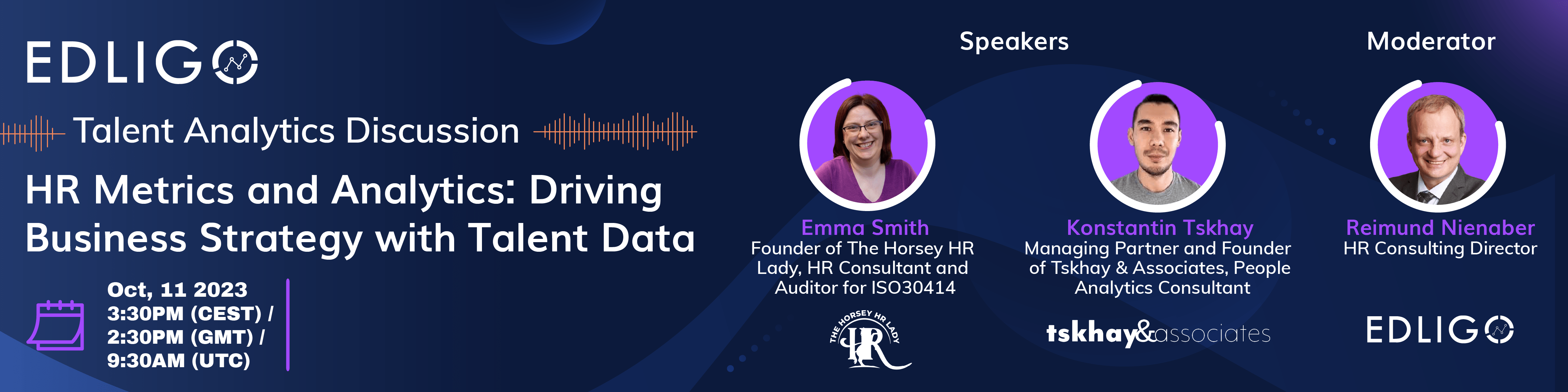
Watch the insightful webinar with Emma Smith

Enhancing Project Performance: Leveraging Skills Data and AI for Staffing Optimization

Enhancing Project Performance: Leveraging Skills Data and AI for Staffing Optimization

In today's highly competitive business landscape, the performance of projects plays a pivotal role in determining an organization's success. Successfully executed projects gave numerous benefits, including heightened efficiency, elevated customer satisfaction, and an enhanced reputation. Nonetheless, achieving superior project performance comes with its fair share of challenges.

Among the crucial elements influencing project success, the composition of the project team and their skill sets stand out as key factors. The right mix of skills within the team is essential for tackling project complexities and delivering results that exceed expectations. By recognizing the significance of skill diversity and actively addressing skill gaps, organizations can ensure a higher likelihood of achieving project objectives and staying ahead in the competitive market.

Skills-Based Project Staffing

Building project teams based on skills is a fundamental aspect of project management. When team members possess the right mix of expertise and knowledge, projects are more likely to be efficient and successful. The correct skill mix ensures that the team can handle various project tasks effectively, minimizing delays and potential roadblocks.

For instance, in a software development project, having a balanced team with experts in required programming languages, design, and testing can lead to faster development cycles and better-quality output. On the other hand, a team lacking the necessary skills may struggle to deliver on time and within budget.

Moreover, based on Deloitte, companies that match the right talent and skills to tasks effectively are 52% more likely to be innovative and 57% more likely to be agile.

Thus, a skills-based approach to project staffing can significantly contribute to an organization's overall competitiveness and adaptability in today's dynamic and rapidly changing business landscape. By aligning team members' strengths and proficiencies with the specific demands of a project, organizations can not only enhance their project outcomes but also foster a culture of continuous improvement.

Identifying Skills for Project Requirements

To optimize the team's skill composition, a thorough assessment of the required team's abilities becomes imperative. The process involves identifying key skills that directly contribute to the achievement of project objectives—an essential and decisive phase.

This step is where AI-driven analytics can significantly augment the process. AI algorithms can scan through project requirements and analyze the skills needed based on keywords and contextual understanding. This involves comparing the skills mentioned in the project description with those present in candidate profiles, resumes, or employee databases. AI can quickly identify matches, helping to ensure that the right skills are available for the project.

Moreover, AI can perform semantic analysis to understand the nuanced skills required for a project. Semantic analysis empowers AI to go beyond simple keyword matching when identifying skills for project requirements. It enables understanding of skill context, recognizing synonyms and variations, mapping hierarchical relationships, and adapting to evolving industry trends. By comprehending implied skills, accommodating industry jargon, and considering complex skill combinations, semantic analysis ensures accurate skill-to-project matches, ultimately enhancing staffing decisions and project success.

Utilizing historical project data and performance metrics, AI algorithms can swiftly analyze the proficiency of individual team members in various areas, highlighting areas of strength and those that could benefit from reinforcement. This data-driven approach ensures that the selection of skillsets aligns precisely with the project's demands, enhancing the overall capability of the team.

Optimizing Staffing for Project Success

Project staffing is the process of strategically assigning the right people to the right projects. According to Deloitte, 83% of leaders believe that leveraging employees’ skills data creates benefits for both the organization and its employees.

By considering each team member's skill sets and experience, project managers can assemble teams that are tailor-made for specific projects. This not only improves project outcomes but also enhances employee satisfaction and engagement.

Additionally, taking into consideration employee availability and workload can prevent burnout and the inability to meet project deadlines. By factoring in these aspects, project managers can ensure a balanced distribution of tasks, promoting a healthier work environment, sustained productivity, and successful project completion.

In this era of technological advancement, AI and Talent Analytics can play a valuable role by providing data-driven recommendations for project staffing, considering individual skills, current workloads, and historical project performance. By factoring in these aspects, project managers can ensure a balanced distribution of tasks, promoting a healthier work environment, sustained productivity, and successful project completion.

Empowering Skills Development

According to Gartner, 64% of IT professionals consider the skills shortage to be the foremost challenge limiting the adoption of transformative technologies. Talent Analytics plays a vital role in bridging skill gaps.

By analyzing data on employees' skills and experiences, organizations can identify potential candidates for projects based on existing or adjacent skills. For instance, if a project requires expertise in a specific programming language that the current team lacks, Talent Analytics can identify individuals with adjacent skills that can be quickly upskilled to meet the project's requirements.

Sometimes, organizations may face a challenge where specific skills needed for a project are not readily available within the team. In such cases, it is crucial to empower employees through skill development initiatives. Investing in employees' growth and upskilling not only meets project demands but also fosters a culture of continuous learning within the organization.

By providing training opportunities and resources, employees can acquire new skills that align with project requirements. Moreover, a culture that encourages skill development attracts top talent and retains skilled employees, making the organization more competitive in the long run.

Incorporating personalized learning initiatives further enhances the team's capabilities. By offering tailored training opportunities and resources, employees can acquire new skills that precisely align with the specific project requirements. This personalized approach not only boosts individual growth but also fosters a culture that values skill development, making the organization more attractive to top talent. Moreover, when skilled employees are encouraged and supported in their professional development, it leads to higher retention rates, ensuring the company's long-term competitiveness in the market.

Monitoring and Evaluating Project Performance

Setting measurable performance indicators for projects is essential to track progress and identify areas for improvement. Regularly monitoring project performance allows teams to make necessary adjustments and ensure that the project stays on track.

Talent Analytics comes into play once again when evaluating project performance. By comparing project outcomes with the skill sets of the team members and staffing decisions, organizations can gain valuable insights into the impact of skill development and staffing optimization on project success.

AI's proficiency in aggregating and integrating data from diverse sources, including project management tools, collaboration platforms, and performance metrics, lays the foundation for comprehensive insights. Complementing this, Talent Analytics meticulously captures skill-related data, offering a panoramic view of project progress and creating a synergistic approach that informs strategic decision-making.

AI's capabilities extend to anomaly detection, where its algorithms identify deviations in project performance to predict and mitigate risks. This proactive identification of anomalies enables taking timely actions to ensure that projects maintain their trajectory. The collaboration of AI and Talent Analytics transforms project monitoring and evaluation, offering predictive insights and skill-driven decisions that elevate project outcomes.

Achieving superior project performance requires a proactive approach to skill development and staffing optimization. By assembling project teams based on skills, identifying essential skills, and leveraging Talent Analytics to bridge skill gaps, organizations can significantly enhance project efficiency and success.

Investing in skill development empowers employees and ensures the availability of necessary expertise for future projects. Continuous learning contributes not only to individual growth but also to the overall growth of the organization.

EDLIGO Talent Analytics helps organizations assess the impact of skill development and staffing decisions on project outcomes. The platform's analytics provide actionable insights into project performance, allowing businesses to identify trends, strengths, and weaknesses. With this data-driven approach, organizations can continuously improve project management strategies and enhance overall project performance.

EDLIGO Talent Analytics Introduces a Comprehensive Workforce Planning Module

EDLIGO Talent Analytics Introduces a Comprehensive Workforce Planning
EDLIGO Talent Analytics Introduces a Comprehensive Workforce Planning Module

EDLIGO Talent Analytics Introduces a Comprehensive Workforce Planning Module

EDLIGO, a leading provider of AI-powered Talent Analytics solutions, is thrilled to announce the release of its latest module, designed to help organizations improve workforce planning, employee matching, and project staffing. These module empowers organizations to strategically align their workforce with business objectives, leveraging HR analytics, workforce analytics, skills inventory, and learning recommendations.

EDLIGO Talent Analytics introduces a paradigm shift in workforce planning by moving away from traditional role-based assignments. Instead, employees are matched to tasks based on their skills, competencies, adjacent skills, availability, and aspirations.

The Workforce Planning Process with EDLIGO involves several key areas:

Analyzing the status quo: In this initial stage an in-depth examination of the organization's talent is conducted. This entails evaluating the current workforce's skills, competencies, and career aspirations. For example, a technology company may analyze the proficiency of its software engineers in programming languages like Python, Java, or C++, as well as their certifications and years of experience. As a result, the organization creates comprehensive and dynamic skills and talent inventory.

Analyzing and closing gaps: EDLIGO's skills gap analysis helps identify skills gaps and provide targeted upskilling and reskilling plans to the employees. The advanced analytics capabilities offered by EDLIGO empower organizations to diagnose teams, departments and projects performance and risks effectively.

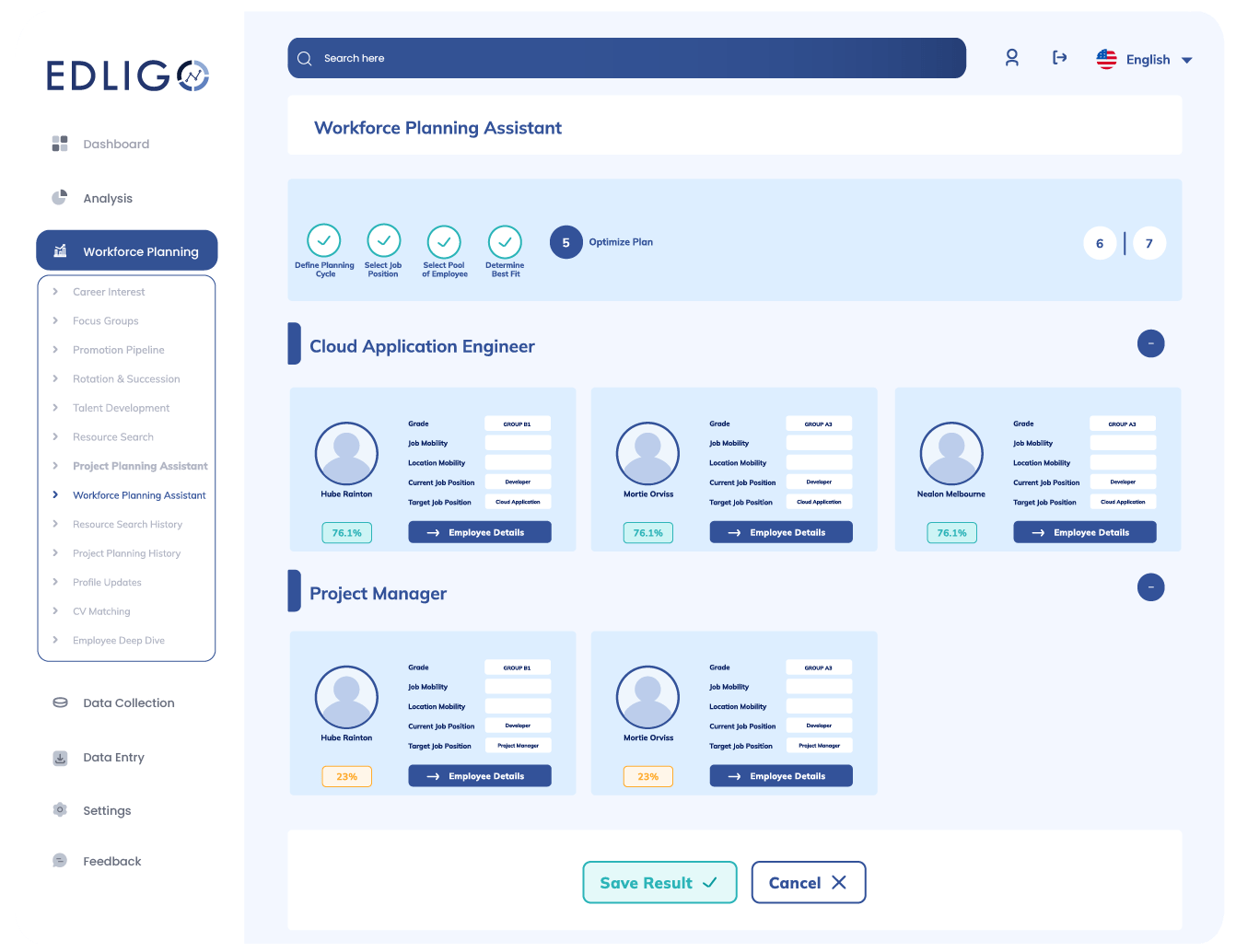
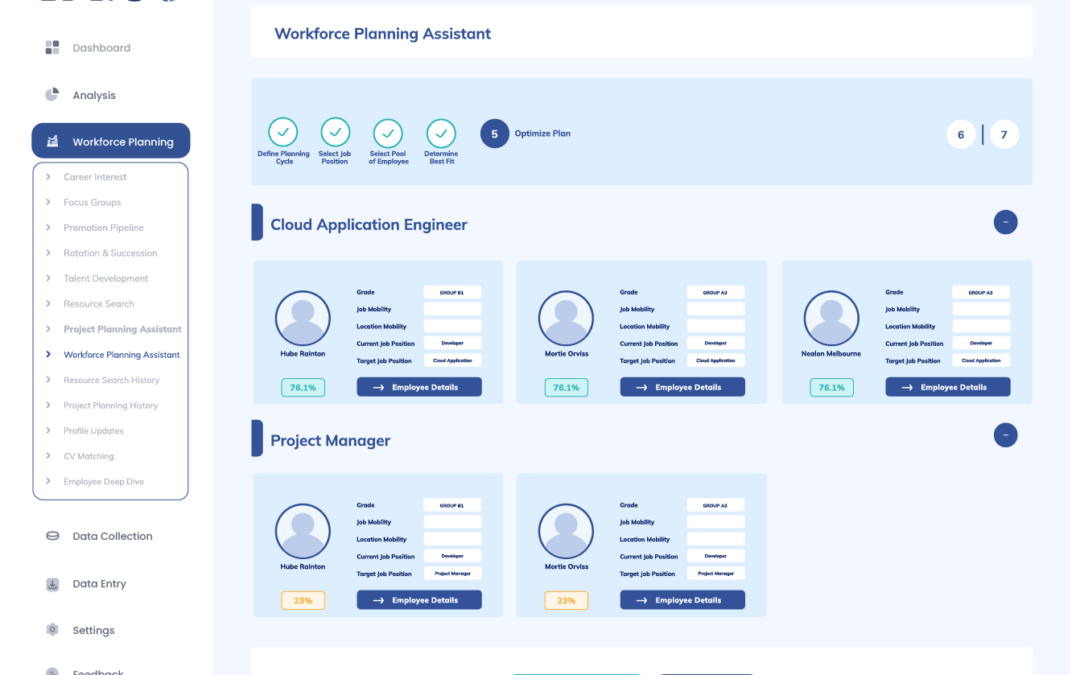
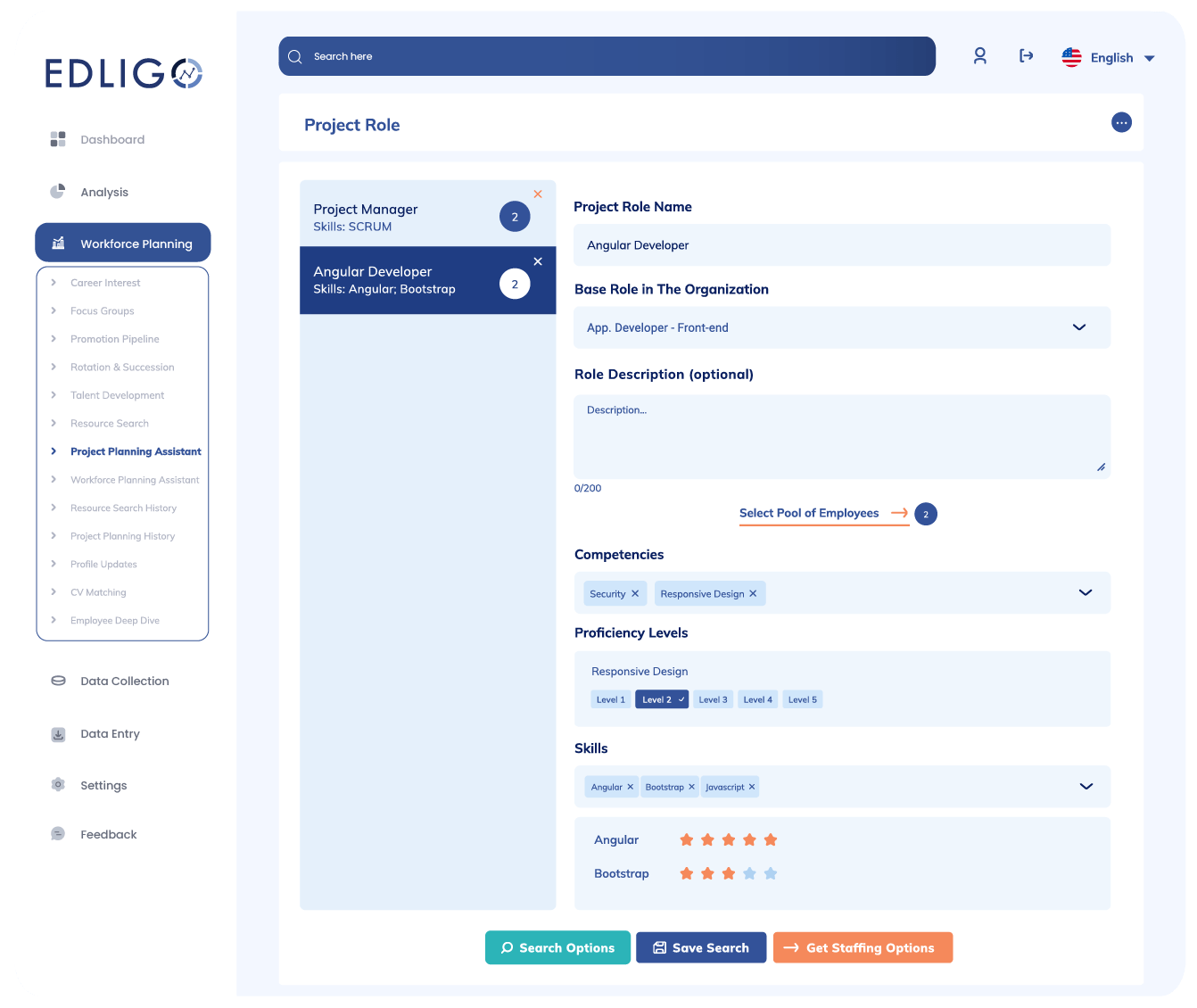
Matching skills to tasks: With resource search feature organizations can quickly find suitable people for any project. Managers can set criteria such as location, department, engagement, tenure, availability, skills and competencies and the platform provide a curated list of employees with required competencies showing the matching scores.

The Project Planning Assistant empowers leaders to create the best teams with the required skills for seamless project execution. Organizations can define project roles, location, timeframe, required skills and competencies at different levels, and EDLIGO will propose a team composition ensuring the best results.

Matching skills to tasks: EDLIGO Talent Analytics

EDLIGO's Workforce Planning features enable organizations to proactively assemble well-equipped teams, optimize their workforce, and ensure seamless project execution. This proven process is widely utilized by numerous industries and organizations of varying sizes, ranging from multinational corporations to small businesses. By leveraging EDLIGO's Workforce Planning capabilities, these entities can effectively align their talent strategies with their business objectives, thereby maximizing productivity and achieving success in their respective fields.

"We are dedicated to empowering organizations with the tools they need to optimize their workforce planning and talent management strategies," said Dr. Lassaad Essafi, Co-founder and CEO of EDLIGO. "Our latest enhancements provide organizations with data-driven insights and innovative capabilities, enabling them to identify and close competency gaps, align employee skills with business objectives, and drive success through effective workforce planning."

With its state-of-the-art solutions for Talent Analytics, planning, organizing skills, and staff planning, EDLIGO Talent Analytics continues to lead the way in transforming talent management and enabling organizations to thrive in the ever-evolving business landscape.

About EDLIGO

EDLIGO is an award-winning provider of AI-powered Talent Analytics solutions and one of the top 3 most innovative soft- and hardware companies in Germany. With a focus on fostering innovation in talent management, the company empowers organizations with data-driven insights to optimize talent decisions and transform their workforce planning strategies. EDLIGO equips companies with the tools to make informed choices, identify top talent, and drive success through cutting-edge technology.

For additional information about EDLIGO and its AI-powered Talent Analytics solutions, please visit www.edligo.com.

Would you like to have a demo call to see the new module? Please book it with our team here.

EDLIGO Receives HR Tech Award for Best Talent Intelligence Solution

EDLIGO Receives HR Tech Award for Best Talent Intelligence Solution

EDLIGO, a leading provider of AI-powered Talent Analytics solutions, is thrilled to announce that it has received the prestigious HR Tech Award for the Best Talent Intelligence Solution 2023. The announcement was made at the highly anticipated HR Tech Awards 2023 ceremony, which recognizes and celebrates the most innovative and impactful companies in the HR technology industry.

This initiative, powered by Lighthouse Research and Advisory, one of the HR technology industry's most innovative research firms, provides peer-reviewed feedback and inputs on technology platforms built to serve employers and the workforce. The program has a rigorous judging component with a panel of independent practitioners, consultants, and educators.

"In the four years we have done this program, hundreds of HR technology providers have sought to participate in the HR Tech Awards. Our judges strive to select technology solutions that have a real, measurable impact on employers. It's such a pleasure to be able to congratulate the winners of this year's program -- they represent some of the very best that the industry has to offer," said Ben Eubanks, Chief Research Officer at Lighthouse Research & Advisory.

"We are incredibly proud to receive the HR Tech Award for Best Talent Intelligence Solution," says Dr. Lassaad Essafi, Co-founder and CEO of EDLIGO. "This recognition underscores our commitment to empowering organizations with data-driven talent management strategies. Our Talent Analytics solutions have consistently helped our clients make informed decisions, optimize their workforce, and unlock the potential of their talent. This award is a testament to the dedication of our employees, customers, and partners to push the boundaries of innovation in the HR technology space."

As one of the top three most innovative medium-sized hardware and software companies in Germany, EDLIGO continues to drive technological advancements and remains at the forefront of innovation. With a team of experienced and passionate professionals, EDLIGO is committed to elevating talent management practices to new heights and delivering cutting-edge solutions that transform the way organizations approach talent optimization.

The HR Tech Awards 2023 celebrate the remarkable achievements and revolutionary solutions in the HR technology landscape. The event brings together industry leaders, experts, and visionaries to foster collaboration and drive innovation in talent management and HR technology.


About HR Tech

HR Tech is a renowned institution committed to advancing HR technology and fostering collaboration among HR professionals, thought leaders, and solution providers. The HR Tech Awards recognize and celebrate the most groundbreaking and impactful companies in the HR technology industry, highlighting their contributions to driving innovation and shaping the future of talent management.

To learn more about the HR Tech Awards, please visit: https://hrtechawards.org/ 

About EDLIGO

EDLIGO is a leading provider of AI-powered Talent Analytics solutions. With a focus on driving innovation in talent management, EDLIGO empowers organizations with data-driven insights to optimize talent decisions. Its comprehensive suite of solutions includes Talent Analytics and Learning Analytics, enabling companies to make informed choices, identify top talent, and enhance workforce planning. With a strong track record of success and a global presence, EDLIGO is dedicated to transforming talent management through cutting-edge technology.

For additional information about EDLIGO and its AI-powered Talent Analytics solutions, please visit: www.edligo.com 

The Corporate Sustainability Reporting Directive – What You Need to Know

The Corporate Sustainability Reporting Directive (CSRD) is a significant regulation aiming to improve the quality and relevance of sustainability reporting by European Union (EU) companies. The CSRD was proposed by the European Commission on April 21, 2021, and entered into force on January 5, 2023. The CSRD requires companies in Europe to report on their sustainability practices, including environmental, social, and governance (ESG) performance, using standardized sustainability reporting requirements.

A new EU legislation requires all large companies to publish regular reports on their environmental and social impact activities. Compliance is happening soon, as companies are required to submit their report aligning with the CSRD on 1 January 2025, for the 2024 financial year.

Although the CSRD primarily targets larger companies, smaller companies will also be affected indirectly. This is because many small and medium-sized enterprises (SMEs) function as suppliers or service providers to larger companies, which are obliged to provide sustainability reports. Consequently, smaller companies will have to be prepared to respond to such requests and exhibit their commitment to sustainability.

The demand for sustainability reporting is not confined to the EU but is a worldwide phenomenon. Many multinational corporations have made sustainability a central aspect of their business strategy and anticipate their suppliers and service providers to do the same. As a result, sustainability is increasingly becoming a criterion for supplier selection and procurement decisions.

Smaller companies that do not prioritize sustainability may face a disadvantage when competing for business against larger, more sustainable rivals. Sustainability reporting, on the other hand, can assist smaller companies in developing their reputation, increasing their visibility, and enhancing their competitiveness.

It's important to note that the CSRD is a directive of the European Union and may be applied differently in other countries. For instance, in Germany, a national law called Lieferkettengesetz has already been implemented, requiring companies to take responsibility for the social and environmental impact of their supply chains. Other countries may choose to adopt similar regulations or develop their own reporting requirements. Companies that operate globally may need to comply with multiple reporting frameworks, which can increase the complexity and cost of their sustainability reporting. Therefore, it's crucial for companies to stay informed about the regulations and reporting requirements in the countries where they do business.

The regulation will impact the following types of companies:

  • Companies with more than 250 employees
  • Companies with a net turnover exceeding €40 million
  • Companies with a balance sheet total greater than €20 million

NFRD versus CSRD: Differences and Action Points

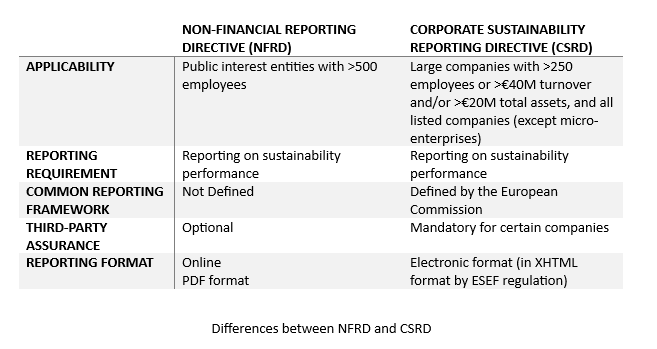
The Non-Financial Reporting Directive (NFRD) is a European Union directive that requires certain companies to report on their environmental, social, and governance (ESG) performance. Specifically, the NFRD requires "public interest entities" to disclose information on their ESG policies, risks, and outcomes.

NFRD versus CSRD: Differences and Action Points

What specific information will companies be required to reveal?

Additional to the NFRD Under Directive 2014/95/EU, large companies are required to publish information related to the:

  • Environmental protection
  • Social responsibility and treatment of employees
  • Respect for human rights
  • Anti-corruption and bribery and
  • Diversity on company boards

Also, the CSRD is adding additional requirements on:

  • Double materiality concept: Sustainability risk (including climate change) affecting the company + companies’ impact on society and the environment
  • Process to select material topics for stakeholders
  • More forward-looking information, including targets and progress
  • Disclose information relating to intangibles (social, human, and intellectual capital)
  • Reporting in line with Sustainable Finance Disclosure Regulation (SFDR) and the EU Taxonomy Regulation

    Obligation to Report

    Under the directive, non-EU companies with EU subsidiaries meeting specific annual revenue thresholds are obligated to disclose their environmental, social, and governance (ESG) impacts.

    It is crucial to note that failure to comply with the CSRD reporting requirements may result in severe consequences. Companies that fail to report and comply with the CSRD face fines of up to 10 million Euros or 5% of their annual revenue. This significant penalty reflects the importance of transparent ESG reporting and encourages companies to prioritize their sustainability efforts.

    Benefits and Consequences of CSRD Compliance

    Investing in CSRD initiatives has many benefits for businesses.

    Cone Communications found that 88% of consumers are more likely to buy from companies that prioritize social and environmental issues.

    In addition, a study by Glassdoor found that 75% of employees expect their employers to take a stand on social issues, which includes sustainability. Furthermore, the Harvard Business Review found that companies that prioritize sustainability are more likely to outperform their peers in the long term.

    Companies with strong ESG practices have a lower cost of capital, which leads to higher profitability and stock returns. The benefits of CSRD initiatives are not just financial. A study by PwC found that diversity and inclusion initiatives can improve employee engagement, increase innovation, and improve decision-making. Companies that prioritize diversity and inclusion also have a better reputation and are more likely to attract and retain top talent.

    However, companies that fail to comply with regulations can face significant penalties. Under the CSRD, companies that fail to comply with reporting requirements can face fines of up to 1% of their annual turnover. For example, French oil and gas company Total was fined for failing to adequately prevent a gas leak at one of its North Sea platforms, releasing nearly 50 tons of gas. Furthermore, Total is currently facing legal action in France over allegations of human rights and environmental violations related to its operations in Uganda.

    How CSRD Addresses the Problem of Quality Reporting

    The CSRD comes into play as Environmental, Social, and Governance (ESG) reporting gains momentum. There is evidence that companies' information is not sufficient in the reporting. According to the European Commission, "reports often omit information that investors and other stakeholders think is important." Reported information can be difficult to benchmark from company to company, and users are often unsure whether they can trust it. With its new requirements, the EU is tackling the problem of quality reporting by establishing a common reporting framework. The CSRD aims to ensure that businesses report reliable and comparable sustainability information to re-orient investments towards more sustainable technologies and companies.

    HR professionals play a vital role in enhancing their organization's strategic impact through CSRD initiatives. By complying with regulations and investing in sustainable practices, companies can improve their reputation, attract, and retain top talent, improve financial performance, and promote diversity and inclusion within their organizations.

    EDLIGO Talent Analytics can support HR departments with a constant flow of data to predict and measure the impact of key strategic decisions and determine the future readiness of the organization, supporting HR departments in their strategic role as a foundation for sustainability.  EDLIGO helps organizations achieve their sustainability goals by providing data-driven, unbiased insights into workforce diversity, employee career aspirations, and mobility opportunities, and supporting the development of individual career paths and training opportunities.

    More about CSRD read here European Commission Portal.


    WordPress Cookie Plugin by Real Cookie Banner