
Views: 37
Your Board Is Already Asking About AI Workforce Impact – Can You Answer?
Artificial intelligence is no longer a future topic in banking. It is already reshaping operations, cost structures, and workforce models. From loan processing to compliance and risk management, AI is automating a growing share of tasks.
But here is the real challenge facing most financial institutions today:
Most banks still cannot quantify what this means for their workforce.
Boards are asking tough questions. Regulators are watching. And without a clear, data-backed answer, transformation slows, budgets are challenged, and strategic credibility erodes.
How Will AI Impact Banking Jobs in 2026?
According to the McKinsey Global Institute, up to 30–40% of banking activities can be automated or AI-augmented in the coming years.
This includes high‑impact areas such as:
- KYC / AML processes
- Risk reporting and monitoring
- Loan underwriting support
- Back‑office operations
- Customer service and document processing
This is not marginal efficiency.
This is structural workforce transformation.
The Core Problem: Banks Lack Workforce Visibility for AI
While AI adoption accelerates, workforce planning remains a blind spot. According to Gartner:
- 54% of CHROs do not know how to prepare their workforce for AI
- 63% feel unprepared for the skills impact
In banking, this translates into a critical gap.
Leadership is asking:
- How many roles are impacted?
- Where will capacity change?
- What is the financial impact of AI on headcount and costs?
And most banks cannot answer with numbers.
Why AI Workforce Planning in Banking Is Becoming a Regulatory Expectation
This is no longer just a strategy conversation – it is a governance imperative.
The EU AI Act introduces requirements around:
- Transparency of AI systems
- Human oversight
- Impact on employees and working conditions
At the same time, regulators like the European Banking Authority (EBA) and the European Central Bank (ECB) expect banks to:
- Assess operational risk linked to AI
- Document transformation assumptions and workforce scenarios
👉 EBA – EBA/REP/2024/02
👉 ECB – Guide on AI in banking
Translation:
Workforce impact is becoming audit‑relevant. If you cannot quantify it, you are exposed.
The Hidden Risk: AI Without Workforce Strategy
Many banks are deploying AI tools without:
- Role‑level impact analysis
- Workforce scenarios for different automation levels
- Financial modeling of FTE changes
👉 Result:
- Decisions are delayed
- Budgets are blocked
- Transformation credibility is questioned
According to Deloitte, organizations that fail to align AI and workforce strategy risk lower ROI and significantly higher transformation costs.
How Can Banks Prepare Their Workforce for AI Transformation?
Forward‑looking banks are shifting from assumptions to quantified workforce planning.
They are starting to:
✔️ Map AI impact at task level
Identify exactly what can be automated or augmented – not just at role level, but at individual task level.
✔️ Quantify role evolution
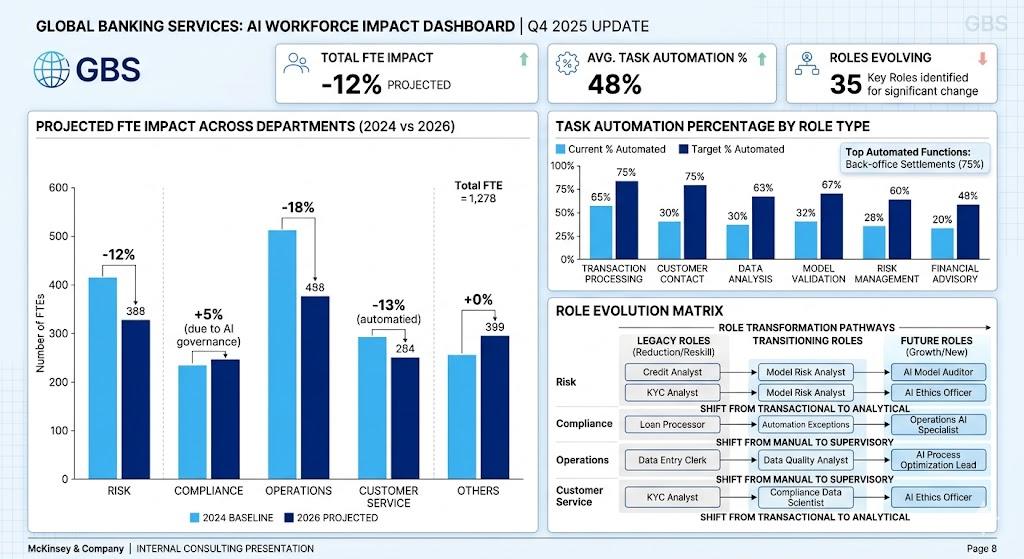
Understand how roles will shift across functions – from KYC analysts to AI‑augmented compliance specialists.
✔️ Model FTE impact over time
Simulate workforce changes under different adoption scenarios (e.g., 30% automation vs. 50%).
✔️ Align HR and Finance
Build defensible business cases for the board, linking AI investments to headcount planning and cost efficiency.
The Real Issue: You Don’t Lack Strategy – You Lack Numbers
Most banks already understand AI is important.
The real problem is: they cannot translate AI into their own workforce reality.
- Benchmark studies → too generic
- HR systems → backward‑looking (they tell you what happened, not what will happen)
- Consulting → static outputs that are outdated by the time they are delivered
👉 What’s missing:
Role‑level, task‑level, quantified workforce visibility that connects AI’s technical impact to people, costs, and organizational design.
AI Workforce Planning Tools for Banks: What to Look For
To answer the board’s questions, banks need tools and frameworks that:
- Work with existing workforce data (Excel, CSV, HRIS)
- Do not require heavy IT integration – because speed matters
- Provide task‑level automation scoring
- Enable what‑if scenarios (e.g., “What if we automate 40% of underwriting tasks?”)
- Generate board‑ready outputs with financial and headcount projections
This is not about replacing HR. It is about giving HR, strategy, and finance the same quantitative foundation that other business decisions already enjoy.
What Roles Will Disappear in Banking Due to AI?
(And What Will Emerge)
While some repetitive roles will shrink, the more powerful story is role evolution:
|
Role |
Impact |
|
Loan underwriter |
From manual review to AI‑augmented decision‑making with exception handling |
|
KYC analyst |
From data collection to risk‑based investigation and quality assurance |
|
Compliance officer |
From reporting to strategic oversight and model validation |
|
Customer service agent |
From handling routine queries to complex relationship management |
The key insight:
AI doesn’t just remove jobs – it transforms them. The question is whether you are managing that transformation or letting it happen to you.
The Question Every Banking Executive Will Be Asked
“How many roles are impacted – and what is the FTE impact?”
If you cannot answer:
- Decisions will stall
- Investments will be challenged
- Transformation will slow
Boards are now expecting quantified workforce impact assessments as part of any AI business case.
Get Your Bank’s Workforce Impact – Before the Next Board Meeting
AI is already changing your operations.
The question is whether you can quantify it before it impacts your numbers.
With a structured workforce analysis, you can:
- Identify task‑level automation potential
- Understand role evolution across functions
- Quantify FTE impact scenarios
- Build a board‑ready workforce strategy that aligns with your AI roadmap
👉 Run Your Bank’s AI Workforce Analysis
Get structured, role‑level insights based on your actual workforce data.
📌 Book an Executive Briefing
Walk through your bank’s AI workforce impact with a clear, defensible framework.
[Link to booking page]
💡 Board‑ready outputs | No IT integration required | Works with Excel / CSV data