
Views: 57
The efficiency gains are real. The workforce response is missing. Here is what to do about it.
The Gap No One Is Talking About : Why AI Impact on Insurance Operations Isn’t Reducing Costs Yet
Artificial intelligence has arrived in insurance operations. Claims processing platforms now handle first notice of loss at scale. Underwriting decision support tools are live at most major carriers. Fraud detection models are running continuously across policy portfolios.
The technology investment is significant. The productivity signals are promising.
And yet, for most insurers, operating costs have not fallen. The combined ratio has not improved the way the investment in AI promised it would. The board is asking why.
The answer is not the technology. The technology is working. The gap is in the workforce response that never followed.
AI was deployed. The workforce was not restructured to match it. And that gap — between the tools that are live and the operating model that has not changed — is where billions in potential value are sitting unrealised.
The Scale of the Opportunity : Quantified Gains From AI in Insurance and Insurance Workforce Planning
The numbers behind this transformation are not speculative. They are documented, sector-specific, and growing.
Claims Processing : The Largest Target for AI-Led Staff Management Insurance
Claims processing represents 40 to 55 percent of total insurance operating costs — the single largest controllable cost line in an insurance business. According to Oliver Wyman’s 2024 Insurance Workforce in the Age of AI report, AI has the potential to reduce manual claims handling time by 30 to 50 percent. That is not a future projection. It is performance already observed in organisations that have restructured their workforce alongside their technology deployment.
Underwriting and Risk Accuracy : Documented Productivity Gains
Accenture’s Insurance Technology Vision 2025 documents a 35 percent reduction in underwriting processing time and a 22 percent improvement in risk accuracy at AI-adopter insurers. The productivity is there. But the workforce implication — which roles shrink, which evolve, which new capabilities emerge — remains unplanned in most organisations.
The Structural Failure : 77% of Insurers Lack a Quantified Workforce Plan
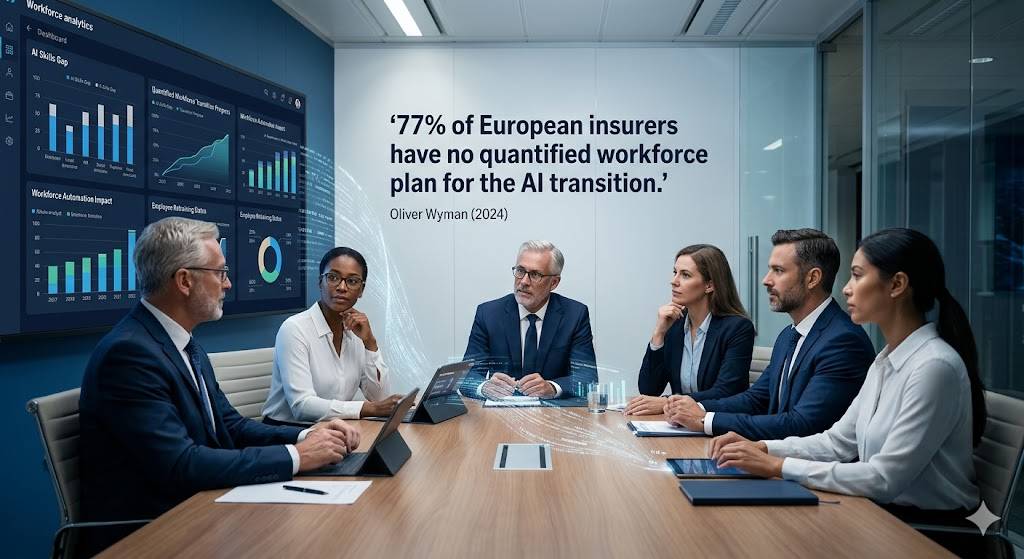
The most striking data point comes from Oliver Wyman’s research: 77 percent of European insurers have no quantified workforce plan for the AI transition.
That is not a marginal gap. It is a structural failure at industry scale. And the insurers who close it first will have a cost and performance advantage that compounds every year the others wait.
👉 Book a demo to explore how insurers are quantifying AI workforce impact and building defensible transformation models.
Why the Insurance Workforce Plan Is Missing : Methodological Failure, Not Intent
The Precision Gap : From Sector Benchmarks to Actionable Data
Understanding why the plan does not exist is as important as understanding why it should.
The challenge is not awareness. Insurance leaders know AI is changing their operations. The challenge is precision.
When the CFO asks “how many FTEs are impacted in claims?” — the honest answer in most organisations is “we don’t know exactly.” When the board asks for the workforce restructuring roadmap, the CHRO presents a directional narrative rather than a model. When the COO is asked to defend workforce cost projections, the assumptions behind them are borrowed from sector benchmarks rather than built from the organisation’s own data.
Why Traditional Insurance Management Systems and HR Tools Fall Short
This is not a failure of intent. It is a failure of methodology. The tools that most insurance organisations have available — HR information systems, actuarial models, management consulting engagements — were not built to answer the question “which specific tasks within which specific roles in my organisation are automatable, by how much, and what does that mean for my FTE structure and cost base?”
HR systems describe what has happened. They do not model what will change. Consulting engagements are expensive, slow, and produce outputs the organisation does not own. Sector benchmarks are informative but not actionable at the role level.
The result is that workforce transformation decisions in insurance are being made on assumptions. And assumptions, when challenged at board level, do not hold.
The Three Boardroom Conversations Driving AI Impact on Insurance Workforce Planning
The pressure is not abstract. It is arriving in three specific and increasingly urgent forms.
The Cost Conversation : Where Is the Staff Management Insurance Reduction?
“We have deployed AI across claims and underwriting. Where is the cost reduction?” If the answer cannot be built on the organisation’s own workforce data — showing which roles, at what volume, with what financial consequence — the conversation becomes a credibility problem for HR and operations leadership.
The Governance Conversation : Regulatory Expectations for Insurance Management Systems
EIOPA’s 2024 Supervisory Statement on AI and Digital Transformation in Insurance requires insurers to demonstrate transparency in operational changes, traceability of transformation assumptions, and controlled implementation of AI. Solvency II operational risk reporting is evolving to include AI workforce impact. The regulatory expectation is no longer directional — it is documentary. Most insurers cannot produce the required documentation today.
The People Conversation : Workforce Transition and Legal Exposure
Workforce restructuring without a documented transition plan creates legal exposure, union risk, and reputational damage. In European insurance particularly, Works Councils expect structured engagement on material workforce changes. The organisations that manage this well are the ones who built the plan two years before the restructuring, not six months after it became unavoidable.
👉 Book a demo to explore how insurers are quantifying AI workforce impact and building defensible transformation models.
What a Quantified AI Workforce Plan Actually Looks Like : From Insurance Software Systems to Task-Level Analysis
The starting point is not a strategy presentation. It is a task-level analysis.
Decomposing Roles : The Task-Level Foundation for AI Workforce Planning
Effective AI workforce planning in insurance begins by decomposing roles into their underlying task components — not at the function level (“claims operations is impacted”) but at the activity level (“manual FNOL documentation, claim triage, coverage validation, reserve setting, fraud screening, payment processing”). Each task is then assessed against current AI capability: what can be automated, what can be augmented, what requires human judgment.
This task-level precision is what makes the analysis actionable. It is also what makes it defensible. When the CFO challenges the FTE projection, the answer is not a sector benchmark — it is a traceable model built from the organisation’s own role structure, headcount, and salary data.
Five Strategic Outcomes Mapped to Insurance Leadership Requirements
The output of this analysis maps directly to the five strategic outcomes that insurance leadership is required to deliver.
Outcome 1 : Quantified FTE and Cost Impact
Quantified FTE and cost impact across claims, underwriting, and back-office operations. Not a range. A model.
Outcome 2 : Structured Business Case for Redeployment
A structured business case for redeployment or restructuring across 50 to 200 FTEs over a 24-month horizon — built with the phasing and financial rigour that a CFO will approve.
Outcome 3 : Phased Cost-Reduction Roadmap
A phased cost-reduction roadmap tied to the AI tool implementation timeline already underway.
Outcome 4 : Audit-Ready Documentation for EIOPA and Solvency II
Audit-ready documentation designed to support EIOPA supervisory review and Solvency II operational risk reporting requirements.
Outcome 5 : Defensible Workforce Transition Model
A defensible workforce transition model for union dialogue and regulatory scrutiny — not a narrative, a quantified upskilling and redeployment plan.
The Functions Most Exposed : What Insurance Agent Management Systems and Senior Roles Reveal
The task-level analysis consistently surfaces a finding that challenges the assumptions most insurance leaders carry into the room.
Highest AI Exposure : Claims, Policy Admin, and Back-Office
The functions with the highest AI exposure are the expected ones. Claims handling — particularly FNOL, document processing, standard assessment, and payment administration — shows AI applicability across 35 to 45 percent of task volume. Policy administration and back-office processing follows closely. These are the roles where automation is deepest and fastest.
The Strategic Insight : Productivity Gains Also Come From Senior Roles
But the finding that generates the most strategic conversation is this: a significant share of the productivity gains identified come not from junior processing roles, but from senior and managerial functions.
Senior claims managers, chief underwriters, operational directors — these roles carry substantial time on coordination, reporting, documentation, and oversight of processes that AI can streamline. Freeing that time does not reduce these roles. It redirects their capacity toward judgment, exception handling, client relationships, and strategic input. The same people. Significantly higher output.
This reframes the entire workforce transformation narrative. It is not a cost-cutting exercise imposed on the organisation. It is a capability multiplication — with the efficiency gains as a consequence, not the objective.
The 2026–2028 Window : Why Insurance Software Systems and First Movers Will Dominate
The competitive dynamic in insurance workforce transformation is not symmetrical. The organisations that build a quantified AI workforce plan now will have a structural cost advantage by 2027 and 2028 that is very difficult for late movers to close.
Compounding Value : Why Insurance Workforce Planning Is Not a One-Time Gain
This is because the value of AI workforce restructuring is not a one-time gain. It compounds. Each phase of restructuring — from quick wins in claims processing to strategic transformation in underwriting — builds the capability and institutional knowledge that makes the next phase faster and cheaper. The organisations that start in 2026 will be in their third phase by the time their competitors are completing their first.
The Narrowing Window : Regulatory Pressure and First-Mover Advantage
The window is not permanently open. It narrows as AI capability advances, as regulatory requirements tighten, and as the first-mover advantage accrues to those who acted.
👉 Book a demo to explore how insurers are quantifying AI workforce impact and building defensible transformation models.
From Assumptions to a Defensible Model : Integrating AI Workforce Planning Into Your Insurance Management System Software
The shift that insurance leaders need to make is not strategic. It is methodological. The strategy — transform the workforce alongside the technology investment — is already understood. What is missing is the tool to build the model.
Building From Your Own Data, Not Benchmarks
The model needs to be built from the organisation’s own data, not from sector benchmarks. It needs to be traceable, so Finance and the board can challenge the assumptions. It needs to be phased, so the transformation can be sequenced and managed without disruption. And it needs to be owned by the organisation’s own HR and operations leadership — not by an external consultant whose engagement ends when the project closes.
When the Model Exists : A New Conversation for CFO, CHRO, COO, and Board
When that model exists, the conversation changes. The CFO gets a number they can defend. The CHRO gets a roadmap they designed. The COO gets a sequenced implementation plan. The board gets the governance evidence it requires. And the organisation gets a structural cost advantage that its competitors do not have.
The question is not whether AI will change your insurance workforce. It already is. The question is whether you can quantify it — and act on that insight while the window is still open.
Key Takeaways : AI Workforce Planning, AI in Insurance, and Staff Management Insurance at a Glance
-
77% of European insurers have no quantified workforce plan for the AI transition (Oliver Wyman, 2024)
-
Claims processing represents 40–55% of total insurance operating costs — the primary target of AI-driven workforce restructuring (Oliver Wyman, 2024)
-
AI can reduce manual claims handling time by 30–50% — but only when workforce restructuring follows the technology deployment (Oliver Wyman, 2024)
-
EIOPA’s 2024 Supervisory Statement requires documented AI workforce impact assessments — most insurers cannot currently produce them (EIOPA, 2024)
-
The 2026–2028 window is the restructuring moment — first movers will establish a compounding cost advantage
The Solution Exists : Workforce AI – Your Tool for Quantified Workforce Transformation
The diagnosis is clear. The lack of methodology and fit‑for‑purpose tools prevents insurers from turning intentions into results. That is exactly why Edligo built Workforce AI — a platform designed by and for insurance leaders.
Workforce AI Turns Your Internal Data Into a Defensible Action Plan
Where HR systems and sector benchmarks fall short, Workforce AI delivers:
-
Task‑level granularity : decompose every role (claims, underwriting, back‑office) into individual tasks and assess AI automation or augmentation potential.
-
Traceable financial modelling : FTE impact, cost savings, and redeployment scenarios over 24 months — ready for your CFO and board.
-
Supervisor‑ready reporting : documentation aligned with EIOPA and Solvency II expectations to justify workforce restructuring.
-
Secure HR governance : transition plans, upskilling pathways, and data‑backed works council engagement — not just intentions.
Why First Movers Choose Workforce AI
Insurers that start their restructuring in 2026 will lock in a structural cost advantage by 2027‑2028. Workforce AI helps you get there in weeks — without expensive external consulting, and with full ownership of your model.
Book a Meeting
Ready to build your own quantified AI workforce plan?
Sources
Oliver Wyman — Insurance Workforce in the Age of AI, 2024 · oliverwyman.com/our-expertise/industries/insurance
Accenture — Insurance Technology Vision 2025 · accenture.com/us-en/insights/insurance
EIOPA — AI and Digital Transformation in Insurance — Supervisory Statement, 2024 · eiopa.europa.eu
Gartner — CHRO Persona Priorities 2026 · gartner.com/en/human-resources
McKinsey Global Institute — The Economic Potential of Generative AI, 2024 · mckinsey.com/capabilities/mckinsey-digital/our-insights
Deloitte — Global Human Capital Trends 2025 · deloitte.com/global/en/pages/human-capital
World Economic Forum — Future of Jobs Report 2025 · weforum.org/publications/the-future-of-jobs-report-2025