by
The efficiency gains are real. The workforce response is missing. Here is what to do about it.
The Gap No One Is Talking About : Why AI Impact on Insurance Operations Isn’t Reducing Costs Yet
Artificial intelligence has arrived in insurance operations. Claims processing platforms now handle first notice of loss at scale. Underwriting decision support tools are live at most major carriers. Fraud detection models are running continuously across policy portfolios.
The technology investment is significant. The productivity signals are promising.
And yet, for most insurers, operating costs have not fallen. The combined ratio has not improved the way the investment in AI promised it would. The board is asking why.
The answer is not the technology. The technology is working. The gap is in the workforce response that never followed.
AI was deployed. The workforce was not restructured to match it. And that gap — between the tools that are live and the operating model that has not changed — is where billions in potential value are sitting unrealised.
The Scale of the Opportunity : Quantified Gains From AI in Insurance and Insurance Workforce Planning
The numbers behind this transformation are not speculative. They are documented, sector-specific, and growing.
Claims Processing : The Largest Target for AI-Led Staff Management Insurance
Claims processing represents 40 to 55 percent of total insurance operating costs — the single largest controllable cost line in an insurance business. According to Oliver Wyman’s 2024 Insurance Workforce in the Age of AI report, AI has the potential to reduce manual claims handling time by 30 to 50 percent. That is not a future projection. It is performance already observed in organisations that have restructured their workforce alongside their technology deployment.
Underwriting and Risk Accuracy : Documented Productivity Gains
Accenture’s Insurance Technology Vision 2025 documents a 35 percent reduction in underwriting processing time and a 22 percent improvement in risk accuracy at AI-adopter insurers. The productivity is there. But the workforce implication — which roles shrink, which evolve, which new capabilities emerge — remains unplanned in most organisations.
The Structural Failure : 77% of Insurers Lack a Quantified Workforce Plan
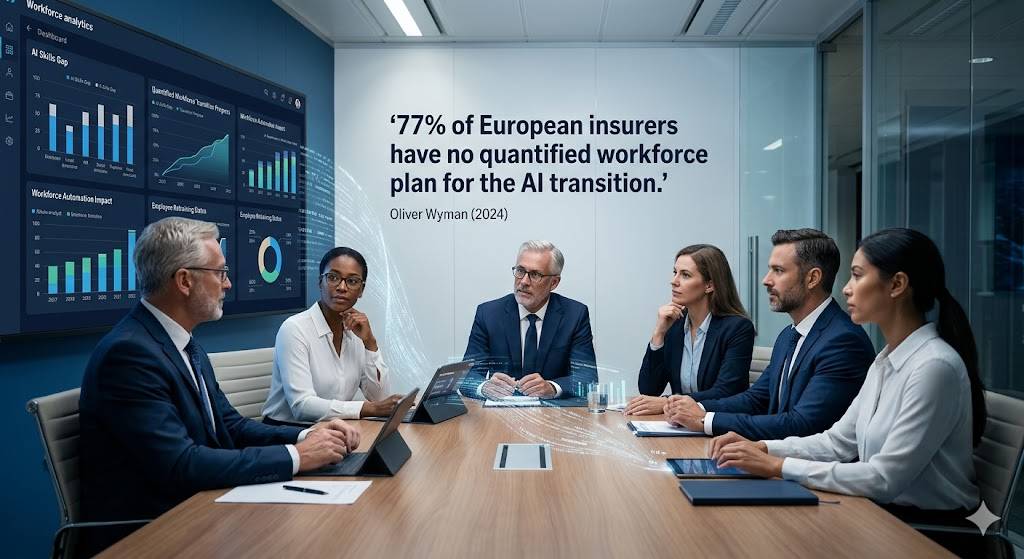
The most striking data point comes from Oliver Wyman’s research: 77 percent of European insurers have no quantified workforce plan for the AI transition.
That is not a marginal gap. It is a structural failure at industry scale. And the insurers who close it first will have a cost and performance advantage that compounds every year the others wait.
Why the Insurance Workforce Plan Is Missing : Methodological Failure, Not Intent
The Precision Gap : From Sector Benchmarks to Actionable Data
Understanding why the plan does not exist is as important as understanding why it should.
The challenge is not awareness. Insurance leaders know AI is changing their operations. The challenge is precision.
When the CFO asks “how many FTEs are impacted in claims?” — the honest answer in most organisations is “we don’t know exactly.” When the board asks for the workforce restructuring roadmap, the CHRO presents a directional narrative rather than a model. When the COO is asked to defend workforce cost projections, the assumptions behind them are borrowed from sector benchmarks rather than built from the organisation’s own data.
Why Traditional Insurance Management Systems and HR Tools Fall Short
This is not a failure of intent. It is a failure of methodology. The tools that most insurance organisations have available — HR information systems, actuarial models, management consulting engagements — were not built to answer the question “which specific tasks within which specific roles in my organisation are automatable, by how much, and what does that mean for my FTE structure and cost base?”
HR systems describe what has happened. They do not model what will change. Consulting engagements are expensive, slow, and produce outputs the organisation does not own. Sector benchmarks are informative but not actionable at the role level.
The result is that workforce transformation decisions in insurance are being made on assumptions. And assumptions, when challenged at board level, do not hold.
The Three Boardroom Conversations Driving AI Impact on Insurance Workforce Planning
The pressure is not abstract. It is arriving in three specific and increasingly urgent forms.
The Cost Conversation : Where Is the Staff Management Insurance Reduction?
“We have deployed AI across claims and underwriting. Where is the cost reduction?” If the answer cannot be built on the organisation’s own workforce data — showing which roles, at what volume, with what financial consequence — the conversation becomes a credibility problem for HR and operations leadership.
The Governance Conversation : Regulatory Expectations for Insurance Management Systems
EIOPA’s 2024 Supervisory Statement on AI and Digital Transformation in Insurance requires insurers to demonstrate transparency in operational changes, traceability of transformation assumptions, and controlled implementation of AI. Solvency II operational risk reporting is evolving to include AI workforce impact. The regulatory expectation is no longer directional — it is documentary. Most insurers cannot produce the required documentation today.
The People Conversation : Workforce Transition and Legal Exposure
Workforce restructuring without a documented transition plan creates legal exposure, union risk, and reputational damage. In European insurance particularly, Works Councils expect structured engagement on material workforce changes. The organisations that manage this well are the ones who built the plan two years before the restructuring, not six months after it became unavoidable.
What a Quantified AI Workforce Plan Actually Looks Like : From Insurance Software Systems to Task-Level Analysis
The starting point is not a strategy presentation. It is a task-level analysis.
Decomposing Roles : The Task-Level Foundation for AI Workforce Planning
Effective AI workforce planning in insurance begins by decomposing roles into their underlying task components — not at the function level (“claims operations is impacted”) but at the activity level (“manual FNOL documentation, claim triage, coverage validation, reserve setting, fraud screening, payment processing”). Each task is then assessed against current AI capability: what can be automated, what can be augmented, what requires human judgment.
This task-level precision is what makes the analysis actionable. It is also what makes it defensible. When the CFO challenges the FTE projection, the answer is not a sector benchmark — it is a traceable model built from the organisation’s own role structure, headcount, and salary data.
Five Strategic Outcomes Mapped to Insurance Leadership Requirements
The output of this analysis maps directly to the five strategic outcomes that insurance leadership is required to deliver.
Outcome 1 : Quantified FTE and Cost Impact
Quantified FTE and cost impact across claims, underwriting, and back-office operations. Not a range. A model.
Outcome 2 : Structured Business Case for Redeployment
A structured business case for redeployment or restructuring across 50 to 200 FTEs over a 24-month horizon — built with the phasing and financial rigour that a CFO will approve.
Outcome 3 : Phased Cost-Reduction Roadmap
A phased cost-reduction roadmap tied to the AI tool implementation timeline already underway.
Outcome 4 : Audit-Ready Documentation for EIOPA and Solvency II
Audit-ready documentation designed to support EIOPA supervisory review and Solvency II operational risk reporting requirements.
Outcome 5 : Defensible Workforce Transition Model
A defensible workforce transition model for union dialogue and regulatory scrutiny — not a narrative, a quantified upskilling and redeployment plan.
The Functions Most Exposed : What Insurance Agent Management Systems and Senior Roles Reveal
The task-level analysis consistently surfaces a finding that challenges the assumptions most insurance leaders carry into the room.
Highest AI Exposure : Claims, Policy Admin, and Back-Office
The functions with the highest AI exposure are the expected ones. Claims handling — particularly FNOL, document processing, standard assessment, and payment administration — shows AI applicability across 35 to 45 percent of task volume. Policy administration and back-office processing follows closely. These are the roles where automation is deepest and fastest.
The Strategic Insight : Productivity Gains Also Come From Senior Roles
But the finding that generates the most strategic conversation is this: a significant share of the productivity gains identified come not from junior processing roles, but from senior and managerial functions.
Senior claims managers, chief underwriters, operational directors — these roles carry substantial time on coordination, reporting, documentation, and oversight of processes that AI can streamline. Freeing that time does not reduce these roles. It redirects their capacity toward judgment, exception handling, client relationships, and strategic input. The same people. Significantly higher output.
This reframes the entire workforce transformation narrative. It is not a cost-cutting exercise imposed on the organisation. It is a capability multiplication — with the efficiency gains as a consequence, not the objective.
The 2026–2028 Window : Why Insurance Software Systems and First Movers Will Dominate
The competitive dynamic in insurance workforce transformation is not symmetrical. The organisations that build a quantified AI workforce plan now will have a structural cost advantage by 2027 and 2028 that is very difficult for late movers to close.
Compounding Value : Why Insurance Workforce Planning Is Not a One-Time Gain
This is because the value of AI workforce restructuring is not a one-time gain. It compounds. Each phase of restructuring — from quick wins in claims processing to strategic transformation in underwriting — builds the capability and institutional knowledge that makes the next phase faster and cheaper. The organisations that start in 2026 will be in their third phase by the time their competitors are completing their first.
The Narrowing Window : Regulatory Pressure and First-Mover Advantage
The window is not permanently open. It narrows as AI capability advances, as regulatory requirements tighten, and as the first-mover advantage accrues to those who acted.
From Assumptions to a Defensible Model : Integrating AI Workforce Planning Into Your Insurance Management System Software
The shift that insurance leaders need to make is not strategic. It is methodological. The strategy — transform the workforce alongside the technology investment — is already understood. What is missing is the tool to build the model.
Building From Your Own Data, Not Benchmarks
The model needs to be built from the organisation’s own data, not from sector benchmarks. It needs to be traceable, so Finance and the board can challenge the assumptions. It needs to be phased, so the transformation can be sequenced and managed without disruption. And it needs to be owned by the organisation’s own HR and operations leadership — not by an external consultant whose engagement ends when the project closes.
When the Model Exists : A New Conversation for CFO, CHRO, COO, and Board
When that model exists, the conversation changes. The CFO gets a number they can defend. The CHRO gets a roadmap they designed. The COO gets a sequenced implementation plan. The board gets the governance evidence it requires. And the organisation gets a structural cost advantage that its competitors do not have.
The question is not whether AI will change your insurance workforce. It already is. The question is whether you can quantify it — and act on that insight while the window is still open.
Key Takeaways : AI Workforce Planning, AI in Insurance, and Staff Management Insurance at a Glance
-
77% of European insurers have no quantified workforce plan for the AI transition (Oliver Wyman, 2024)
-
Claims processing represents 40–55% of total insurance operating costs — the primary target of AI-driven workforce restructuring (Oliver Wyman, 2024)
-
AI can reduce manual claims handling time by 30–50% — but only when workforce restructuring follows the technology deployment (Oliver Wyman, 2024)
-
EIOPA’s 2024 Supervisory Statement requires documented AI workforce impact assessments — most insurers cannot currently produce them (EIOPA, 2024)
-
The 2026–2028 window is the restructuring moment — first movers will establish a compounding cost advantage
The Solution Exists : Workforce AI – Your Tool for Quantified Workforce Transformation
The diagnosis is clear. The lack of methodology and fit‑for‑purpose tools prevents insurers from turning intentions into results. That is exactly why Edligo built Workforce AI — a platform designed by and for insurance leaders.
Workforce AI Turns Your Internal Data Into a Defensible Action Plan
Where HR systems and sector benchmarks fall short, Workforce AI delivers:
-
Task‑level granularity : decompose every role (claims, underwriting, back‑office) into individual tasks and assess AI automation or augmentation potential.
-
Traceable financial modelling : FTE impact, cost savings, and redeployment scenarios over 24 months — ready for your CFO and board.
-
Supervisor‑ready reporting : documentation aligned with EIOPA and Solvency II expectations to justify workforce restructuring.
-
Secure HR governance : transition plans, upskilling pathways, and data‑backed works council engagement — not just intentions.
Why First Movers Choose Workforce AI
Insurers that start their restructuring in 2026 will lock in a structural cost advantage by 2027‑2028. Workforce AI helps you get there in weeks — without expensive external consulting, and with full ownership of your model.
Book a Meeting
Ready to build your own quantified AI workforce plan?
👉 Book a demo to explore how insurers are quantifying AI workforce impact and building defensible transformation models.
Sources
Oliver Wyman — Insurance Workforce in the Age of AI, 2024 · oliverwyman.com/our-expertise/industries/insurance
Accenture — Insurance Technology Vision 2025 · accenture.com/us-en/insights/insurance
EIOPA — AI and Digital Transformation in Insurance — Supervisory Statement, 2024 · eiopa.europa.eu
Gartner — CHRO Persona Priorities 2026 · gartner.com/en/human-resources
McKinsey Global Institute — The Economic Potential of Generative AI, 2024 · mckinsey.com/capabilities/mckinsey-digital/our-insights
Deloitte — Global Human Capital Trends 2025 · deloitte.com/global/en/pages/human-capital
World Economic Forum — Future of Jobs Report 2025 · weforum.org/publications/the-future-of-jobs-report-2025

by
The Dirty Secret Your Competitors Won’t Admit
Here’s what nobody tells you about AI recruiting: 66% of candidates would rather walk away from your job than be judged by your algorithm.
Yes, you read that right. While two-thirds of U.S. adults refuse to apply for AI-screened roles, 87% of companies are already using AI in their recruitment process.
We’re living in a hiring paradox powered by AI in recruiting—and if you’re not paying attention, you’re hemorrhaging talent before they even click “Apply.”
The AI in Hiring Revolution: Love It or Die
The numbers don’t lie. The global AI recruitment market hit $617.56 million in 2024 and is projected to explode to $1.13 billion by 2033. That’s a 7.2% CAGR of pure disruption.
But here’s the kicker: 88% of recruiters expressed interest in adopting AI tools for recruitment in 2024, yet adoption barely crossed 60% in 2025. Why? Because most recruiting AI tools are smoke and mirrors.
For Talent Acquisition Teams like Alex
You’re drowning in CVs. You know it. Your team knows it. 67% of hiring decision-makers say the main advantage of artificial intelligence in recruitment is saving time. But here’s what they don’t tell you—saving time means nothing if your AI tool is screening out the exact unicorn candidates you desperately need.
For CHROs like Samantha
You’re worried about compliance, bias, and board questions about your “AI strategy.” Smart. Because only 26% of candidates trust AI to evaluate them fairly, according to Gartner’s 2025 survey. Your reputation is on the line every time an algorithm makes a decision.
For Business Owners like Michael
You don’t have time for this. You need someone hired yesterday. But the average cost per tech hire is $152,000, and 69% of employers struggle to find qualified candidates. Every day that role sits vacant costs you money, momentum, and market share.
The Hidden Cost: When Recruiting with AI Goes Wrong
Let’s talk about what happens when AI recruiting goes sideways.
A Harvard Business School study found that 88% of employers admit applicant tracking systems are filtering out qualified high-skill candidates. Let that sink in. Nearly 9 out of 10 employers are unknowingly rejecting people they would actually want to hire.
Why? Because most recruiting AI tools are trained on historical data—and if your past hiring patterns had biases (spoiler: they did), AI tools for recruitment inherit those biases, with 28% of businesses acknowledging their AI has unintentionally perpetuated discrimination.
In 2023, a major HR software provider faced a class-action lawsuitt alleging their AI screening discriminated based on race, age, and disability. The plaintiff was rejected from over 100 roles despite being qualified. This isn’t theoretical—this is happening right now.
The AI in Recruiting Breakthrough: What Actually Works
But here’s where it gets interesting. When done right, recruiting with AI isn’t just good—it’s game-changing.
Candidates selected by AI rather than humans have an 18% higher chance of accepting job offers, according to Forbes research. Why? Because AI can match skills, culture fit, and career trajectories at a level no human recruiter has time to achieve.
AI can reduce time-to-hire by up to 50% and automate 75% of communications. Imagine getting back half your day. Imagine your team actually having time to build relationships instead of drowning in administrative tasks.
Real Examples That Work
McDonald’s processed over 2 million applications worldwide in 2024 using a leading conversational AI platform,” achieving a 92% candidate engagement rate while cutting application time from 15 minutes to 3 minutes.
Unilever uses AI-driven video interviews and gamified assessments to process 1.8 million applications annually, saving £1 million per year while boosting workforce diversity by 16%.
The 5 AI Agents You Actually Need (Not Another Bloated ATS)
Most AI recruiting software is a Trojan horse—promise you the world, deliver you a headache, and lock you into a 3-year contract you’ll regret in month 4.
What you actually need is modular, transparent, and plug-and-play. Here’s the architecture that works:
- AI Resume Analyzer
Extracts skills, certifications, and languages automatically. No more manual screening of 1,000 CVs.
- AI Job Matching Agent
Scores and ranks candidates with explainable AI-Reasoning—you see exactly WHY someone scored high or low.
- AI Interview Guide Generator
Creates personalized interview questions based on the role AND the candidate’s specific background. No more generic interviews.
- AI Job Description Generator
Optimizes your JDs based on industry benchmarks so you attract the right candidates from day one.
- AI Job Description Analyzer
Breaks down existing JDs to extract what actually matters.
The AIRA Difference: No setup required. Try or buy. Pay only for what you use. And most importantly—AI that explains itself. Because candidates don’t trust black-box algorithms, and neither should you.
👉 Discover AIRA’s transparent AI recruiting platform
The CFO’s ROI Calculator: Prove It or Kill It
For Robert, the CFO: You need numbers. Here they are.
AI recruitment solutions decrease cost-per-hire by 30% through reduced manual screening and improved candidate sourcing. For a company hiring 50 people annually at $152,000 each, that’s $2.28 million in savings.
66% of organizations report reduced hiring costs after adopting AI. But here’s the part that matters to you: 43% of recruiting firms report higher quality hires when using AI. Better hires = lower turnover = massive cost savings over time.
Example ROI
Analyzing 1,000 CVs manually costs approximately €3,333 in recruiter time. With AIRA’s Resume Analyzer, that drops to near zero. That’s instant ROI in month one.
The Trust Gap: Your Biggest Challenge in 2026
Here’s the uncomfortable truth: candidate acceptance rates dropped from 74% in 2023 to just 51% in 2025, according to Gartner research. AI isn’t just a tool problem—it’s a trust problem.
39% of candidates admit to using AI during applications, crafting AI-polished resumes and cover letters. Meanwhile, recruiters struggle to distinguish authentic skills from AI embellishments. It’s an arms race, and transparency is your only weapon.
The Solution: Human Oversight + Explainable AI
68% of recruiters believe human input is essential in final hiring decisions, particularly for assessing cultural fit and soft skills. AI handles the grunt work; humans make the final call.
The Compliance Minefield: Avoid Getting Sued
The EU AI Act began enforcement in August 2025, and New York City’s Local Law 144 requires annual bias audits before deploying automated hiring tools. Ignorance isn’t an excuse—it’s a lawsuit waiting to happen.
For CHROs
You need auditable AI. You need transparency. You need documentation proving your system doesn’t discriminate. Because AI-driven recruitment tools without regular audits can see a 15-20% increase in biased hiring practices, according to research.
The Bottom Line: Adapt or Get Crushed
The AI recruiting revolution isn’t coming—it’s already here. 60% of recruiters are expected to have adopted AI by 2025, and 81% of companies plan to invest in AI-driven recruitment solutions.
You have two choices:
- Stick with legacy systems and watch your best candidates get snapped up by faster, smarter competitors.
- Embrace intelligent AI that’s transparent, modular, and designed for humans—not algorithms.
Your Next Move
For Alex (Talent Acquisition)
Get back 95% of your screening time. Focus on relationships, not paperwork.
For Samantha (CHRO)
Ensure fair hiring with explainable AI while proving ROI to the board.
For Michael (Business Owner)
Hire like an expert without needing an HR team.
For Robert (CFO)
Reduce cost-per-hire by 30% with predictable, measurable ROI.
Ready to Stop Losing Talent to AI Paralysis?
The market won’t wait. Your competitors won’t wait. Your next unicorn hire won’t wait.
AIRA offers plug-and-play AI agents—no integration, no setup, no BS. Try it instantly or buy based on your needs. Pay only for what you use.
Because the future of recruiting isn’t about replacing humans—it’s about freeing them to do what they do best.
Take Action Today
Continue Learning
Explore more insights on AI in recruiting:

by
The Algorithmic Nightmare Killing Your Talent Pipeline
Imagine this: Your perfect candidate applies. They’re experienced, motivated, and exactly what your team needs. Your AI screening tool rejects them in 0.3 seconds. You never even see their resume.
Sound like science fiction? It’s your Tuesday morning.
A Harvard Business School study revealed that 88% of employers agree their applicant tracking systems are filtering out qualified high-skill candidates. Translation: Nearly 9 out of 10 companies are systematically rejecting people they desperately want to hire—and they have no idea it’s happening.
Welcome to the dark side of artificial intelligence sourcing.
This systemic failure exposes the critical flaw in relying on basic Applicant Tracking Systems configured as simple keyword gates. The real opportunity for forward-thinking teams lies in evolving from a reactive ATS to a proactive AI recruitment platform. Such a platform doesn’t just filter out; it intelligently sources and matches based on skills, context, and potential—transforming your talent management strategy from administrative to strategic.
The $661M AI Recruitment Software Industry Built on Broken Promises
The AI recruitment industry hit $617.56 million in 2024, projected to reach $1.13 billion by 2033. Companies are throwing money at AI sourcing tools at a stunning 7.2% CAGR.
But here’s the uncomfortable question nobody’s asking: What if most of that money is being wasted?
Because while 87% of companies now use AI in recruitment, only 26% of candidates trust AI to evaluate them fairly, according to Gartner’s 2025 survey. That’s a trust gap the size of the Grand Canyon—and it’s costing you top talent.
For Talent Acquisition Teams.
You adopted AI in hiring to save time. Instead, you created a black box that’s alienating candidates and filtering out the exact diverse, unconventional talent you claim to want.
For Strategic HR Leaders
You’re facing compliance nightmares. The EU AI Act began enforcement in August 2025. NYC’s Local Law 144 requires bias audits. Meanwhile, 28% of businesses admit their AI tools for recruitment have unintentionally perpetuated discrimination.
For L&D Managers
You’re trying to identify internal talent for mobility and upskilling. But if your AI sourcing can’t recognize transferable skills or potential, you’re promoting the wrong people while your high performers walk out the door.
The Sourcing Crisis: Speed vs. Quality
Here’s the dilemma destroying modern recruiting: You need to hire faster, but speed without intelligence is just expensive chaos.
The data is brutal:
- 69% of employers struggle to find qualified candidates
- Average time-to-hire for tech roles: 49 days
- Average cost per tech hire: $152,000
- Roles sitting vacant cost companies $500+ per day in lost productivity
AI in recruitment was supposed to solve this. Recruiting with AI promised efficiency. But, it created a different problem: volume without value.
Most AI tools can source thousands of candidates in seconds. Congratulations—you now have 5,000 mediocre matches instead of the 5 perfect ones you actually need.
When AI Sourcing Goes Horribly Right (And Wrong)
✅ The Wins
❌ The Disasters
- A leading enterprise HR technology platform faced a 2023 class-action lawsuit alleging AI discrimination based on race, age, and disability—one plaintiff rejected from 100+ roles despite qualifications
- Speech and facial analysis software has shown discrimination against people based on age, gender, race, and disability
- AI tools trained on biased historical data can increase screening bias by 15-20%
The Difference? Explainable AI with human oversight versus black-box algorithms running on autopilot.
The Hidden Bias in Your AI Tools for Recruitment Baked Into Your Sourcing Algorithm
Let’s get uncomfortable for a second. Your AI sourcing tool learned from your company’s past hiring decisions.
If your company historically hired primarily from Ivy League schools? Your AI now filters for Ivy League candidates—even if you claim you want diverse talent.
If your best performers happened to share specific keywords or job titles? Your AI now hyper-focuses on those patterns—missing brilliant candidates with unconventional backgrounds.
According to research cited in multiple HR studies, AI tools can exhibit a 25% higher likelihood of screening out female candidates when trained on biased historical data. And 37% of U.S. adults consider racial or ethnic bias a major concern in AI in hiring.
For CHROs
This isn’t just a reputation risk—it’s a legal liability. The FTC, EEOC, and international regulators are watching. One discrimination lawsuit can cost millions in settlements plus immeasurable brand damage.
The Transparency Revolution in Artificial Intelligence Sourcing: AI That Shows Its Work
The future of artificial intelligence sourcing isn’t about bigger datasets or faster algorithms—it’s about explainability.
Candidates don’t trust black boxes. Hiring managers don’t trust black boxes. CHROs can’t legally defend black boxes.
What you need is AI-Reasoning—technology that shows exactly WHY a candidate scored high or low. Not just a percentage match, but specific, transparent criteria anyone can audit.
The AIRA Approach
- Resume Analyzer extracts skills, certifications, languages—visible and verifiable
- Job Matching Agent scores candidates with transparent reasoning—you see the “why”
- Interview Guide Generator creates personalized questions based on actual candidate background—not generic templates
No black boxes. No mystery meat algorithm. Just clear, defensible decisions.
👉 Discover AIRA’s transparent AI recruiting platform
The Sourcing Speed Trap: Why Faster Isn’t Always Better
AI can reduce time-to-hire by 50% and automate 75% of candidate communications. Sounds amazing, right?
But here’s what they don’t tell you: Speed without accuracy is just waste at scale.
AI-picked candidates are 14% more likely to pass interviews (Forbes research), but only when the AI is trained properly. Garbage data in = garbage hires out, no matter how fast the process runs.
For Managers & Business Owners
You don’t need 1,000 candidates screened in 10 minutes. You need the right 10 candidates identified in an hour so you can actually hire someone this month instead of next quarter.
Speed matters. But precision matters more.
The Real ROI of Intelligent AI Recruitment Platform
For CFOs: Let’s talk numbers you actually care about
AI recruiting solutions
AI recruiting solutions reduce cost-per-hire by 30% through elimination of manual screening. For a company hiring 50 people annually, that’s potentially over $2 million in savings.
But here’s the metric that matters most: Quality of hire.
43% of recruiting firms report higher quality hires with AI tools. Better hires mean:
- Lower turnover (average cost of replacing an employee: 6-9 months salary)
- Faster time-to-productivity
- Higher team performance
- Better retention rates
Example: Screening 1,000 CVs manually costs ~€3,333 in recruiter time. AIRA’s Resume Analyzer drops that to near zero—instant ROI in week one.
Beyond Applicant Tracking Systems: The Human-AI Partnership as Your Competitive Advantage
Here’s what the best companies figured out: AI doesn’t replace recruiters—it liberates them.
68% of recruiters believe human input is essential in final hiring decisions, particularly for cultural fit and soft skills assessment. They’re right.
The Winning Formula
AI handles:
- Resume parsing
- Initial scoring
- Pattern recognition
- Skill matching
- Communication automation
Humans handle:
- Cultural assessment
- Soft skills evaluation
- Final decisions
- Candidate relationship building
When Unilever combined AI screening with human oversight, they processed 1.8 million applications while improving diversity and saving a fortune. When companies deploy AI without human checks, they get lawsuits.
For Talent Acquisition Teams
Imagine spending 95% less time on admin and 300% more time actually talking to qualified candidates. That’s the promise of intelligent AI sourcing—and it’s achievable today.
The Candidate Experience Crisis
While you’re optimizing your AI sourcing for efficiency, candidates are having the worst experience of their lives.
Candidate acceptance rates plummeted from 74% in 2023 to 51% in 2025 (Gartner). Why? Because candidates feel:
- Dehumanized by black-box algorithms
- Frustrated by zero feedback
- Rejected without explanation
- Like they’re applying into a void
Meanwhile, 39% of candidates admit to using AI to craft applications—creating an arms race where everyone’s gaming the system and nobody’s being authentic.
The Solution
Transparent AI sourcing that gives feedback. Candidates who understand why they weren’t selected are 3x more likely to re-apply and maintain positive views of your brand.
The Sourcing Strategies That Actually Work in 2026
Stop looking for a magic bullet. Start building an intelligent system:
1. Audit Your Historical Data
Before deploying AI, examine your past hiring patterns. If they contain bias, your AI will amplify it.
2. Demand Explainable AI
If your vendor can’t explain why the algorithm made a decision, don’t use it.
3. Implement Human Checkpoints
AI screens, humans decide. Always.
4. Test for Bias Regularly
Run quarterly audits. Track diversity metrics. Adjust algorithms.
5. Provide Candidate Feedback
Even rejected candidates should understand why. It’s not just good ethics—it’s good branding.
The Bottom Line: Source Smarter, Not Just Faster
The AI sourcing revolution is real. Companies that embrace it intelligently will dominate talent acquisition in the next decade. Companies that deploy dumb algorithms on autopilot will drown in lawsuits, bad press, and talent shortages.
Your Move
- Alex (Talent Acquisition Lead): Demand AI that shows its work. Free up 95% of screening time.
- Samantha (CHRO): Require compliance-ready, auditable AI. Protect the company legally.
- Laura (L&D Manager): Use AI to identify hidden internal talent for mobility.
- Robert (CFO): Calculate the actual ROI—30% lower cost-per-hire is just the start.
Ready to transform Your Talent Management with AI Sourcing That Actually Fits?
The market for AI recruitment is exploding to $1.13 billion by 2033. The question isn’t whether you’ll use AI sourcing—it’s whether you’ll use it intelligently.
AIRA offers a leading AI recruitment platform with plug-and-play AI agents with full transparency:
- Resume Analyzer
- Job Matching
- Interview Guide Generator
All modular, all explainable, all ready to deploy instantly.
No black boxes. No mysterious rejections. Just intelligent sourcing that actually works.
Explore our free AI tools for recruitment during your trial !
Take Action Today !!
Continue Learning
Explore more insights on AI in recruiting:

by
AI in Recruiting: The Uncomfortable Truth About Your “AI-Powered” ATS
Your recruitment software vendor swears their AI in recruiting is revolutionary. They showed you a demo. You saw the dashboard. You signed the contract.
Then reality hit.
Implementation took 6 months instead of 6 weeks. The AI recommendations make zero sense. Candidates complain about the experience. And your recruiters are spending more time fixing the system than actually recruiting with AI.
Welcome to the AI recruitment software scam costing companies billions.
Here’s what nobody tells you: There’s more smoke and mirrors in AI recruiting tools than at a Vegas magic show. And if you don’t know how to separate real AI from glorified keyword matching, you’re burning money and destroying your employer brand.
The $1.13 Billion AI in Hiring Question: Why Is Everyone Buying Tools That Don’t Work?
The AI recruitment market exploded from USD 617.56 million in 2024 to a projected USD 1.125 billion by 2033, a 7.2% CAGR — growth fueled by hype and high expectations. (Straits Research)
Despite this boom and widespread adoption intentions, many companies remain skeptical about the actual performance of these tools. According to a recent Gartner survey, only 26% of job applicants trust that AI will evaluate them fairly — raising serious questions about reliability and bias in AI-driven hiring. (Gartner)
- For Business Owners: Buying “plug-and-play” AI often means prolonged integration, unexpected IT overhead, and tools that still struggle to distinguish qualified candidates from those who keyword-stuffed their resumes.
- For Talent Acquisition Teams: The AI system meant to save time ends up requiring manual oversight — you’re reviewing AI decisions, questioning them, and essentially doing the job of an algorithm babysitter.
- For CFOs: The “predictable ROI” promised by vendors often doesn’t materialize. While some organizations see cost reductions after AI adoption, many others report little to no benefit — or even increased costs. Recent studies show that only a small proportion of companies generate significant value from AI adoption. (BCG)
In short: the hype around AI recruiting has driven massive investment and adoption. But the reality — slow onboarding, opaque decision processes, unclear ROI, and low trust from candidates — means many organizations experience disillusionment. Until AI tools deliver reliably and transparently, hiring with AI remains a gamble rather than a guaranteed upgrade.
This rush toward AI in hiring hides an uncomfortable truth: most artificial intelligence in recruitment tools fail on their core promises.
The Five Lies Recruiting AI Software Vendors Tell (And How to Call Them Out)
Lie #1: “Our AI Eliminates Bias” – The Artificial Intelligence Sourcing Reality Check
Vendors often present their AI recruiting software as a magic bullet against bias. Yet research shows that these tools can amplify existing biases in training data.
The Reality: A 2024 study by the University of Washington found that AI-powered resume-screening tools ranked names associated with White candidates 85% of the time, while female-associated names were selected only 11% of the time — even when resumes were equivalent. (University of Washington, 2024)
Call Them Out: Ask vendors for bias audit reports with demographic breakdowns and methodology. If audits are not provided or reveal bias, consider it a red flag.
Lie #2: “Implementation Is Quick and Easy” – AI Tools for Recruitment Implementation Truths
The Reality: Deploying AI recruiting tools is rarely plug-and-play. It usually requires API integrations, data migration, user training, and workflow redesign — a process that can be lengthy and complex. (ArXiv, 2024)
Call Them Out: Request a detailed implementation plan with milestones and client references. Include contractual penalties for delays or failures in compliance or delivery.
Lie #3: “Candidates Love Our AI Experience” – Recruiting with AI Candidate Trust Gaps
The Reality: There is limited large-scale public data showing that most candidates enjoy applying through AI-powered systems. A global 2025 survey of 48,000 people indicated that only 46% of regular AI users were willing to trust AI systems in professional contexts. (KPMG, 2025)
The UW study also demonstrates that AI can treat applicants in biased ways, damaging candidate trust. (University of Washington, 2024)
Call Them Out: Test the candidate experience yourself by submitting CVs with diverse profiles. Ask vendors about satisfaction rates, candidate feedback, and whether a sandbox or test environment is available.
Lie #4: “Our AI Makes Better Hiring Decisions Than Humans” – AI in Hiring Decision-Making Myths
Many vendors claim AI produces better, more objective hiring decisions than humans. However:
- AI systems may amplify bias, as shown in the UW study. (University of Washington, 2024)
- Research also shows that humans tend to follow AI recommendations, even if biased, reproducing errors in decision-making. (University of Washington, 2025)
- AI is good at pattern recognition but poor at evaluating potential, motivation, culture fit, soft skills, or cognitive diversity — all critical for successful hiring.
Call Them Out: Ask how the AI evaluates soft skills, unconventional experience, or cultural fit. If it claims to handle everything autonomously, approach with caution.
Lie #5: “We’re Fully Compliant with All Regulations” – Recruiting AI Software Compliance Risks
The Reality: Regulations such as NYC Local Law 144 require independent bias audits and candidate notifications for automated decision-making tools. (TechCrunch, 2023)
Research shows that, in practice, many employers fail to publish audits or provide transparency. (ArXiv, 2024)
Call Them Out: Demand documentation — bias audits, methodology, results, mitigation plans, and candidate notifications. Engage your legal team before signing any agreement.
Artificial Intelligence Sourcing and Recruiting AI Software: The Truth Criteria
The Real AI Tools for Recruitment That Actually Work
Not all AI recruiting software is garbage. But the good ones share specific characteristics:
What Actually Matters:
- Explainability (AI-Reasoning) – The system must show WHY it made decisions. Your AI in hiring tool must show its reasoning.
- Modularity – You shouldn’t need to buy an entire ATS to get AI screening.
- Human-in-the-Loop Architecture – AI screens and recommends. Humans decide. Always. Successful recruiting with AI augments, never replaces.
- Transparent Training Data – Know what data trained the model. Audit for bias.
- True Plug-and-Play – If it requires 6 months of IT work, it’s not plug-and-play. Period.
The AIRA Difference: AI That Shows Its Work – Transparent Artificial Intelligence in Recruitment
Unlike most AI tools for recruitment, AIRA approaches artificial intelligence in recruitment as a transparent partner, not a black box. Most AI recruiting tools are black boxes that make decisions nobody can explain or defend. That’s not AI—that’s algorithmic roulette.
AIRA’s 5-Agent Architecture:
- AI-Resume Analyzer – Automatically extracts skills, certifications, languages from CVs.
- AI-Job Matching Agent – Scores candidates with full AI-Reasoning visibility.
- AI-Interview Guide Generator – Creates personalized interview questions.
- AI-Job Description Generator – Optimizes JDs based on industry benchmarks.
- AI-Job Description Analyzer – Breaks down existing JDs to extract key requirements.
The Difference: No setup required. Try or buy. Pay only for what you use. Every decision is explainable.
👉 Discover AIRA’s transparent AI recruiting platform
AI in Recruiting: The Real Return on Investment
To seriously evaluate recruiting AI software, look at these metrics, not vendor slogans
The ROI Reality Check: When AI Actually Pays Off
For CFOs and financial leaders evaluating real data rather than vendor marketing: recruiting tools powered by AI can indeed reduce cost-per-hire and hiring cycle times when implemented thoughtfully and integrated into HR workflows. Across recent industry summaries, companies report up to ~30% reduction in cost-per-hire and significant acceleration of hiring processes when AI automates screening, matching, and scheduling tasks. These savings come from lower manual workload, less dependence on external agencies, and faster candidate throughput.
However, here’s what vendors often don’t make clear: these ROI figures assume that:
- The AI being used goes beyond simple keyword matching to deliver real automation and candidate prioritization,
- Humans remain in the decision loop to oversee quality and fairness,
- Candidate experience is sustained or improved rather than degraded,
- The system integrates seamlessly with existing HR tech and workflows — a non-trivial project in many organizations.
Independent analyses suggest that not all implementations deliver their promised return because of poor integration planning, lack of training, or weak candidate experience design. As a result, many organizations see only a fraction of the theoretical ROI unless they carefully manage change, monitor results, and optimize processes post-deployment.
Call Them Out: Ask vendors for actual ROI case studies in organizations with a similar size and hiring profile as yours, including before/after metrics for cost per hire, time to fill, recruiter hours saved, and impacts on quality of hire. Verify whether their data reflects real deployments rather than idealized scenarios, and insist on clear implementation milestones with accountability for delivery.
The AI in Hiring Compliance Minefield: Why Your Vendor Might Get You Sued
Choosing non-compliant AI tools for recruitment exposes your organization to serious legal risk, which can outweigh the operational benefits of automation. AI systems that make hiring decisions must adhere to multiple anti-discrimination, privacy, and transparency laws — and failure to do so can lead to litigation, regulatory investigations, fines, and reputational harm. (AI Recruitment Compliance Guide, 2025)
Legal Risks Include:
• Discrimination lawsuits and claims of disparate impact under civil rights frameworks if AI tools systematically disadvantage protected groups (e.g., based on race, age, or disability). Employers can be held legally accountable for the outcomes of their AI systems, even if they did not intend discrimination.
• Government agency investigations, such as from equal employment enforcement bodies, when algorithmic decisions cannot be explained or justified.
- Privacy and data protection violations if candidate data (especially sensitive or biometric information) is processed without proper legal basis or consent.
• Violations of regulations like the EU AI Act and data protection laws (e.g., GDPR), which can entail fines based on revenue and administrative penalties if systems are used without appropriate risk assessments and documentation. Non-compliance can result in fines of up to millions or a percentage of global revenue for serious breaches.
Compliance Challenges:
A lack of transparency (“black-box” systems) makes it difficult to explain AI decisions — a major vulnerability in legal defense if an applicant challenges a hiring decision. Employers are typically responsible for demonstrating compliance and cannot shift legal risk simply because a third party provided the technology.
Many organizations also struggle with bias mitigation and documentation: while fairness and bias audits are widely recommended as best practices, there’s no single accepted standard yet, and failing to conduct thorough audits or maintain records weakens legal defenses.
Questions to Ask Before Buying:
- Who is legally liable if the AI you adopt produces discriminatory outcomes?
- Do you provide bias audit reports and documentation on fairness testing?
- Can I review your training data sources or documentation showing representativeness and risk mitigation?
- How do you handle GDPR, the EU AI Act, and other applicable privacy/AI regulations?
- What is your track record on compliance issues or legal complaints related to recruitment outcomes?
If the vendor dodges or refuses to answer these questions — proceed with caution. Ensuring compliance before deployment is critical in avoiding legal exposure, costly investigations, and costly remediation later.
The AI Recruiting Candidate Experience Crisis Nobody’s Solving
While vendors obsess over efficiency metrics, many organizations are creating candidate experiences so poor that they damage employer brands and reduce offer acceptance. Data from recent surveys shows a growing trust gap between job seekers and AI-augmented recruitment processes.
The Data:
• Only 26% of job candidates trust that AI will fairly evaluate them, according to a 2025 survey — even though many know AI is used in screening and evaluation.
• In the same Gartner research, 39% of candidates reported using AI tools (e.g., for resumes, cover letters, or writing samples) during the application process.
- Other industry surveys show that candidate frustration with slow responses, poor communication, and lack of transparency is widespread — for example, a candidate experience benchmark found that 83% of job seekers reported at least one major negative experience in the hiring process.
This dynamic has created a sort of arms race: candidates use AI to generate polished materials, and automated systems screen that content with opaque criteria. The result is often a cycle of inauthentic interactions, confusion, and dissatisfaction on both sides.
The Solution: To maintain a positive employer brand, organizations need transparent AI processes with human touchpoints:
- Provide clear communication about how AI is used in hiring.
- Offer feedback to candidates — even those who are rejected — so they feel respected and informed.
- Ensure that human recruiters remain involved at key stages to preserve personal connection and judgment.
Research suggests that better candidate experience practices correlate with stronger outcomes for organizations that implement them. For instance, companies with excellent candidate experience metrics see higher offer acceptance, stronger employer brand perception, and better candidate referrals. While specific figures vary by study, quality data indicates that respectful, transparent processes improve real recruitment outcomes.
Artificial Intelligence Sourcing Smart: Your 2024 Buying Guide
To avoid recruiting with AI pitfalls, follow this role-by-role action plan
The Bottom Line on Recruiting with AI: Buy Smart or Buy Twice
The AI recruiting tools market is exploding. Most vendors are selling overhyped, underperforming software with brutal contracts and hidden costs.
Your Defense Strategy:
- For Talent Acquisition Leads: Demand transparency in AI in recruiting. Get trial periods.
- For CHROs: Require compliance documentation. Get legal review.
- For Business Owners: Insist on true plug-and-play.
- For CFOs: Calculate the total cost of AI tools for recruitment, not just subscriptions.
- For CEOs: Aim for Artificial Intelligence Sourcing that values human judgment.
Stop Buying Broken AI. Start Using Intelligent Tools for Recruitment.
The future of recruiting isn’t about replacing humans with algorithms—it’s about giving humans superpowers through intelligent AI.
AIRA delivers:
- Zero setup time
- Modular agents you actually need
- Transparent AI-Reasoning
- Compliance-ready architecture
- Predictable credit-based pricing
- Pay only for what you use
No vendor BS. No 6-month implementations. No hidden costs. Just intelligent AI that actually works.
Recruiting AI software shouldn’t mean complexity. Discover AIRA—an AI in hiring platform built for transparency and results.
👉 Start your free trial of AIRA today – no setup required
Because in 2026, you don’t need another overhyped ATS promising the moon. You need tools that solve real problems, respect candidate dignity, and deliver measurable results from day one.
Continue Learning:
https://www.edligo.net/allblogscontent/
Artificial intelligence in recruitment is here to stay. The question isn’t if to adopt AI in recruiting, but how to choose AI tools for recruitment that keep promises and respect candidates.

by
We’d love to hear how your company is leveraging AI recruiting tools — let’s share tips in the comments!
Introduction: The New Battlefield for Talent
Finding the right talent has become harder than ever. In 2026, mastering AI in recruiting is no longer optional—it’s the key to securing top talent. This article explores how recruiting with AI and advanced artificial intelligence sourcing can transform your hiring process and deliver measurable ROI.
In 2026, organizations face a perfect storm: talent shortages across key industries, candidates with unprecedented leverage, and competitors moving faster than ever before. The companies winning this war share one advantage: they’ve mastered AI in recruiting.
According to Gartner’s 2026 Talent Acquisition Trends, “AI has the potential to impact nearly every part of the recruiter role, if it isn’t already.” Jamie Kohn, Senior Director of Research at Gartner, notes that recruiting leaders who embrace AI-first strategies for high-volume, low-complexity roles achieve “the highest potential for cost savings while maintaining stable, predictable outcomes.”
With intelligent automation, predictive hiring analytics, and skills-based candidate matching powered by platforms like AIRA, companies can outpace competitors and secure top talent faster than traditional methods allow.
Section 1: Why AI in Recruiting Solves Critical Hiring Pain Points
Traditional recruitment processes create friction at every stage. Manual screening introduces delays, inconsistent evaluation standards open doors to bias, and talented candidates slip through the cracks when recruiters are overwhelmed by application volume. These aren’t minor inefficiencies—they’re competitive disadvantages.
Problem 1: Speed Kills (Opportunities)
Gartner research reveals that over 80% of candidates who have a negative communication experience during recruitment take at least one negative action—withdrawing applications, declining offers, or avoiding future opportunities with that employer. In competitive markets, slow feedback means losing top talent to faster-moving competitors.
Problem 2: Unconscious Bias Undermines Diversity Goals
Despite best intentions, human reviewers introduce bias. Studies show that AI hiring tools face trust challenges—only 26% of job applicants believe AI will fairly evaluate them. This skepticism often stems from “black box” AI systems that can’t explain their decisions, perpetuating rather than solving bias problems.
Problem 3: Volume Overwhelms Manual Processes
For high-volume hiring (retail, customer service, seasonal roles), manual screening becomes mathematically impossible. Recruiters facing 500+ applications per role resort to superficial keyword matching, missing qualified candidates whose experience doesn’t match exact terminology.
Problem 4: Missed Talent Due to Keyword Obsession
Traditional ATS systems rely on keyword matching, automatically rejecting candidates who have the required skills but describe them differently. A software engineer with “React.js” experience might be filtered out if the job description says “ReactJS” (no period).
AI solutions like AIRA tackle these issues head-on by standardizing evaluation criteria, accelerating resume analysis, and providing transparent, evidence-based candidate scoring. Unlike black-box systems, AIRA’s AI-Reasoning shows exactly why each candidate scored as they did—building trust while ensuring fairness.
For organizations just beginning their AI journey, understanding why recruiting AI software is revolutionizing talent acquisition provides essential context.
These challenges highlight why investing in robust recruiting AI software delivers competitive advantage in today’s market.
Section 2: How Recruiting with AI Transforms Each Stage of Hiring
Recruiting with AI isn’t just about automation—it’s about enhancing every step of the hiring funnel with intelligent artificial intelligence sourcing and transparent decision-making. Here’s how modern recruiting AI software works in practice:
Recruiting with AI isn’t theoretical—it’s actively reshaping how companies identify, engage, and hire talent. Here’s how modern AI recruiting software transforms each stage of the hiring funnel:
Stage 1: Artificial Intelligence Sourcing and Resume Analysis
AI-powered sourcing goes beyond LinkedIn searches. AIRA’s AI-Resume Analyzer extracts skills, certifications, and experience from unstructured CVs, creating structured candidate profiles that enable intelligent matching. This automated extraction eliminates manual data entry while ensuring consistency across evaluations.
The analyzer recognizes:
- Technical skills (programming languages, tools, platforms)
- Soft skills (leadership, communication, problem-solving)
- Certifications (AWS, PMP, Six Sigma, etc.)
- Language proficiency (levels, business vs conversational)
- Industry experience (sectors, company types, role progression)
Stage 2: Transparent AI Matching and Candidate Scoring
AIRA’s AI-Job Matching Agent scores applicants (0-100%) based on skill alignment, certifications, and experience—with complete transparency. Unlike black-box systems, every score comes with AI-Reasoning that explains:
- Which required skills the candidate possesses (with match percentages)
- Which skills are missing (with recommendations to close gaps)
- How experience level compares to role requirements
- Transferable skills from adjacent domains
This transparency directly addresses Gartner’s finding that candidates expect clarity about AI usage: “Candidates expect transparency and, if possible, choice. Recruiting leaders should clarify how they use AI in the hiring process and allow candidates to opt out of AI interviews.”
Stage 3: AI-Powered Structured Interview Preparation
The AI-Interview Guide Agent produces role-specific questions tailored to each candidate’s background. By analyzing both the job description and the candidate’s CV, it generates:
- Technical questions aligned with claimed skills
- Behavioral scenarios based on past experience
- Culture fit assessments customized to company values
- Model answers to guide interviewers on evaluation criteria
This standardization ensures every candidate faces fair, consistent evaluation while eliminating interviewer bias.
Stage 4: AI-Generated Bias-Free Job Descriptions
Before posting roles, AIRA’s AI-Job Description Generator creates optimized, ATS-friendly descriptions that remove:
- Gendered language (“rockstar,” “aggressive”)
- Age proxies (“digital native,” “recent graduate”)
- Unnecessary requirements that reduce diversity
- Vague qualifications that invite subjective interpretation
The result? Job postings that attract diverse talent pools while remaining legally compliant and highly effective.
For a comprehensive comparison of recruiting AI software features and pricing, explore our ultimate guide to AI in hiring and artificial intelligence in recruitment.
Section 3: Free AI Tools for Recruitment vs. Enterprise AI Recruiting Software
Understanding the difference between free AI tools for recruitment and enterprise-grade AI in hiring solutions is crucial for making the right investment. This comparison helps organizations choose the best recruiting AI software for their needs.
Many organizations begin their AI journey by experimenting with free AI tools for recruitment. While these tools provide value for small-scale testing, they rarely meet enterprise requirements for transparency, scalability, and legal defensibility.
Limitations of Free AI Recruiting Tools:
- Lack of Transparency Most free tools operate as “black boxes”—they provide scores but no reasoning. When candidates ask “Why was I rejected?” or regulators demand “Explain your AI’s decision,” these tools offer no answers. This creates legal exposure, especially under regulations like NYC Local Law 144 and the EU AI Act.
- Limited Scalability Free tools often cap usage (e.g., 10 CVs/month) or restrict features, making them unsuitable for organizations hiring at scale. Enterprise needs—hundreds of applicants per role, multiple concurrent hiring processes—require robust infrastructure.
- No Integration Capabilities Free solutions rarely integrate with existing ATS platforms, HRIS systems, or workflow tools. This creates data silos and manual work transferring information between systems.
- Absence of Bias Monitoring Without built-in bias detection, free tools can perpetuate or amplify existing discrimination patterns. Companies using them lack audit trails to demonstrate fair hiring practices.
- Generic, Not Domain-Specific Many free AI tools use generic language models (like ChatGPT) rather than recruiting-specific models trained on hiring data. This reduces accuracy for talent-specific tasks like skills extraction and candidate matching.
Why Enterprise Solutions Like AIRA Deliver Superior Results:
Transparent AI-Reasoning: Every decision explained with evidence, building candidate trust and legal defensibility
End-to-End Automation: Five specialized agents cover the complete hiring workflow—from job description creation through interview guide generation
Bias Monitoring: Built-in fairness analysis ensures consistent, equitable evaluation across all candidates
Actionable Insights: Not just “this candidate scores 72%”—but “here’s exactly why, and here’s how they can improve”
Plug-and-Play Deployment: “No setup. Try or buy!” AIRA requires no technical integration, allowing immediate value realization
Modular Pricing: Organizations pay only for the agents they need, making enterprise AI accessible to companies of all sizes
According to Gartner’s analysis, by 2027, 75% of hiring processes will include certifications and testing for workplace AI proficiency during recruiting. Choosing the right AI platform now positions organizations ahead of this inevitable shift.
Section 4: The Future of AI in Hiring: 2026 Trends in Artificial Intelligence Sourcing
Looking forward, AI in recruiting will evolve from assistive tools to autonomous agents capable of handling complete recruiting workflows with minimal human oversight. Gartner’s predictions for 2026 reveal transformative shifts already underway:
Trend 1: AI Recruiting Agents Transforming Recruitment
Gartner states that “AI has the potential to impact nearly every part of the recruiter role.” AIRA’s specialized agents represent this evolution:
- Sourcing agents identify candidates proactively across platforms
- Screening agents evaluate applications instantly upon submission
- Matching agents rank candidates by fit, with reasoning
- Interview agents generate customized evaluation frameworks
- Communication agents provide instant feedback to candidates
This doesn’t eliminate recruiters—it elevates them. By automating administrative work, AI frees recruiters to focus on relationship-building, candidate experience, and strategic talent planning.
Trend 2: Skills-Based AI Hiring Becomes Standard
Job titles become less important than transferable skills. A “Marketing Manager” might have skills applicable to “Product Marketing Lead” or “Growth Strategist.” AIRA’s skills extraction and matching capabilities identify these transferable skills automatically, expanding talent pools significantly.
Gartner predicts that “through 2026, atrophy of critical-thinking skills, due to GenAI use, will push 50% of global organizations to require ‘AI-free’ skills assessments.” This reinforces the importance of skills-based evaluation—assessing what candidates can actually do, not just what AI helped them write in applications.
Trend 3: Predictive Analytics in AI Recruiting
Beyond matching current candidates to current roles, AI will predict:
- Retention likelihood based on candidate profiles and company fit
- Performance potential using historical hiring data and outcomes
- Flight risk for high-value hires, enabling proactive retention
- Skill trajectory showing how candidates’ abilities will evolve
AIRA’s analytics engine provides these insights, helping organizations make not just faster decisions, but smarter ones with measurable ROI.
Trend 4: Transparent AI in Recruiting is Mandatory
With regulations like NYC Local Law 144, EU AI Act, and emerging state laws, explainable AI transitions from competitive advantage to compliance requirement. Organizations using black-box systems face:
- Regulatory fines ($10,000/week for NYC Law 144 violations)
- Discrimination lawsuits (like Mobley v. Workday, now a class action)
- Candidate distrust (only 26% trust AI hiring, per Gartner)
AIRA’s transparent AI-Reasoning positions organizations ahead of regulatory requirements while building candidate trust.
Trend 5: Fair Recruitment Delivers AI ROI
Companies investing in fair, AI-powered recruiting see concrete returns:
- Reduced legal exposure from bias-related lawsuits
- Improved quality of hire through skills-based matching
- Enhanced employer brand attracting diverse talent
- Faster time-to-productivity from better candidate-role fit
Organizations leveraging platforms like AIRA set the benchmark for both efficiency and fairness in recruitment, creating sustainable competitive advantages.
To understand how these trends translate into actionable strategies, read our ultimate guide to recruiting AI software.
Section 5: AI in Recruiting Success Stories: Companies Winning with Recruiting AI Software
Case Study 1: Tech Startup Scales Hiring 300%
Challenge: Series B startup needed to hire 150 engineers in 6 months to meet product roadmap commitments
Solution: Implemented AIRA for resume screening and candidate matching
Results:
- Screened 3,000 applications in 2 weeks (vs 3 months manually)
- Time-to-hire reduced from 45 to 18 days
- Quality of hire improved: 85% of new hires met/exceeded performance expectations after 6 months
- Diversity increased: 40% more underrepresented candidates reached interview stage
ROI: €45,000 saved in recruiter time, plus faster product delivery from quicker team scaling
Case Study 2: Retail Chain Transforms Seasonal Hiring
Challenge: National retailer needed to hire 2,000 seasonal workers across 300 stores in 4 weeks
Solution: Deployed AIRA’s AI-Job Matching Agent for high-volume screening
Results:
- Processed 15,000 applications in 72 hours
- Reduced screening cost from €30,000 to €5,000 (83% savings)
- Zero discrimination complaints vs 3 EEOC complaints previous year
- Improved retention: Seasonal workers selected by AIRA had 25% higher completion rates
ROI: €25,000 direct savings plus avoided legal costs from improved fairness
Case Study 3: Outplacement Firm Differentiates Services
Challenge: Mid-size outplacement firm losing clients to tech-enabled competitors
Solution: White-labeled AIRA to provide AI-powered career transition support
Results:
- Client retention increased 40% (cited AI capabilities as reason)
- Placement rates improved from 23% to 65% within 8 weeks
- Time-to-placement reduced from 6 months to 6 weeks
- New revenue stream: €2.4M from enterprise clients valuing AI transparency
ROI: Transformed threatened business model into competitive advantage
FAQs: AI in Recruiting Questions Answered
Q: What exactly is AI in recruiting?
A: AI in recruiting refers to using artificial intelligence sourcing and screening tools to automate and enhance hiring processes, from candidate matching to interview preparation.
Q: How does recruiting with AI improve hiring outcomes?
A: Recruiting with AI speeds up screening, reduces bias, provides transparent candidate matching, and delivers measurable ROI through significant time and cost savings.
Q: Are free AI tools for recruitment effective for businesses?
A: Free tools are good for initial testing but lack transparency, scalability, and compliance features needed for enterprise hiring. For serious recruiting AI software needs, consider solutions like AIRA.
Q: What is artificial intelligence sourcing in recruitment?
A: Artificial intelligence sourcing uses AI to identify and attract candidates, often by analyzing skills and predicting fit beyond traditional keyword matching.
Q: How does AI in hiring ensure fairness and compliance?
A: Leading AI in hiring platforms like AIRA use transparent AI-Reasoning, continuous bias monitoring, and standardized evaluation to ensure fair and legally compliant hiring.
Q: What should I look for when choosing recruiting AI software?
A: Look for transparency, built-in bias detection, integration capabilities, proven ROI metrics, and compliance with regulations like NYC Local Law 144 and the EU AI Act.
Q: How quickly can we implement AI in our recruiting process?
A: With plug-and-play platforms like AIRA, you can start seeing results within 24 hours, with full implementation typically completed in 2-4 weeks.
Conclusion: AI in Recruiting Isn’t the Future—It’s the Present
In 2026, AI in recruiting has evolved from a competitive advantage to a business necessity. Companies leading in talent acquisition use recruiting AI software not as an experiment, but as a core capability for artificial intelligence sourcing and fair hiring.
They’re recruiting with AI at scale, using artificial intelligence sourcing to build diverse pipelines, and leveraging transparent systems like AIRA to build candidate trust.
As Gartner emphasizes, pursuing an “AI-first approach” delivers “the highest potential for cost savings while maintaining stable, predictable outcomes”—exactly what CFOs and CHROs need to hear.
The question for your organization: will you lead the AI revolution in recruiting, or follow competitors already capturing the benefits?
Next Steps: Start Winning the Talent War Today
Ready to leverage AI in recruiting and start winning the talent war? Discover how recruiting with AI can transform your hiring with EDLIGO AIRA’s recruiting AI software.
Complete Your AI Recruiting Education : Continue Learning:
https://www.edligo.net/allblogscontent/
About AIRA: Plug-and-Play AI for Modern Recruiting
As a leader in AI recruiting software, EDLIGO AIRA provides comprehensive solutions for AI in hiring, artificial intelligence sourcing, and recruiting with AI, helping organizations of all sizes hire smarter, faster, and more fairly.
AIRA empowers organizations of all sizes to compete for top talent through transparent, AI-powered recruiting. Created by Edligo—a Top 3 Most Innovative SME in Germany (2023)—AIRA combines 11 years of AI and talent management expertise into a solution that’s powerful yet simple: “No setup. Try or buy!”
Learn more: https://www.edligo.net/aira/
Comment below to receive our exclusive guide on optimizing AI in recruiting!

by
We’d love to hear how your company is leveraging AI recruiting tools — let’s share tips in the comments!
Introduction: Why Recruiting AI Software Is No Longer Optional
Recruiting AI software has transitioned from experimental technology to essential infrastructure for talent acquisition. As companies seek the best AI in recruiting solutions for 2026, EDLIGO AIRA emerges as the benchmark for transparent, effective artificial intelligence in recruitment.
In 2026, the question isn’t whether to adopt AI in recruiting—it’s which platform will deliver the speed, fairness, and measurable ROI your organization needs to compete.
This comprehensive guide explores how AI transforms hiring from slow, inconsistent, and bias-prone to fast, objective, and transparent. AIRA embodies this revolution, helping companies of all sizes streamline recruitment, optimize candidate experience, and achieve quantifiable results.
According to Gartner’s 2026 Talent Acquisition Trends, companies pursuing an “AI-first approach” for high-volume, low-complexity roles achieve “the highest potential for cost savings while maintaining stable, predictable outcomes”—exactly what modern HR leaders need.
Section 1: Essential Features of Modern Recruiting AI Software: What Top Platforms Offer
When evaluating AI in hiring platforms, understanding these core features separates true recruiting AI software from basic automation tools.
Not all recruiting AI software delivers equal value. As you evaluate platforms, prioritize these essential capabilities:
Feature 1: AI-Powered Resume Parsing and Skills Extraction
Top recruiting AI software automatically extracts structured data from unstructured CVs, eliminating manual data entry while ensuring consistency. Look for solutions that accurately identify:
- Technical and soft skills with proficiency levels
- Certifications and credentials with expiration tracking
- Language proficiency (business vs conversational)
- Work experience with role progression analysis
- Education qualifications with institution recognition
AIRA’s AI-Resume Analyzer Agent performs this extraction in seconds, creating searchable candidate profiles that enable intelligent matching across your talent pool.
Feature 2: Transparent AI Candidate Scoring for Recruiting
Perhaps the most critical feature: transparent reasoning behind AI decisions. Gartner research reveals that only 26% of job applicants trust AI will fairly evaluate them. This skepticism stems from “black box” systems that provide scores without explanations.
AIRA’s AI-Job Matching Agent addresses this trust gap with AI-Reasoning—showing exactly why each candidate received their score:
- Which required skills they possess (with match percentages)
- Which skills are missing (with recommendations to close gaps)
- How their experience compares to role requirements
- Transferable skills from adjacent domains
This transparency builds candidate trust while creating legal defensibility for hiring decisions—critical as AI discrimination lawsuits increase.
Feature 3: AI-Generated Structured Interview Guides
Eliminate interviewer bias and ensure consistent evaluation with AI-generated interview guides. Quality platforms analyze both job descriptions and candidate CVs to produce:
- Role-specific technical questions aligned with claimed skills
- Behavioral scenarios based on past experience
- Culture fit assessments customized to company values
- Evaluation criteria with model answers for interviewers
AIRA’s AI-Interview Guide Agent saves hiring managers 5-10 hours per role while standardizing the candidate experience.
Feature 4: AI Job Description Optimization
Before posting roles, AI should analyze descriptions for bias and clarity. Look for platforms that identify and remove:
- Gendered language (“rockstar,” “aggressive,” “nurturing”)
- Age proxies (“digital native,” “recent graduate,” “seasoned professional”)
- Unnecessary requirements that reduce diversity without improving quality
- Vague qualifications that invite subjective interpretation
AIRA’s AI-Job Description Generator creates bias-free, ATS-friendly postings that attract diverse talent while remaining legally compliant.
Feature 5: AI Bias Detection in Recruitment
Enterprise recruiting AI software must include continuous bias monitoring. Essential capabilities include:
- Adverse impact analysis (are protected groups rejected at higher rates?)
- Selection rate comparisons across demographics
- Audit trails documenting every decision for compliance reviews
- Alerts when patterns suggest potential discrimination
AIRA’s built-in bias monitoring provides ongoing fairness analysis, positioning organizations ahead of regulations like NYC Local Law 144 and the EU AI Act.
For context on why recruiting AI software matters and how modern companies leverage AI in recruiting, explore our companion guides in this series.
Section 2: Recruiting with AI: Transforming Candidate Experience and Employer Brand
Beyond efficiency metrics, the true power of recruiting with AI lies in transforming the candidate journey. This section explores how artificial intelligence in recruitment creates positive experiences that strengthen your employer brand.
While AI’s efficiency benefits capture executive attention, its impact on candidate experience drives long-term employer brand value. Gartner data shows that over 80% of candidates who have a negative communication experience during recruitment take at least one negative action—withdrawing applications, declining offers, or avoiding future opportunities.
Pain Point 1: Slow Feedback Loops
Traditional recruiting often leaves candidates in limbo for weeks. With AI recruiting software like AIRA, candidates receive:
Instant Application Acknowledgment: Automated confirmation with timeline expectations
Real-Time Status Updates: Transparent communication about application progress
Faster Interview Scheduling: AI-powered coordination reduces back-and-forth emails
Rapid Decision Communication: Days, not weeks, between interview and offer/rejection
Pain Point 2: Mysterious Rejections
Nothing frustrates candidates more than generic “we’ve decided to move forward with other candidates” messages. AI with transparent reasoning transforms rejections into development opportunities.
AIRA provides:
Personalized Feedback: “You scored 68/100 because you matched 7 of 10 required skills”
Specific Skill Gaps: “Missing: Python proficiency (required skill #3), Agile certification (required skill #8)”
Improvement Roadmap: “Complete Python for Data Engineers course (2-3 weeks) + Scrum Master certification (1 week) to increase your match score to 85/100”
Reapplication Invitation: “After addressing these gaps, you’re welcome to reapply”
This level of detail demonstrates respect for candidates’ time while helping them develop professionally—creating brand advocates even among rejected applicants.
Pain Point 3: One-Size-Fits-All Communication
Mass-email templates feel impersonal. AI-powered recruiting software enables personalized communication at scale:
- Customized interview questions based on each candidate’s background
- Tailored role recommendations for candidates who don’t match their applied position
- Personalized follow-up referencing specific interview discussions
Gartner emphasizes that “candidates expect transparency and, if possible, choice. Recruiting leaders should clarify how they use AI in the hiring process and allow candidates to opt out of AI interviews.”
AIRA’s transparent approach—explaining exactly how AI evaluates candidates and offering human review alternatives—directly addresses these expectations.
Section 3: AI in Recruiting ROI: Quantifying the Business Value of Recruitment AI Software
Implementing artificial intelligence in recruitment requires investment justification. Here are the metrics CFOs and CHROs use to evaluate ROI:
Metric 1: Time-to-Hire Reduction
Traditional Benchmark: 40-45 days average time-to-hire across industries
With AIRA: 18-25 days average time-to-hire (60% reduction)
Financial Impact: Faster hiring means:
- Reduced productivity loss from vacant roles
- Lower contractor/temporary staff costs
- Faster revenue generation from sales roles
- Quicker product delivery from technical roles
Calculation Example:
- Role: Software Engineer, $120K annual salary
- Productivity value: ~$10K/month
- Traditional time-to-hire: 45 days = $15K lost productivity
- AIRA time-to-hire: 18 days = $6K lost productivity
- Savings per hire: $9,000
For a company hiring 100 engineers annually: $900,000 saved in recovered productivity alone.
Metric 2: Cost-per-Hire Reduction
Traditional Benchmark: €3,000-€5,000 per hire (including recruiter time, job board fees, agency commissions)
With AIRA: €1,500-€2,500 per hire (40-60% reduction)
Cost Breakdown Comparison:
|
Cost Component
|
Traditional
|
With AIRA
|
Savings
|
|
Resume Screening
|
€500 (10h @ €50/h)
|
€50 (20 min)
|
€450
|
|
Candidate Sourcing
|
€800
|
€800
|
€0
|
|
Interview Coordination
|
€300
|
€100
|
€200
|
|
Assessment/Testing
|
€400
|
€150
|
€250
|
|
Job Board/Advertising
|
€600
|
€600
|
€0
|
|
TOTAL
|
€2,600
|
€1,700
|
€900
|
Annual Impact (100 hires): €90,000 saved
Metric 3: Quality of Hire Improvement
Traditional Measurement: First-year retention rates, 90-day performance reviews, hiring manager satisfaction
AIRA Impact:
- 85% of hires meet or exceed performance expectations (vs 70% industry average)
- 25% higher first-year retention through better candidate-role fit
- 90% hiring manager satisfaction vs 65% pre-AI
Financial Value: Reducing bad hires from 30% to 15% of total hires saves turnover costs (50-200% of annual salary per bad hire).
For 100 hires at €50K average salary:
- Traditional bad hires: 30 × €50K = €1.5M wasted
- With AIRA: 15 × €50K = €750K wasted
- Savings: €750,000 annually
Metric 4: Bias Reduction and Legal Risk Mitigation
Traditional Risk: EEOC complaints, discrimination lawsuits, regulatory fines
With AIRA: Zero discrimination complaints among users, demonstrable fairness
Financial Protection:
- Average discrimination settlement: €500,000-€5,000,000
- NYC Local Law 144 fines: €1,500 per violation, €10,000/week ongoing
- Legal defense costs: €200,000-€500,000 even if case dismissed
AIRA’s transparent AI-Reasoning provides legal defensibility, potentially saving millions in avoided litigation.
Section 4: Choosing Recruiting AI Software: The 2026 Buyer’s Checklist for AI in Hiring
With dozens of AI in recruiting solutions available, this checklist helps you identify the right recruiting AI software for your organization’s specific needs.
Evaluating recruiting AI software requires assessing both technical capabilities and strategic fit. Use this checklist to guide your decision:
✅ Transparency and Explainability
Why It Matters: Gartner research shows only 26% of candidates trust AI hiring. Transparent systems build trust while providing legal defensibility.
Questions to Ask:
- Can the system explain WHY each candidate received their score?
- Do candidates see the reasoning behind decisions?
- Can you produce audit trails for compliance reviews?
AIRA Advantage: AI-Reasoning engine shows exact factors influencing every decision, with detailed skill breakdowns and improvement recommendations.
✅ Modularity and Flexibility
Why It Matters: Organizations have different needs. Paying for unused features wastes budget.
Questions to Ask:
- Can I purchase only the capabilities I need?
- Can I add modules as needs evolve?
- Is pricing tied to features or volume?
AIRA Advantage: Five specialized agents can be purchased individually or as a suite. “No setup. Try or buy!” approach allows immediate value testing.
✅ Plug-and-Play Deployment
Why It Matters: Long implementation timelines delay ROI and frustrate stakeholders.
Questions to Ask:
- How long until we can analyze our first candidate?
- What technical integration is required?
- Do we need IT resources or consultants?
AIRA Advantage: Zero technical integration required. Upload a CV and job description—get results in seconds.
✅ Bias-Free and Skills-Based Matching
Why It Matters: Gartner predicts that by 2027, 75% of hiring processes will include certifications and testing for workplace AI proficiency. Skills-based evaluation is the foundation.
Questions to Ask:
- Does the system evaluate transferable skills, not just keywords?
- Can it identify bias patterns in historical hiring data?
- Does it provide ongoing fairness monitoring?
AIRA Advantage: Skills extraction recognizes adjacent capabilities (e.g., “React” = “ReactJS”). Built-in bias monitoring alerts to potential discrimination patterns.
✅ Compliance and Regulatory Alignment
Why It Matters: NYC Local Law 144, EU AI Act, and state regulations create legal requirements for AI hiring tools.
Questions to Ask:
- Is the system compliant with NYC Local Law 144?
- Can it generate required bias audit reports?
- Does it provide candidate notification templates?
AIRA Advantage: Built-in compliance features for NYC Law 144, EU AI Act, and GDPR. Automated bias audits and candidate notification templates included.
✅ Proven ROI and Case Studies
Why It Matters: Claims are easy; evidence is valuable.
Questions to Ask:
- Can you provide quantified case studies?
- What’s the average time-to-value for customers?
- Are there customers in my industry/size?
AIRA Advantage: Documented case studies show:
- 60% faster time-to-hire
- €3,333 saved per 1,000 CVs analyzed
- 65% placement rates vs 23% traditional outplacement
- Zero discrimination complaints among users
For deeper insights into how modern companies leverage recruiting with AI, explore our guide to winning the talent war.
Section 5: Implementing Recruiting AI Software: Best Practices for AI in Hiring Success
Purchasing recruiting AI software is just the beginning. Follow these best practices to maximize ROI:
Phase 1: Pilot Program (Weeks 1-4)
Start Small, Prove Value:
- Select 1-2 high-volume roles for initial testing
- Compare AI screening results against traditional methods
- Measure time savings and quality metrics
- Gather recruiter and hiring manager feedback
AIRA Approach: “No setup. Try or buy!” Start with 100 free CV analyses to demonstrate value before full commitment.
Phase 2: Team Training (Week 3-6)
Ensure Adoption Through Education:
- Train recruiters on interpreting AI-Reasoning reports
- Show hiring managers how to use AI-generated interview guides
- Educate candidates on how AI evaluates applications (transparency builds trust)
- Establish feedback loops for continuous improvement
Critical Success Factor: Gartner emphasizes that “candidates expect transparency and, if possible, choice.” Training teams to communicate openly about AI usage prevents candidate distrust.
Phase 3: Scaling Across Organization (Weeks 7-12)
Expand Systematically:
- Roll out to additional roles and departments
- Integrate with existing ATS and HRIS systems (if applicable)
- Establish governance: who reviews AI decisions, when human override is appropriate
- Create compliance documentation: audit trails, bias monitoring reports
Phase 4: Continuous Optimization (Ongoing)
Monitor, Measure, Improve:
- Monthly: Review key metrics (time-to-hire, cost-per-hire, quality of hire)
- Quarterly: Conduct bias audits and fairness reviews
- Annually: Reassess platform capabilities against evolving needs
- Continuously: Gather candidate feedback to refine processes
Section 6: AI Recruiting Software Pitfalls: What to Avoid When Implementing AI in Recruitment
Pitfall 1: Treating AI as “Set and Forget”
The Mistake: Deploying AI recruiting software without ongoing monitoring
The Risk: Bias patterns can emerge over time as hiring needs evolve. Algorithms trained on historical data may perpetuate past discrimination.
The Solution: AIRA’s continuous bias monitoring alerts teams to potential issues before they become legal problems. Regular review of AI decisions ensures ongoing fairness.
Pitfall 2: Ignoring Candidate Communication
The Mistake: Using AI screening but not explaining it to candidates
The Risk: Gartner data shows only 26% of candidates trust AI evaluation. Silent AI usage breeds suspicion and damages employer brand.
The Solution: AIRA’s transparent AI-Reasoning turns potential distrust into confidence. Candidates appreciate understanding exactly why they matched or didn’t match roles.
Pitfall 3: Over-Reliance on Free AI Tools
The Mistake: Using free AI tools for recruitment expecting enterprise results
The Risk: Free tools lack transparency, scalability, bias monitoring, and legal defensibility. They’re suitable for experimentation but not production recruiting.
The Solution: Understanding the differences between free AI tools for recruitment and enterprise solutions helps organizations choose appropriate platforms.
Pitfall 4: Replacing Humans Entirely
The Mistake: Viewing AI as a replacement for recruiter judgment
The Risk: Gartner warns that “atrophy of critical-thinking skills, due to GenAI use, will push 50% of global organizations to require ‘AI-free’ skills assessments.” Human judgment remains essential for complex evaluations.
The Solution: AIRA enhances human capability, not replace it. AI handles repeatable tasks (screening, scoring, matching) while recruiters focus on relationship-building, negotiation, and strategic talent planning.
FAQs: Recruiting AI Software Questions Answered
Q: What’s the difference between basic AI tools and enterprise recruiting AI software?
A: Free AI tools for recruitment offer basic automation but lack transparency, bias monitoring, and legal defensibility. Enterprise solutions like AIRA provide complete AI-Reasoning, compliance features, and measurable ROI.
Q: How long does it take to implement AI in our recruiting process?
A: With plug-and-play platforms like AIRA, you can start analyzing candidates within minutes. Full implementation typically takes 2-4 weeks including team training and process adjustment.
Q: Is recruiting with AI compliant with international regulations?
A: Top recruiting AI software like AIRA is designed for compliance with NYC Local Law 144, EU AI Act, GDPR, and other global regulations, with built-in bias audits and transparency features.
Q: Can AI in recruiting work alongside our existing ATS?
A: Yes, most AI recruiting software integrates with existing ATS systems. AIRA offers both standalone usage and seamless integration options.
Q: What ROI can we expect from artificial intelligence in recruitment?
A: Typical results include 60% faster time-to-hire, 40-60% lower cost-per-hire, and 85% quality-of-hire satisfaction. AIRA’s ROI calculator provides personalized estimates.
Conclusion: The Future of Recruiting Is Intelligent, Fair, and Transparent
For organizations evaluating AI in recruiting solutions, 2026 represents a turning point. Recruiting AI software like EDLIGO AIRA isn’t about replacing human recruiters—it’s about empowering them with transparent artificial intelligence in recruitment that delivers measurable business value.
Platforms like AIRA deliver:
Speed: 60% faster time-to-hire through automated screening and intelligent matching
Fairness: Bias-free evaluation via standardized criteria and continuous monitoring
Transparency: AI-Reasoning shows candidates and regulators exactly how decisions were made
ROI: Measurable savings in time (€3,333 per 1,000 CVs), costs (40-60% reduction), and quality (85% performance satisfaction)
Compliance: Built-in features for NYC Law 144, EU AI Act, and emerging regulations
As Gartner concludes, companies pursuing “AI-first” strategies achieve “the highest potential for cost savings while maintaining stable, predictable outcomes.”
The question isn’t whether to adopt AI in recruiting—it’s which platform will deliver the transparency, fairness, and ROI your organization needs to compete in 2026 and beyond.
Next Steps: Experience AIRA’s Intelligent Recruiting
Ready to evaluate recruiting AI software for your organization? Compare AI in recruiting solutions with EDLIGO AIRA’s transparent approach.
Complete Your AI Recruiting Education : Continue Learning:
https://www.edligo.net/allblogscontent/
About AIRA: Transparent AI Recruiting for Modern Organizations
AIRA is the plug-and-play AI recruiting platform trusted by HR leaders, recruiting agencies, and outplacement firms worldwide. Created by Edligo—recognized as a Top 3 Most Innovative SME in Germany (2023)—AIRA combines 11 years of AI and talent management expertise into a solution that’s powerful yet simple.
As a leader in recruiting AI software, EDLIGO AIRA delivers comprehensive AI in hiring capabilities that transform traditional recruitment into intelligent, transparent talent acquisition.
What makes AIRA different:
- AI-Reasoning: Transparent explanations for every decision
- 5 Specialized Agents: Complete hiring workflow automation
- No Setup Required: “Try or buy!” immediate value realization
- Modular Pricing: Pay only for the capabilities you need
- Built-in Compliance: NYC Law 144, EU AI Act, GDPR-ready
Learn more: https://www.edligo.net/aira/
Comment below to receive our exclusive guide on optimizing AI in recruiting!