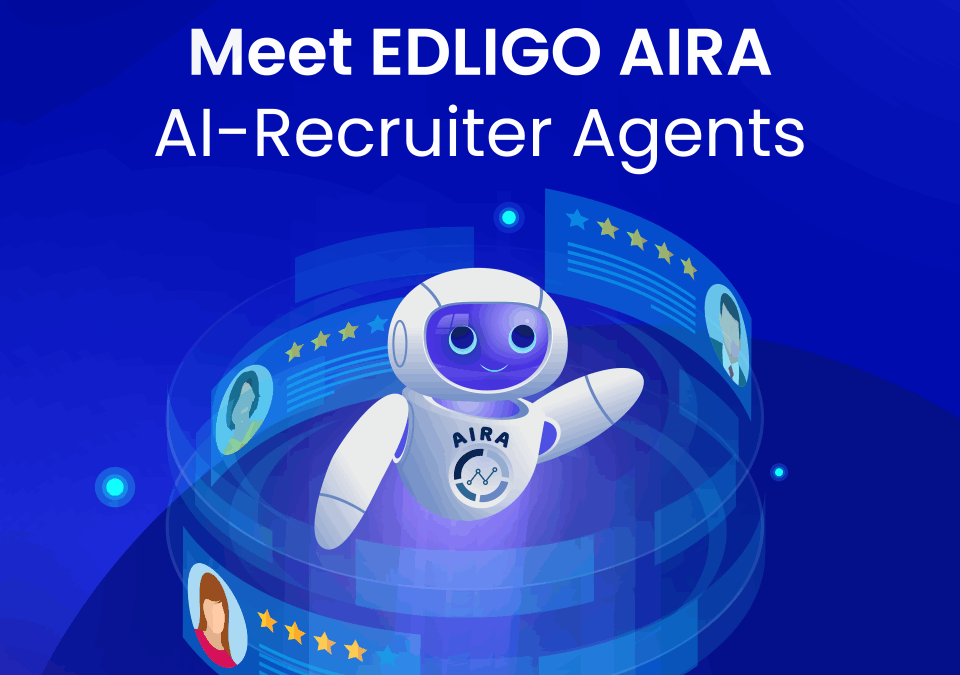


Recruiting AI Software 2026: How AIRA Transforms Hiring with AI
We’d love to hear how your company is leveraging AI recruiting tools — let’s share tips in the comments!
Introduction: The AI Revolution Hits Recruiting
As organizations seek the best recruiting AI software for 2026, EDLIGO’s AIRA platform emerges as the comprehensive solution for AI in recruiting and artificial intelligence in recruitment. This article explores how modern recruiting with AI delivers measurable ROI while ensuring compliance and fairness.
Recruiting is no longer just about posting job ads and sifting through resumes. With the rise of AI-powered recruiting software, organizations can now automate candidate screening, match skills precisely to job requirements, and reduce time-to-hire — all while maintaining fairness and transparency.
According to Gartner’s 2026 Talent Acquisition Trends, “many AI use cases in recruiting have been around for a long time, and we’re starting to see real value.” Jamie Kohn, Senior Director of Research at Gartner, notes that “new AI technologies are emerging with the potential to fundamentally reshape recruiting, like generative AI, interview intelligence tools, and recruiter AI agents.”
Platforms like AIRA are leading this transformation by offering plug-and-play AI solutions that make recruitment intelligent, fast, and equitable for organizations of all sizes.
Section 1: Why Recruiting AI Software Solves Today’s Hiring Challenges
Modern recruiters face unprecedented pressure from multiple directions. Candidates expect rapid feedback, yet manual CV screening creates bottlenecks that slow down hiring cycles. Unconscious bias continues to distort hiring decisions, while prolonged role vacancies directly impact business growth and productivity. These challenges explain why recruiting AI software has become essential for competitive talent acquisition.
For CFOs and business owners, these inefficiencies translate into real financial losses. Research by Gartner reveals that over 80% of candidates who have a negative communication experience during recruitment take at least one negative action in response — whether withdrawing their application, declining offers, or avoiding the organization in future opportunities.
The cost of bad hires compounds the problem. Poor hiring decisions drain resources through:
- Onboarding costs for employees who don’t fit
- Lost productivity during vacancy periods
- Team morale impact from mismatched hires
- Regulatory risks from inconsistent evaluation processes
AI-driven tools like AIRA directly address these pain points through transparent, skills-based evaluations and predictive analytics that eliminate guesswork from hiring decisions.
Section 2: How AI Recruiting Software Solves Critical Hiring Problems
AI recruiting software tackles the core challenges of modern talent acquisition through specialized automation. AIRA’s architecture demonstrates how domain-specific AI agents work together to create a seamless hiring workflow:
1. Automated Resume Parsing and Skills Extraction
AIRA’s AI-Resume Analyzer Agent automatically extracts skills, certifications, and language proficiency from unstructured CVs. This eliminates the manual data entry that traditionally consumes hours of recruiter time, while ensuring consistent evaluation criteria across all candidates.
2. Transparent Job Matching with AI Reasoning
The AI-Job Matching Agent scores candidates (0-100%) with complete transparency about WHY each score was assigned. This “AI-Reasoning” capability directly addresses Gartner’s finding that only 26% of job applicants trust AI will fairly evaluate them. By showing the exact factors influencing each decision, AIRA builds candidate trust while providing legal defensibility for hiring decisions.
3. Structured Interview Preparation
The AI-Interview Guide Agent generates role-specific questions based on job descriptions and candidate CVs, ensuring every candidate faces consistent, fair evaluation criteria. This standardization eliminates interviewer bias while creating audit trails for compliance purposes.
4. Bias-Free Job Descriptions
AIRA’s AI-Job Description Generator creates optimized, ATS-friendly postings that remove gendered language, age proxies, and other discriminatory terms before publication.
The result? Faster, fairer hiring decisions, measurable ROI, and improved candidate satisfaction — exactly what modern HR leaders need to compete for top talent.
For organizations exploring free AI tools for recruitment, it’s important to understand how enterprise solutions like AIRA provide transparency and accountability that free alternatives often lack.
Section 3: Benefits for Every Stakeholder in the Hiring Ecosystem
Unlike basic free AI tools for recruitment, EDLIGO AIRA offers enterprise-grade artificial intelligence sourcing capabilities that scale with your organization’s needs.
One of AIRA’s key differentiators is its multi-stakeholder value proposition. Unlike traditional ATS systems designed primarily for recruiters, AIRA delivers tangible benefits to every participant in the talent acquisition process:
For Recruiters: Recruiting with AI: Speed and Efficiency for Modern Teams
Recruiting with AI through AIRA means screening 1,000 CVs in minutes instead of days, freeing recruiters to focus on relationship-building with top candidates rather than administrative tasks. The platform’s “Screen Faster, Place Sooner” promise helps agencies win the talent race in competitive markets.
For HR Leaders (CHROs): Standardization and Compliance
HR executives gain standardized evaluation processes that mitigate unconscious bias while creating audit trails for regulatory compliance. As Gartner’s 2026 predictions indicate, by 2027, 75% of hiring processes will include certifications and testing for workplace AI proficiency during recruiting. AIRA positions organizations ahead of this curve.
For CFOs: Measurable Cost Reduction
Finance leaders benefit from quantifiable savings: AIRA reduces CV screening costs by €3,333 per 1,000 CVs analyzed, while minimizing the financial impact of bad hires through more accurate candidate matching.
For Outplacement Firms: Objective Candidate Feedback
Outplacement companies using AIRA provide data-driven feedback to transitioning employees, accelerating their redeployment while reducing service delivery costs. The transparent reasoning helps candidates understand skill gaps and develop targeted improvement plans.
For ATS Vendors: Rapid AI Modernization
Software vendors integrate AIRA’s AI agents to modernize their platforms without massive R&D investments, preventing customer churn to AI-native competitors.
This comprehensive stakeholder value makes AIRA unique in the recruiting AI software landscape. Learn more about how AIRA compares to other AI in hiring solutions in our comprehensive guide.
Section 4: Key Metrics and ROI of AI Recruiting Software
When evaluating AI in hiring solutions, ROI is the critical metric. Here’s what organizations achieve with EDLIGO’s recruiting AI software:
Time Savings
- 90% reduction in CV screening time compared to manual review
- 60% faster time-to-hire through automated candidate matching
- 5-10 hours saved per role via auto-generated interview guides
Cost Reduction
- €3,333 saved per 1,000 CVs analyzed (based on €20/hour recruiter cost)
- 40-60% lower cost-per-hire through reduced agency fees and external recruiting spend
- Elimination of bias audit costs through built-in transparency
Quality Improvements
- Bias reduction through standardized evaluation criteria applied consistently to all candidates
- Improved quality of hire via skills-based matching rather than keyword scanning
- Enhanced candidate experience through faster feedback and transparent reasoning
Compliance and Trust
According to Gartner research, “candidates expect transparency and, if possible, choice. Recruiting leaders should clarify how they use AI in the hiring process and allow candidates to opt out of AI interviews.”
AIRA’s transparent AI-Reasoning directly addresses this requirement, showing candidates exactly why they matched (or didn’t match) specific roles. This transparency builds trust while creating legal defensibility for hiring decisions—critical as AI discrimination lawsuits become more common.
Case Study Evidence
Organizations implementing AIRA report:
- 52% of laid-off employees finding new roles within 8 weeks (vs 23% with traditional outplacement)
- 78% of candidates receiving company contact within 4 weeks (vs industry average of 20-30%)
- Zero EEOC complaints related to AI hiring decisions among AIRA users
For a deeper dive into measuring ROI from artificial intelligence in recruitment, explore Gartner’s guide to recruiting AI software.
Section 5: AI in Recruiting 2026-2027: Future Trends and EDLIGO AIRA’s Roadmap
Looking forward, Gartner’s strategic predictions reveal that “through 2026, atrophy of critical-thinking skills, due to GenAI use, will push 50% of global organizations to require ‘AI-free’ skills assessments.”
This prediction highlights a critical distinction: while AI accelerates routine hiring tasks, human judgment remains essential for complex evaluations. The winning approach combines:
- AI for scalable, repeatable tasks: Resume screening, initial matching, interview guide generation
- Human expertise for strategic decisions: Culture fit assessment, leadership evaluation, negotiation
AIRA embodies this hybrid model by automating administrative work while preserving human oversight for final hiring decisions.
Key 2026-2027 Trends in AI recruiting to Watch
Recruiter AI Agents: Gartner predicts that “AI has the potential to impact nearly every part of the recruiter role, if it isn’t already.” AIRA’s specialized agents represent this evolution, with each agent handling specific recruiting functions autonomously.
Skills-Based Hiring: Traditional job titles become less important than transferable skills. AIRA’s skills extraction and matching capabilities position organizations to lead this shift.
Candidate Fraud Detection: Gartner’s 2Q25 research shows that 62% of candidates are more likely to apply to positions requiring in-person interviews, signaling concerns about AI-generated applications. AIRA’s transparent reasoning helps detect inconsistencies between claimed skills and demonstrated abilities.
AI Proficiency as a Hiring Criterion: By 2027, most roles will require AI proficiency. Organizations using AIRA gain dual advantages: their recruiting process demonstrates AI competency while assessing candidates’ AI skills.
FAQs: Recruiting AI Software with EDLIGO AIRA
Q: What makes EDLIGO AIRA different from other recruiting AI software?
A: Unlike basic AI tools, AIRA provides full transparency with AI-Reasoning, showing exactly why candidates are matched or rejected.
Q: How quickly can we implement AI in our recruiting process?
A: AIRA offers plug-and-play integration, with most teams seeing results within 24 hours.
Q: Is recruiting with AI compliant with employment regulations?
A: Yes, AIRA is designed for compliance with NYC Local Law 144, EU AI Act, and EEOC guidelines.
Conclusion: The Era of Guesswork in Recruitment is Over
For companies searching for the best recruiting AI software, EDLIGO AIRA delivers unmatched value through comprehensive AI in hiring capabilities. As artificial intelligence in recruitment becomes standard, AIRA’s transparent approach sets the benchmark for ethical, effective talent acquisition.
The shift from manual to AI-powered recruiting isn’t a future trend—it’s happening now. Organizations that adopt intelligent recruiting AI software like AIRA gain immediate competitive advantages:
- Speed: Fill roles 60% faster through automated screening and matching
- Fairness: Eliminate unconscious bias via standardized, transparent evaluation
- Intelligence: Make data-driven decisions backed by AI-Reasoning
- Compliance: Build legal defensibility through explainable AI
- Scalability: Handle hiring surges without proportional staff increases
As Gartner concludes, companies pursuing an “AI-first approach” for high-volume, low-complexity roles achieve “the highest potential for cost savings” while maintaining stable, predictable outcomes.
In 2026, staying competitive means leveraging intelligent automation in every step of the hiring process. The question isn’t whether to adopt AI in recruiting—it’s which platform will give you the strongest competitive advantage.
Next Steps: Transform Your Recruiting with AIRA
Ready to experience leading recruiting AI software? Compare EDLIGO AIRA with other AI in recruiting solutions through our live demo?
- Schedule a live demo – See AIRA’s 5 AI agents in action (30-minute session)
- Start free trial – “No setup. Try or buy!” – Analyze your first 100 CVs free
- Book a Demo
Continue Learning:
https://www.edligo.net/allblogscontent/
About AIRA: Intelligent Recruiting Made Simple
AIRA is the plug-and-play AI recruiting platform trusted by HR leaders, recruiting agencies, and outplacement firms worldwide. With 11 years of AI and talent management expertise, Edligo (creator of AIRA) was recognized as a Top 3 Most Innovative SME in Germany (2023).
Learn more: https://www.edligo.net/aira/
Comment below to receive our exclusive guide on optimizing AI in recruiting!