by
The Broken Game Nobody Talks About
The cat-and-mouse game between job seekers gaming Applicant Tracking Systems and recruiters tightening filters is broken. Discover why ATS optimization fails—and how intelligent AI recruitment tools like AIRA create a fairer hiring ecosystem with better AI resume builder technology.
Here’s a dirty secret about modern hiring: it’s an ATS arms race, and everyone is losing.
Job seekers stuff resumes with keywords to trick Applicant Tracking Systems. Recruiters respond by tightening ATS filters, rejecting even more candidates. Candidates then hire “ATS optimization services” to reverse-engineer the algorithms. Recruiters implement AI screening to catch the gaming. And the cycle continues.
According to Harvard Business School’s “Hidden Workers: Untapped Talent” report, 88% of employers believe qualified candidates are filtered out by their ATS—yet they keep adding more filters. Meanwhile, Jobscan reports that 98% of Fortune 500 companies now use ATS software, creating a talent bottleneck where 75% of qualified applications never reach human eyes (Indeed Career Advice).
The result? A hiring ecosystem where both sides invest massive resources just to stay in place—and the best talent slips through the cracks.
The Job Seeker Side: Gaming the System (And Paying the Price)
Let’s start with what candidates are doing to survive the ATS gauntlet.
The Resume Black Hole Phenomenon
According to SHRM’s 2024 Talent Trends report, 92% of applicants abandon online application processes before completion. Why? Because traditional Applicant Tracking Systems create exhausting, multi-step processes that candidates experience as “resume black holes”—applications that disappear into silence.
This frustration has spawned an entire industry of ATS optimization services. Job seekers now:
- Use AI resume buildertools to keyword-stuff resumes with exact phrases from job descriptions
- Create ATS-specific versions of their CVs, using ATS CV ckecker technology.
- Pay $50-$200 for “ATS optimization services” to reverse-engineer screening algorithms
- Use “invisible white text” to hide keywords that match job postings (Forbes)
The irony? These tactics often backfire. A study on algorithmic CV-matching found that resumes optimized purely for keywords scored lower on actual fit than authentically written CVs—because they lacked the contextual coherence that modern AI-powered ATS now detect.
The Psychological Cost
Beyond wasted money, there’s a hidden psychological toll. According to LinkedIn’s “Future of Recruiting 2025” report, 73% of job seekers say the application process makes them feel “dehumanized”—reduced to keyword-matching algorithms rather than evaluated as complete professionals.
The Recruiter Side: Drowning in Noise (While Missing the Signal)
Now let’s flip the script. Recruiters aren’t villains—they’re overwhelmed.
The Volume Problem
Zippia’s ATS statistics show that the average corporate job posting receives 250+ applications. For a recruiter managing 10 open roles simultaneously, that’s 2,500 resumes to review—an impossible task without automation.
So what do recruiters do? They tighten ATS filters.
But here’s where it breaks down: according to SHRM’s research, 68% of recruiters report frustration with their current ATS—primarily because these systems:
- Over-filter qualified candidates who use different terminology (e.g., “Project Manager” vs. “Program Manager”)
- Create false negatives by rejecting candidates with equivalent but differently-worded skills
- Lack transparency, making it impossible to understand why the ATS ranked candidates in a particular order
David Francis, VP of a talent acquisition consulting firm, warns: “Employers configure ATS criteria that exclude qualified candidates”—often without realizing it.
The Time Trap
Despite ATS automation, LinkedIn’s research shows that 22% of HR professionals still spend 3-5 hours per day reviewing applications. Why? Because they don’t trust their ATS to surface the best candidates, so they manually review anyway—defeating the purpose of automation.
Meanwhile, time-to-fill has increased 23% between 2019-2024 (SHRM 2024 Talent Trends), and 91% of organizations report hiring difficulties—even as their ATS reject thousands of applicants.
The painful truth? Recruiters are working harder than ever, while filling fewer roles with lower confidence in candidate quality.
The Arms Race Escalates: Enter AI (For Better or Worse)
As both sides have escalated their tactics, AI has entered the battlefield—but not always helpfully.
Job Seekers Fight Back with AI
Candidates now use AI tools to:
- Generate ATS-optimized resumes using ChatGPT prompts
- Create multiple CV versions automatically tailored to each job posting
- Automate application submissions via bots (sending hundreds of applications overnight)
Forbes reports that this “AI washing” on both sides—candidates exaggerating AI-generated credentials, companies over-promising AI screening accuracy—has created a trust crisis in hiring.
Recruiters Respond with Deeper Filters
To combat AI-generated spam applications, recruiters are:
- Implementing “knockout questions” that auto-reject candidates
- Using video screening AI to detect deepfakes (IT-ISAC research)
- Adding identity verification at early stages, increasing candidate friction
The escalation continues—and quality-of-hire keeps dropping.
The Breaking Point: Why This Can’t Continue
Here’s why the ATS arms race is unsustainable:
For Job Seekers:
- Resume optimization fatigue leads to lower application quality
- Loss of authentic personal branding makes candidates indistinguishable
- Increased rejection rates despite more effort invested
For Recruiters:
- Rising cost-per-hire even with “automated” systems (Glassdoor reports 2.5x higher costs when candidate experience is poor)
- Mis-hire rates remain at 74% (SHRM Cost of Bad Hire study)
- Employer brand damage from poor candidate experience (60% of candidates abandon applications due to complexity, OnRec research)
The fundamental problem? Traditional ATS and the gaming tactics used to defeat them both optimize for the wrong metric: keyword matching instead of actual job fit.
The Solution: Intelligent AI That Serves Both Sides
What if, instead of an arms race, we created an AI referee that helps both candidates and recruiters win?
This is where next-generation platforms like EDLIGO AIRA help:
For Job Seekers: Transparency Instead of Gaming
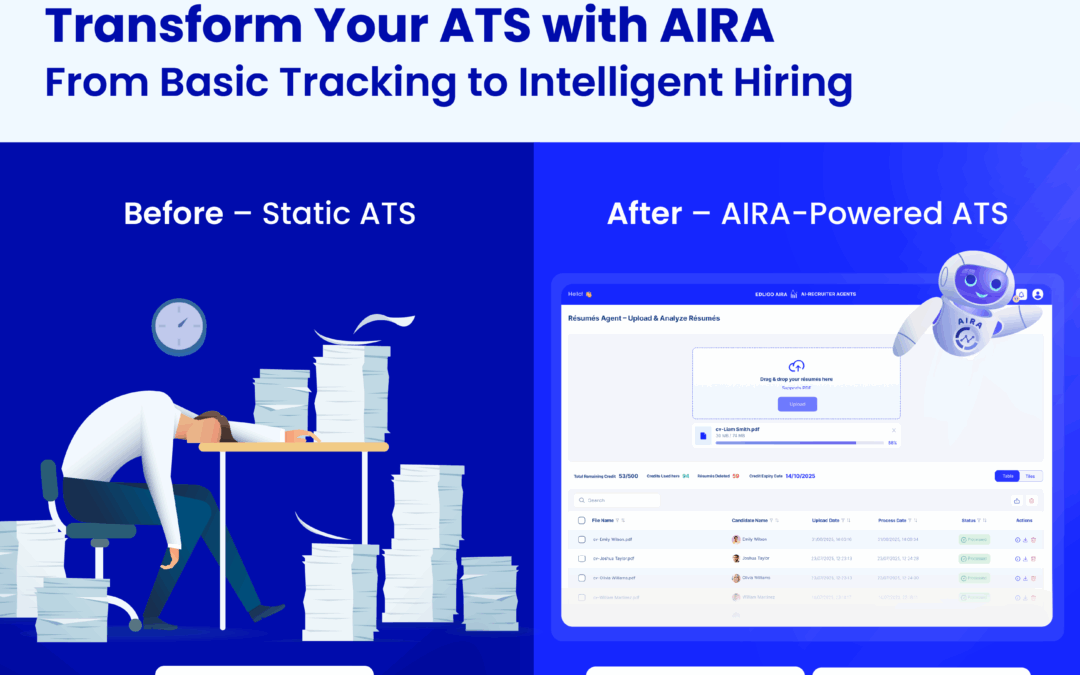
Rather than forcing candidates to guess what the ATS wants, AIRA’s AI-Résumé Analyzer shows you:
- Exactly what data the system extracts from your CV (skills, experience, certifications)
- Your actual job-match score with clear explanations via AI-Reasoning
- Specific gaps between your profile and target roles
No more black-box rejections. You see what the AI sees—and can improve authentically, not through keyword stuffing.
For Recruiters: Quality Over Quantity
AIRA’s AI-Job Matching Agent doesn’t just filter—it understands context:
- Semantic matching recognizes equivalent skills even when worded differently (“business development” = “sales,” “program manager” = “project manager”)
- Transparent scoring with AI-Reasoning shows why candidates rank where they do
- Bias-aware screening flags potential discrimination in filtering criteria
According to PwC’s “Workforce of the Future 2030” analysis, organizations using AI-driven foresight in talent strategies see 40% improvement in quality-of-hire when they combine intelligent screening with human oversight.
The Five-Agent System
AIRA has five specialized AI agents:
- AI-Résumé Analyzer → Extracts and structures candidate data consistently
- AI-Job Matching Agent → Provides fit scores with transparent reasoning
- AI-Interview Guide Generator → Creates personalized interview frameworks
- AI-Job Description Optimizer → Writes bias-free, skills-focused postings
- AI-Job Description Analyzer → Breaks down requirements for candidates
This multi-agent approach addresses both sides of the equation: helping candidates present themselves authentically, while helping recruiters evaluate holistically.
The Path Forward: Cooperation, Not Combat
The ATS arms race has reached a breaking point. Job seekers are exhausted from gaming systems. Recruiters are drowning in noise while missing qualified talent. And everyone agrees: the current system is broken.
The alternative isn’t to eliminate technology—it’s to use intelligent AI recruitment tools that creates transparency rather than escalation.
When job seekers can see exactly how they’re being evaluated, they optimize for genuine fit rather than ATS optimization tricks. When recruiters can understand why the AI ranked candidates a certain way, they make better hiring decisions with confidence.
The war doesn’t have to continue. It’s time for a truce—mediated by AI that serves both sides.
Ready to exit the arms race?
→ Job Seekers: Analyze your CV with AIRA and see your actual match score (no guessing, no gaming)
The future of hiring isn’t about better weapons—it’s about better intelligence. And that starts with platforms that work for everyone, not against them.
by
The Hidden Cost of a Poor ATS
The Hidden Cost of Poor ATS: Why AI-Powered Applicant Tracking Systems Are the Solution
The 75% Problem
According to “HIDDEN WORKERS: UNTAPPED TALENT” (Harvard Business Review), 88% of employers believe their applicant tracking systems filter out qualified candidates. Yet most companies continue using outdated ATS technology without AI capabilities. The “resume black hole” phenomenon costs companies billions in missed talent.
It is a real challenge for companies to find people with the skills they need, which hinders their competitiveness and growth prospects.
Management practices that limit the number of candidates considered lead to the creation of a population of overlooked or “hidden” talent. Companies that hire “hidden” workers achieve an attractive ROI and report being 36% less likely to face talent and skills shortages than companies that do not hire hidden workers.
What keeps them hidden? Research by jobscan reveals that traditional ATS technology—lacking modern AI recruitment tools—is a primary culprit. Over 90% of employers surveyed use their ATS to initially filter or rank potential candidates — even those with average or high skills. In fact, 99% of Fortune 500 companies rely on ATS software to process resumes.
Imagine losing 3 out of 4 perfect candidates before you even see their resume. That’s not a hiring strategy—it’s a talent hemorrhage. And it’s happening right now in your applicant tracking system with AI upgrade potential sitting unused.
The Recruiter’s Dilemma
According to SHRM’s “2024 Talent Trends” survey of 2,500 HR professionals:
- 68% of recruiters report frustration with current ATS—primarily due to lack of AI-powered screening capabilities –
- Average time-to-fill increased by 23% between 2019-2024 –
- More than 75% of organizations struggle with recruitment challenges
- A peak of 91% of organizations experiencing recruitment difficulties was reached in 2022
- The three main challenges faced by these organizations are: low number of candidates (60%), competition from other employers (55%), and an increase in “ghosting” (46%) (recruiters being ghosted by candidates during the hiring process, sometimes even after a job offer was extended).
Even today, it remains very difficult to measure recruitment quality. In the report “The Future of Recruiting 2025, How AI redefines recruiting excellence”, only 25% of professionals surveyed say they are confident in their organization’s ability to recruit effectively.
AI is capable of analyzing employee performance data, identifying trends, and predicting long-term success. In fact, six out of ten human resources professionals (61%) believe that AI can improve the way they measure recruitment quality.
Key findings from LinkedIn’s “Future of Recruiting” report:
- #1 recruiter complaint: “Too much time on administrative tasks”
- 52% of recruiters say their current tech slows them down rather than speeds them up
- Solution gap: Most lack access to automated candidate screening tools powered by AI
The average Time to Fill rate is 36 days, according to “The 2017 Talent Acquisition Benchmark Report”, spending too long in the recruiting phase will cost you time, money, and good candidates!
Companies invest heavily in applicant tracking systems to streamline recruitment, yet HR teams still waste 40% of their time manually reviewing resumes. Why? Because traditional ATS lack the AI for talent acquisition capabilities needed to automatically prioritize top candidates.
Employer Branding at Risk
A clunky applicant tracking system doesn’t just slow you down—it actively damages your employer brand and drives top candidates away. Here’s the data:
- 60% of candidates abandon job applications if the process is too complex (onrec).
- According to Sowmiya Soundar, 72% share negative hiring experiences on social media.
- As a result, 57% refuse to apply to companies with poor reviews (Raymondgeorge agency).
- Poor candidate experience increases cost-per-hire by 2.5x (Glassdoor study).
Every rejected candidate is a potential brand ambassador. When your ATS creates a frustrating experience, you’re not just losing candidates—you’re actively damaging your employer brand.
Transition to AI Solution
What if an AI recruitment tool could transform your existing ATS—identifying and prioritizing top candidates automatically, without disrupting your workflow?
AI-powered applicant tracking systems substantially reduce manual work:
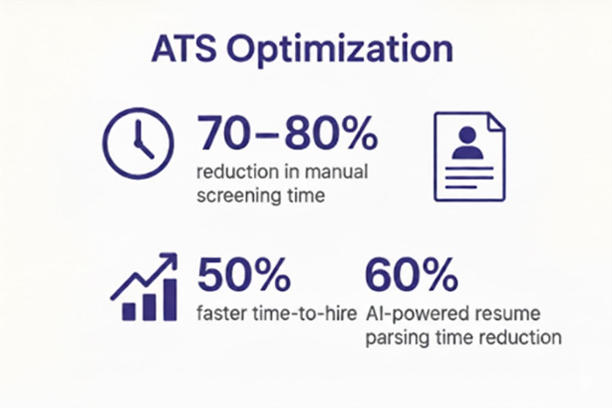
- Automated candidate screening reduces manual time by 70-80%
- Recruitment time drops by 40%
- Administrative costs decrease by thousands annually(Seemehired).
“The ultimate AI recruitment guide » explains that implementing AI-based ATS software reduces recruitment time by 40% and saves thousands of dollars in administrative costs each year.
87% of companies are now using AI-driven tools (AI Recruitment Statistics 2025)
Imagine an AI HR software that thinks like your best recruiter—reading between the lines, understanding context, and surfacing candidates based on potential, not just keywords. That’s the power of modern AI in recruitment.
What Goes Wrong with Traditional Applicant Tracking Systems (And Why AI Changes Everything)
The Keyword Trap: When Good Candidates Look “Wrong”
Traditional applicant tracking systems rely on rigid keyword matching—rejecting qualified candidates who describe their experience differently. Modern AI recruitment tools solve this with semantic understanding.
if your ATS expects the phrase “project manager,” it may miss a candidate who labelled themselves “program manager” or “product manager.” Research shows these terminological mismatches matter.
In a study using algorithmic CV-matching, a 62.0 % similarity threshold was used to distinguish ‘similar’ versus ‘not similar’ resumes — indicating that many qualified candidates may be excluded under strict keyword-matching régimes.
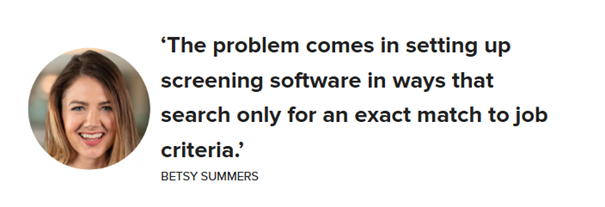
The U.S. Chamber of Commerce U.S. Chamber of Commerce reports that candidates lacking exact keyword matches risk being rejected too early and failing to make a good impression. They are often auto-rejected—regardless of actual qualifications. This is where automated candidate screening powered by AI makes the difference: it understands synonyms and context.
According to a SHRM article titled “Is Your Applicant Tracking System Hurting Your Recruiting Efforts?”, many AI-powered ATS systems may actually worsen the talent shortage they were designed to solve.
The latest researches show that the configuration of applicant tracking systems (ATS) and other automated selection tools often leads to the rejection of candidates who may be qualified for certain positions but do not exactly match the profile sought by recruiters.
David Francis, VP of a talent acquisition consulting firm, warns: “Employers configure ATS criteria that exclude qualified candidates.” The solution? AI for talent acquisition that evaluates holistically—not just keyword presence.
The Application Black Hole: Where Candidates Disappear
The second failure: traditional applicant tracking systems create an “application black hole” where candidates disappear mid-process. The data is alarming:
The dropout crisis:
Result? Your applicant tracking system with AI potential is actually repelling talent.
Your ATS isn’t just screening—it’s hemorrhaging talent. This 92% dropout rate explodes cost-per-hire. Modern AI recruitment tools fix this by simplifying applications while maintaining data quality.
The Feedback Vacuum: The Silent Killer of Candidate Experience
Traditional applicant tracking systems often create a “feedback vacuum” that frustrates candidates and harms employer reputation. While many companies avoid providing explicit rejection feedback due to potential legal risks (SHRM), the real issue lies in the lack of timely updates.
According to a Greenhouse study, 61% of candidates report being ignored after interviews, and 60% never receive any update at all. Candidates who receive feedback are 4x more likely to reapply and maintain a positive perception of the company (Survey by LinkedIn).
A good ATS should therefore prioritize communication speed and transparency, not necessarily detailed feedback. Candidates should hear back while they still remember applying — ideally within a few days, not weeks.
Another frustration comes from poor data extraction: 69% of candidates abandon applications when the ATS fails to parse their CV correctly and forces them to re-enter the same information manually (CareerBuilder).
That’s where AI-powered recruitment tools like AIRA make a difference. They automatically extract and structure candidate data from resumes, ensure instant acknowledgment messages, and keep applicants informed of their progress — creating a smoother, faster, and more respectful hiring experience.
Bottom line: Your applicant tracking system with AI capabilities can automate timely updates and maintain transparent communication — turning rejected candidates into future brand advocates.
Silence isn’t neutral — it’s negative. When candidates apply and hear nothing, they don’t think “maybe later.” They think “never again.” And they often share that experience with others.
The Soft Skills Blind Spot
The fourth failure: traditional applicant tracking systems can’t assess soft skills—the actual predictors of job success. The soft skills gap:
- 93% of executives say soft skills are critical (Deloitte)
- Only 17% of ATS have soft skill assessment (Deloitte Global Trends)
- 89% of “bad hires” fail due to soft skills, not technical skills (LinkedIn)
- Yet traditional ATS can only match hard skills and keywords
Your ATS can tell you if someone knows Python. AI HR software can tell you if they’re coachable, resilient, and collaborative—the qualities that separate good hires from great ones.
How AI Recruitment Tools and Automated Candidate Screening Solve These Challenges
Modern AI recruitment tools transform applicant tracking systems from keyword matchers into intelligent hiring assistants. Solutions like AIRA bring automated candidate screening, semantic matching, and transparent AI reasoning to your existing workflow.
With AI-powered applicant tracking systems like AIRA, you screen faster, hire smarter, and make data-driven decisions with full transparency.
You can Try AIRA for free today and see the difference.
From Keywords to Context: Semantic Understanding
- Problem Solved: Traditional ATS reject qualified candidates due to strict keyword matching.
- How AIRA Solves It: AIRA’s AI-Job Matching Agent uses Natural Language Processing (NLP) to understand context, not just keywords. It recognizes skill equivalencies and achievements phrased differently from the job description.
- Example: “Mentored 5 junior analysts” = leadership; “increased revenue 40%” = strong sales performance.
- Transparency: The AI-Reasoning feature explains exactly why candidates score as they do, avoiding black-box decisions.
Faster and Smarter Candidate Screening
- Problem Solved: Manual CV screening is time-consuming and inconsistent.
- How AIRA Solves It: The AI-Resumes Analyzer Agent automates extraction of skills, certifications, and key achievements, enabling automated candidate screening with precision.
- Impact: Saves hours per vacancy and ensures consistent evaluation across all candidates.
Discover how AIRA can accelerate your screening process and identify top talent effortlessly.
Personalized Interview Preparation
- Problem Solved: Preparing interviews for each candidate takes time and may lack structure.
- How AIRA Solves It: The AI-Interview Guide Agent generates tailored interview guides with questions and suggested answers based on the candidate’s profile and the job description.
Protecting Against Risky Hires
- Problem Solved: Inflated titles, impossible timelines, or fake credentials can slip through traditional ATS.
- How AIRA Solves It: AIRA flags suspicious patterns automatically, ensuring recruiters focus only on genuine, qualified candidates.
With AIRA’s suite of intelligent agents, you can analyze resumes, rank candidates accurately, and generate interview guides—all in one platform. Say goodbye to manual bottlenecks and hello to smarter, faster, and fairer hiring.
Try AIRA for free today and see how this AI HR software will transform your talent acquisition process.