AI Workforce Transformation Platform

AI Workforce Transformation Platform

The Future of Workforce Transformation Has Arrived

Organizations today face unprecedented workforce challenges. Rapid advances in AI, automation, changing business models, and evolving skill requirements demand a new approach to workforce planning.

EDLIGO's AI Workforce Planning module enables organizations to move beyond traditional headcount planning by combining workforce architecture, skills intelligence, competency data, and organizational structures into a unified planning platform.

Instead of relying on spreadsheets and manual analysis, HR leaders can rapidly generate workforce insights that support strategic decision-making across the enterprise.


Why Traditional Workforce Planning Falls Short

Conventional workforce planning often focuses on headcount rather than workforce capability.

Modern organizations require visibility into:

  • Current workforce capacity
  • Critical skill availability
  • Future workforce demand
  • Internal mobility opportunities
  • Project staffing readiness
  • Workforce transformation scenarios

EDLIGO helps organizations connect these dimensions using AI-assisted analysis and workforce intelligence.


AI-Powered Workforce Planning

EDLIGO combines organizational data with AI to accelerate workforce planning activities while maintaining full human oversight.

The solution enables organizations to:

  • Analyze current workforce structures
  • Identify capability gaps
  • Forecast future workforce demand
  • Match employees to projects based on skills
  • Support succession planning
  • Improve workforce utilization
  • Prepare organizations for AI-driven transformation

Core Capabilities

Workforce Analysis

Gain visibility into workforce composition, organizational structures, and talent distribution across the enterprise.

Skills Intelligence

Map existing skills and competencies to identify organizational strengths and capability gaps.

AI Skills Matching

Identify the most suitable employees for projects, internal vacancies, or strategic initiatives based on skills and competencies.

Workforce Forecasting

Model future workforce requirements based on business growth, technology adoption, and changing organizational priorities.

Project Staffing

Accelerate staffing decisions by matching workforce capabilities with project requirements.

Internal Mobility

Identify employees who can transition into new roles through existing capabilities or targeted upskilling.


Business Benefits

Organizations using AI Workforce Planning can:

  • Reduce workforce planning effort from weeks to hours
  • Improve workforce visibility
  • Support data-driven workforce decisions
  • Increase workforce agility
  • Strengthen succession planning
  • Improve resource allocation
  • Support enterprise-wide workforce transformation
  • Build skills-based organizations

Supporting AI Workforce Transformation

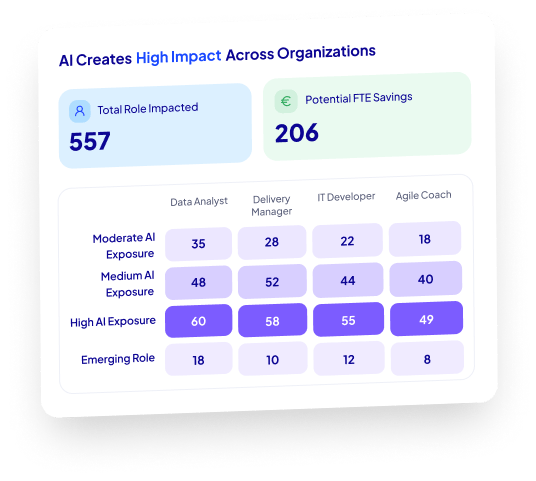
AI is changing how work is performed across every industry.

Successful organizations require a clear understanding of:

  • Which work can be automated
  • Which roles will evolve
  • Which new skills will be required
  • Where workforce gaps will emerge
  • How employees can be redeployed

EDLIGO's Workforce Planning module provides the analytical foundation required to support sustainable AI Workforce Transformation.


Typical Use Cases

Organizations use EDLIGO to support:

  • Strategic Workforce Planning
  • Organizational Design
  • Job Architecture
  • Competency Framework Development
  • Skills Management
  • Succession Planning
  • Project Staffing
  • Internal Talent Mobility
  • Workforce Transformation
  • AI Readiness Assessments

Why EDLIGO

EDLIGO combines AI with workforce architecture expertise to help organizations accelerate workforce planning while maintaining governance, transparency, and expert validation.

The platform enables HR, business leaders, and consulting teams to move from fragmented workforce data to actionable workforce intelligence.


About EDLIGO

EDLIGO develops AI-powered workforce solutions that help organizations design workforce architectures, competency frameworks, skills libraries, and workforce transformation strategies.

Its platform supports organizations in accelerating workforce planning, improving workforce intelligence, and preparing employees for the future of work.


FAQ

What is AI Workforce Planning?

AI Workforce Planning combines organizational data with artificial intelligence to help organizations forecast workforce demand, identify skills gaps, and optimize workforce decisions.

How does EDLIGO support workforce planning?

EDLIGO analyzes organizational structures, roles, competencies, and skills to generate workforce insights that support strategic planning and workforce transformation.

Which organizations benefit from AI Workforce Planning?

Organizations undergoing digital transformation, organizational redesign, AI adoption, skills-based workforce initiatives, or strategic workforce planning can benefit from AI-assisted workforce planning.

Can Workforce Planning support AI Transformation?

Yes. Workforce Planning helps organizations understand how AI will impact roles, skills, workforce demand, and future capability requirements, enabling informed transformation decisions.

Book a Meeting

Ready to plan your AI workforce transofrmation plan?
Book a demo

Your Soft Skills Are Gold: How to Showcase Them in an AI-Driven World

Your Soft Skills Are Gold: How to Showcase Them in an AI-Driven World

Introduction: The Soft Skills Paradox

While automated recruitment systems focus on technical abilities, a Deloitte study reveals that 93% of executives consider soft skills essential for performance. Discover how to make these “invisible” skills visible to both robots and recruiters.

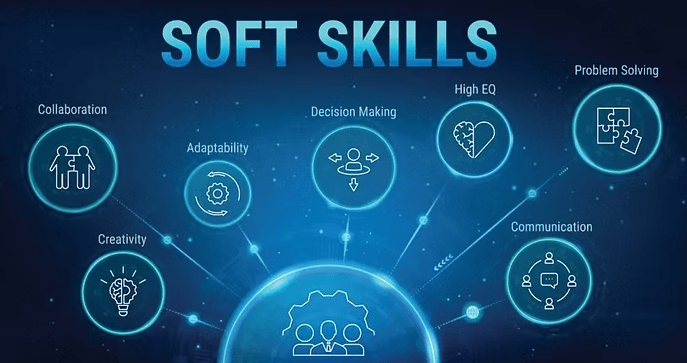
You master Python, analyze complex data, and create detailed reports. Yet your job applications go unanswered. The reason? Behavioral competencies – those human qualities like resilience, adaptability, or emotional intelligence – have become the new hunting ground in modern AI recruitment.

According to the World Economic Forum’s “The Future of Jobs Report 2025”, behavioral skills now represent 50% of the most in-demand workplace aptitudes. Yet, less than 17% of traditional Applicant Tracking Systems (ATS) can detect them effectively, according to Deloitte Global Human Capital Trends.

The paradox is stark: what makes you uniquely valuable is often what gets missed by automated screening systems. But the game is changing with the emergence of next-generation AI recruitment tools.

Why Soft Skills Have Become the New Currency

A revealing LinkedIn study found that 89% of “bad hires” fail not due to insufficient technical skills, but because of deficient soft skills.

The numbers speak for themselves:

  • 72% of HR managers believe soft skills are more important than hard skills for long-term success (SHRM)
  • Companies that specifically train for soft skills see productivity increase by 12% (Harvard Business Review)
  • 94% of recruitment professionals believe an employee with excellent soft skills is more likely to be promoted than a technical expert without these qualities (Forbes)

Michael Hansen, CEO of Cengage Group, summarizes this shift: “We’re witnessing a historic shift: employers are now seeking skills before degrees. And among these skills, human qualities have become the ultimate differentiator.”

The Problem: How to Measure the Immeasurable?

The challenge is significant. How do you quantify your ability to manage team conflict or your agility in facing the unexpected? Traditional applicant tracking systems struggle with this question.

Research conducted by the U.S. Chamber of Commerce confirms this limitation: “Standard ATS function through technical keyword recognition. They excel at identifying a ‘Java Developer’ but fail to spot a ‘natural leader’.”

Worse: A Harvard Business School study on “hidden workers” showed that 88% of employers acknowledge that their automated candidate screening systems unintentionally eliminate qualified candidates, particularly those whose soft skills aren’t explicitly formulated according to expected norms.

The Revolution Underway: AI That Understands Humanity

The good news? AI recruitment tools are rapidly evolving to bridge this gap. Platforms like AIRA now use Natural Language Processing (NLP) to detect behavioral competencies behind your CV’s wording.

How does it work in practice?

  • AIRA’s AI Résumé Analyzer Agent scans your experience for evidence of soft skills
  • “Trained 3 new team members” becomes proof of mentoring and leadership
  • “Adapted our sales strategy following regulatory changes” translates to adaptability and problem-solving
  • “Reduced tensions within my team during high-pressure periods” demonstrates emotional intelligence

Transparency is key: Unlike traditional ATS systems, platforms like AIRA provide explicit AI Reasoning that explains how each behavioral competency was identified and evaluated.

5 Strategies to Make Your Soft Skills Visible to AI

  1. The CAR Method (Context-Action-Result)
    Instead of “good communication,” describe: “Context: Misalignment between technical and marketing teams. Action: I established weekly synchronization meetings with shared minutes. Result: 30% reduction in delivery delays within 3 months.”
  2. The Power of Contextual Keywords
    Incorporate action verbs that imply soft skills: “negotiated,” “mediated,” “facilitated,” “mentored,” “influenced,” “calmed.” SHRM’s analysis of job descriptions shows these terms are 3 times more present in senior position listings.
  3. Proof Through Numbers
    “Team management” becomes: “Supervision of a 5-person team with 95% retention over 2 years and 25% increase in internal satisfaction scores.”
  4. The Art of Technical Reformulation
    “Empathy” can become: “Implementation of new customer feedback processes that improved satisfaction scores by 40%.”
  5. The Truth Test
    Use AI resume analysis tools like AIRA to identify which soft skills are actually detected in your CV and get precise improvement suggestions.

The Future is Already Here: When AI Becomes Your Ally

LinkedIn’s latest study on the future of recruitment predicts that by 2026, 65% of soft skills assessments will be AI-assisted. But far from replacing humans, this technology becomes a potential amplifier.

Platforms like AIRA embody this transition by offering:

  • Transparent analysis of your profile with detailed score explanations
  • Personalized guidance to improve the visibility of your unique competencies
  • Interview preparation that highlights your behavioral strengths

The result? You’re not cheating the system – you’re learning to speak its language to reveal your full value.

Conclusion: From Invisible to Strategic

In tomorrow’s talent economy, your most human skills become your most strategic asset. Employers actively seek them, and AI tools are becoming sophisticated enough to recognize them.

The question is no longer “do you have soft skills?” but “do you know how to make them visible?”

As noted in the World Economic Forum’s 2025 Report: “The competitive advantage of organizations and individuals will lie in their ability to articulate and demonstrate the behavioral competencies that complement automation.”

Don’t leave your human qualities in the shadows anymore. Test your CV with advanced AI analysis tools, learn the language that makes the invisible visible, and transform what makes you human into your most powerful career asset.

WordPress Cookie Plugin by Real Cookie Banner