by |
1. AI in Banking: The Strategic Imperative
AI is transforming financial services far beyond automation.
According to McKinsey, generative AI could deliver between $200 billion and $340 billion in value annually for banks, mostly through increased productivity and smarter decision‑making, not just cost cutting.
Deloitte’s research shows 86% of financial services executives believe AI will be very or critically important to business success in the next two years.
This means AI is shifting from tactical pilots to enterprise‑wide transformation—but that transformation cannot succeed without workforce readiness.
2. AI Impact on Banking Jobs: What the Data Says
Understanding AI impact on banking jobs requires separating perception from evidence.
Industry reports warn that AI will gradually reshape job structures rather than replace all positions. For example, recent research shows most job postings still don’t explicitly mention AI, suggesting jobs are evolving, not disappearing overnight.
At the same time, forecasts estimate that up to 200,000 banking jobs in Europe could be affected by AI‑driven efficiency gains over the next decade, especially in back office and middle office roles.
Academic research emphasizes this transformation at a macro level: AI alters task composition and organizational design, creating both productivity gains and new skill demands across occupations.
Key takeaway: AI changes what work gets done and how it gets done—not simply whether work exists.
3. Why Traditional Workforce Planning Fails Banks
Most banks still base strategy on:
- Static job descriptions
- Manual competency tracking
- Fragmented HR data systems
This legacy approach can’t answer modern workforce questions such as:
- Which roles will be most impacted by AI in 2026?
- What skills will be essential for future value creation?
- How can we measure workforce readiness and performance outcomes?
Instead, banks need AI workforce planning tools for banks that deliver real‑time skills visibility and strategic workforce insights.
4. What Effective AI Workforce Planning Looks Like
A future‑ready workforce plan answers four essential questions:
-
Where are the skills today?
Map existing competencies across all roles, departments, and locations.
-
Where will skills be needed tomorrow?
Benchmark current capabilities against future role requirements driven by AI transformation.
-
How do we close the gaps?
Develop targeted L&D, internal mobility, succession planning, and hiring strategies.
-
How do we measure success?
Link skills to performance outcomes and business value—not gut feel.
This approach is grounded in research showing that banks must embed AI planning into their strategic roadmaps, governance, and talent models, not just in isolated experiments.
5. Future of Banking Jobs AI: Skills That Matter
AI won’t impact all jobs equally.
According to industry veterans:
- Front‑office roles (e.g., customer engagement and relationship management) will expand with AI augmentation.
- Back‑office and repetitive compliance tasks are most likely to be automated or redesigned.
- Demand will grow for roles emphasizing AI governance, data strategy, digital product execution, and decision support.
The World Economic Forum emphasizes that human capital—reskilling and cross‑industry collaboration—will be essential in the banking AI era.
6. The ROI of AI Workforce Strategy in Banking
Banks that invest in strategic workforce planning don’t just survive—they thrive. Strong AI workforce readiness:
✔ Boosts operational efficiency
✔ Enhances customer outcomes with intelligent automation
✔ Reduces external hiring costs via internal mobility
✔ Provides measurable business impact linked to HR decisions
In contrast, banks that fail to align HR strategy with AI risk slower productivity gains and possible systemic risks in decision‑making and talent deployment.
7. Final Thought: Transform Banking with Skills‑Driven AI Strategy
AI is not a tool reserved for tech teams or pilots. It’s a strategic force reshaping how banks operate, who they hire, and how they deploy talent.
Yet without AI workforce planning, banks won’t capture the full value of AI investments or prepare for the future of the banking workforce.
🚀 Ready to Build Your AI Workforce Strategy?
If you’re responsible for HR, transformation, or strategy in banking, the question isn’t if AI will impact your workforce—it’s how prepared you are for it.
Book a personalized AI Workforce Planning session with EDLIGO today and get:
- Historic vs future skills gap analysis
- AI workforce impact forecast
- Board‑ready transformation insights
👉 Book Your Meeting Now — future‑proof your workforce with data, not guesswork.
by safa ch |
The Numbers That Set the Stage
The scale of what is coming is not in dispute. What is in dispute is whether organizations are measuring it accurately enough to act.
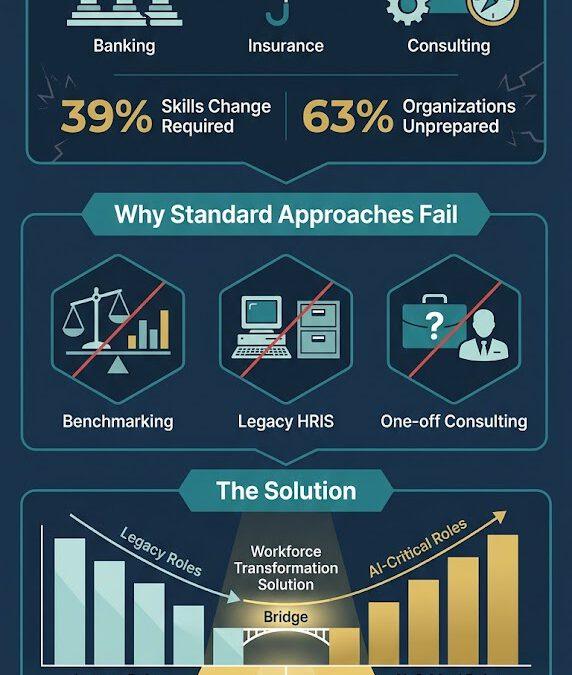
39%
of workers’ core skills are projected to change by 2030
(World Economic Forum, Future of Jobs Report 2025)
63%
of employers cite the skills gap as their primary barrier to transformation
(World Economic Forum)
41%
of employers globally plan to reduce headcount as AI automates tasks
(World Economic Forum)
These figures — drawn from the Future of Jobs Report 2025 — do not describe a distant future scenario. They describe decisions that financial services leaders are being asked to make now: which roles to protect, which to restructure, which skills to invest in, and how to present all of this to a board that has lost patience with vague ambitions.
The problem is not a lack of awareness. It is a structural absence of the right data.
“54% of CHROs do not know how to prepare their workforce for AI transformation. 67% say they lack the data infrastructure to answer basic board questions about AI’s impact.”
(Gartner CHRO Survey, Q3 2024)
Why Financial Services Is Facing This First
AI is not disrupting all sectors equally. Banking, insurance, and professional services are at the leading edge of workforce transformation for a precise structural reason: they are industries built on information processing, cognitive analysis, and document-heavy workflows — exactly the categories of work that AI augments most rapidly.
Banking
McKinsey & Company research on banking operations shows that 50–60% of FTEs in a typical bank are tied to operations (see: The paradigm shift: How agentic AI is redefining banking operations).
These are the roles most exposed to AI:
loan processing, compliance reporting, credit analysis, customer service documentation, and back-office reconciliation.
The upside is massive: generative AI could add $200–340 billion annually to global banking (The Economic Potential of Generative AI).
But here is the leadership problem:
When efficiency gains become structural, FTE planning can no longer follow historical patterns.
A bank that does not know — at role level — where its workforce is exposed:
- cannot plan redeployment
- cannot design reskilling programs
- cannot present a defensible roadmap to regulators or the board
The Governance Dimension
The EU AI Act (enforcement from August 2026) introduces a new requirement: traceable, explainable workforce decisions when AI impacts employment.
Generic benchmarks are no longer sufficient.
Organizations must explain — role by role — how decisions were made.
Insurance
In insurance, the numbers are equally compelling.
Oliver Wyman found that AI can:
- reduce manual claims handling time by 30–50%
- reduce underwriting processing time by 35%
- improve risk accuracy by 22%
Claims processing alone represents 40–55% of total operating costs.
Yet only 23% of European insurers have a quantified workforce plan.
That means:
- the COO builds cost cases on assumptions
- the CHRO designs reskilling without data
Accounting & Professional Services
For firms, the disruption is structural.
ICAEW research shows:
47% of accounting tasks at associate level are automatable today
ACCA reports:
82% of firms expect AI to change their model within 3 years — but only 31% have a plan
The traditional pyramid model is breaking.
It is not disappearing — it is:
- flattening
- shifting upward
- requiring fewer juniors, more augmented experts
Firms that do not model this transition will be structurally misaligned.
The Question That Exposes the Gap
These are the questions your board, CFO, and regulators are already asking:
- Which roles are most exposed to AI — and how many FTEs does that represent?
- Where does capacity increase vs decrease over 3 years?
- What is the financial value of AI-driven efficiency?
- Which skills become critical vs obsolete?
- How does this align with the EU AI Act?
These are no longer strategic questions.
They are governance questions.
And most organizations still cannot answer them with data.
Why Standard Approaches Fall Short
Three common approaches fail systematically:
1. Industry benchmarks
Useful for context — useless for decision-making.
Your board needs your numbers, not averages.
2. HRIS systems (SAP, Workday, Oracle)
They describe the past — not AI-driven future transformations.
3. One-off consulting projects
- 4–6 months
- €300K–€1M
- obsolete within months
What a Credible Answer Looks Like
Leading organizations have shifted from narrative to numbers.
A credible AI workforce analysis provides:
- FTE impact by function
- workload redistribution
- phased headcount scenarios
- skills evolution roadmap
All based on your internal data, not benchmarks.
And critically — it addresses the human dimension:
- who is impacted
- what reskilling is needed
- how to maintain trust
According to Gartner (Future of Work Trends 2026),
organizations redesigning workflows with AI are 2x more likely to exceed revenue goals.
The Window Is Narrowing
Three forces are accelerating urgency:
1. Regulation
EU AI Act enforcement → August 2026
Supervisors expect traceable workforce decisions.
2. Competition
Faster movers:
- redeploy talent better
- invest earlier
- avoid costly layoffs + rehiring cycles
3. Talent
Demand for People Analytics leaders is exploding
(LinkedIn Workforce Report)
The Dual Challenge Nobody Is Talking About
The World Economic Forum highlights a critical paradox:
- 92% of executives report workforce overcapacity (up to 20%)
- 94% face shortages in AI-critical roles
This is not a technology issue.
It is a workforce planning failure.
Winning organizations model both simultaneously:
- where capacity is shrinking
- where talent is missing
Where to Start
Step 1: Visibility
Do you know which roles are exposed to AI — at role level?
Step 2: Translation
Can you translate AI impact into:
Step 3: Tempo
Can you produce board-ready outputs in days — not months?
EDLIGO Workforce AI
What Does AI Change in Your Workforce — Specifically?
If you are a CHRO, HR Director, or Operations leader in banking, insurance, or professional services — and you do not yet have a quantified answer — this is where to start.
👉 Book a 30-minute meeting
See what a role-level AI workforce analysis looks like for an organization like yours.
👉 Request your Workforce AI diagnostic
Get a first view of:
- AI exposure by role
- FTE impact scenarios
- skills transformation roadmap
The Stakes Are Not Abstract
This is not about AI theory.
It is about:
- governance
- financial planning
- competitive advantage
The 39% of skills changing by 2030 represents millions of employees whose future depends on decisions being made now.
The organizations that act with:
will define the market.
The others will not avoid the decision.
They will make it by default.
The Board Meeting Is Coming
The question will be asked.
The only variable is:
Will you have an answer?